
Calculate actual boom sprayer GPA from a timed nozzle catch, or find the flow each nozzle needs for your target carrier rate.
Catch-test measurement
Nozzle measurement
Sprayer settings and target
Table of contents
How to use our Boom Sprayer Calibration and Nozzle Flow Calculator
- Choose what you want to calculate: check GPA with a catch test, check GPA from nozzle flow, or plan nozzle flow for a target GPA.
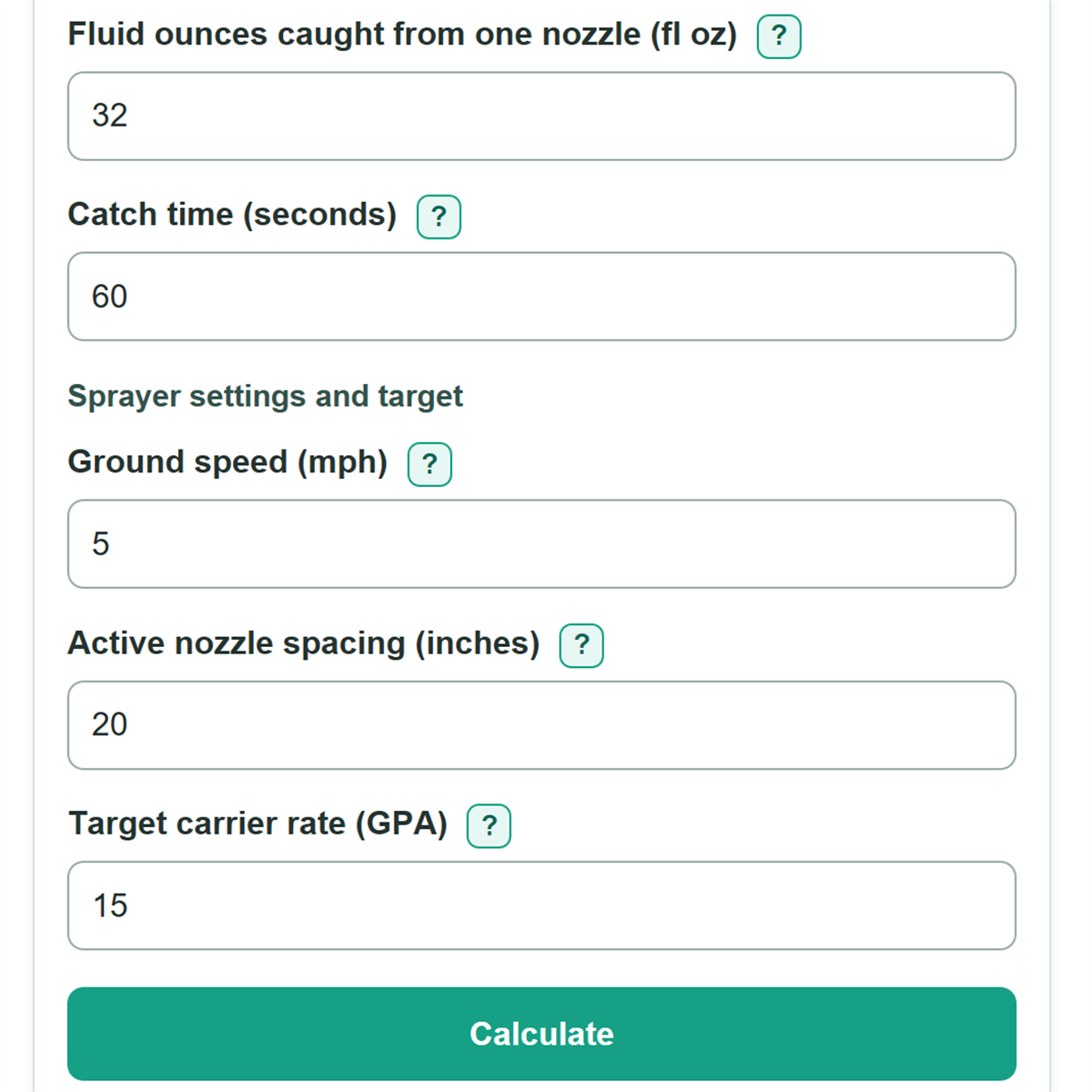
- For a catch test, collect output from one nozzle at normal operating pressure and enter the measured Fluid ounces caught from one nozzle and Catch time.
- Enter Ground speed measured while spraying and Active nozzle spacing measured center to center between active nozzles.
- Enter the Target carrier rate from the product label or application plan, then select Calculate.
- Sanity-check the result by comparing Actual carrier application rate with your target. A large difference can mean the speed, pressure, spacing, or per-nozzle measurement needs to be checked again.
Definitions
GPA: Gallons per acre. It is the carrier liquid volume applied across one acre of ground.
GPM per nozzle: Gallons per minute delivered by one active nozzle, not the combined output from the full boom.
Carrier rate: The GPA of water, fertilizer solution, or other spray carrier. It is different from the amount of pesticide product per acre.
Catch test: A timed measurement of liquid collected from one nozzle at normal operating pressure.
Active nozzle spacing: The center-to-center distance in inches between adjacent nozzles that are spraying.
Target gap: Actual carrier application rate minus Target carrier rate. A negative gap is below target; a positive gap is above target.
5940 constant: A US boom-sprayer conversion constant used with GPA, GPM per nozzle, mph, and inch spacing. [1]
Common mistakes and quick fixes
Mistake: Entering total boom output in Flow from one nozzle (GPM).
Fix: Enter flow from one nozzle only. Total boom flow is not used in this GPA formula.
Mistake: Using boom width for Active nozzle spacing (inches).
Fix: Measure center to center between two adjacent active nozzles and enter that distance in inches.
Mistake: Treating Target carrier rate (GPA) as the pesticide product amount per acre.
Fix: Enter the carrier volume in GPA. Keep product-rate and tank-mix calculations separate.
Mistake: Catching several nozzles together for Fluid ounces caught from one nozzle (fl oz).
Fix: Catch one nozzle at a time, or divide a verified equal total by the number of nozzles before entering it.
Mistake: Copying a nozzle-chart value without matching operating pressure.
Fix: Use Flow from one nozzle (GPM) measured at the pressure you will use, or use a chart value for that same pressure.
Mistake: Entering a road speed instead of Ground speed (mph) in field conditions.
Fix: Measure speed during normal spraying with the equipment and load conditions you expect to use.
Limitations & Key Assumptions / Boundary Conditions
- The calculation applies to a boom with uniformly spaced active nozzles. It does not use boom width, field area, tank size, or total boom flow.
- Results depend on steady ground speed, nozzle output, and spacing. Changes in terrain, wheel slip, pressure, pump performance, or speed change actual GPA.
- A timed catch from one nozzle checks that nozzle only. Other nozzles can have different output because of wear, clogs, damaged tips, or filters.
- Fluid-ounce catch calculations use US fluid ounces and US gallons: 128 fl oz equals 1 US gallon.
- The target comparison shows a math difference from the entered Target carrier rate. It does not decide label compliance, product suitability, or nozzle pressure requirements.
- Use the product label, equipment manual, and local application rules when choosing carrier rate, pressure, nozzle type, and operating conditions.
Methodology
Calculation method
The catch-test workflow first converts the measured volume from one nozzle into gallons per minute. It then uses that per-nozzle flow with field speed and nozzle spacing to estimate carrier GPA.
measured_nozzle_gpm = collected_ounces * 60 / (128 * collection_seconds)
actual_gpa = 5940 * measured_nozzle_gpm / (speed_mph * spacing_inches)
When you enter direct nozzle flow, the calculator uses the same GPA formula with Flow from one nozzle instead of converting a timed catch.
actual_gpa = 5940 * nozzle_flow_gpm / (speed_mph * spacing_inches)
For the planning workflow, the formula is rearranged to calculate the flow required from each nozzle. The calculator also converts that flow to expected 60-second and 30-second catch volumes.
required_nozzle_gpm = target_gpa * speed_mph * spacing_inches / 5940
required_ounces_per_minute = required_nozzle_gpm * 128
required_ounces_30_seconds = required_nozzle_gpm * 128 * 30 / 60
Target comparison
The target comparison keeps its sign so you can see the direction of the difference.
target_gap_gpa = actual_gpa - target_gpa
target_gap_percent = 100 * target_gap_gpa / target_gpa
Worked example
A 32 fl oz catch collected in 60 seconds equals 0.25 GPM from one nozzle. At 5 mph with 20-inch spacing, the estimated application rate is 14.85 GPA. Compared with a 15 GPA target, the gap is -0.15 GPA, or -1%.