
Calculate a PCR master mix for samples and controls, with template kept separate and pipetting overage added your way.
Table of contents
How to use our PCR Master Mix and Pipetting Overage Calculator
- Choose Recipe type to match your kit insert, protocol, or lab SOP: Commercial 2x master mix or Custom reagents.
- Enter Sample reactions, Control reactions, Final reaction volume, and Template per reaction from your plate plan and reaction recipe.
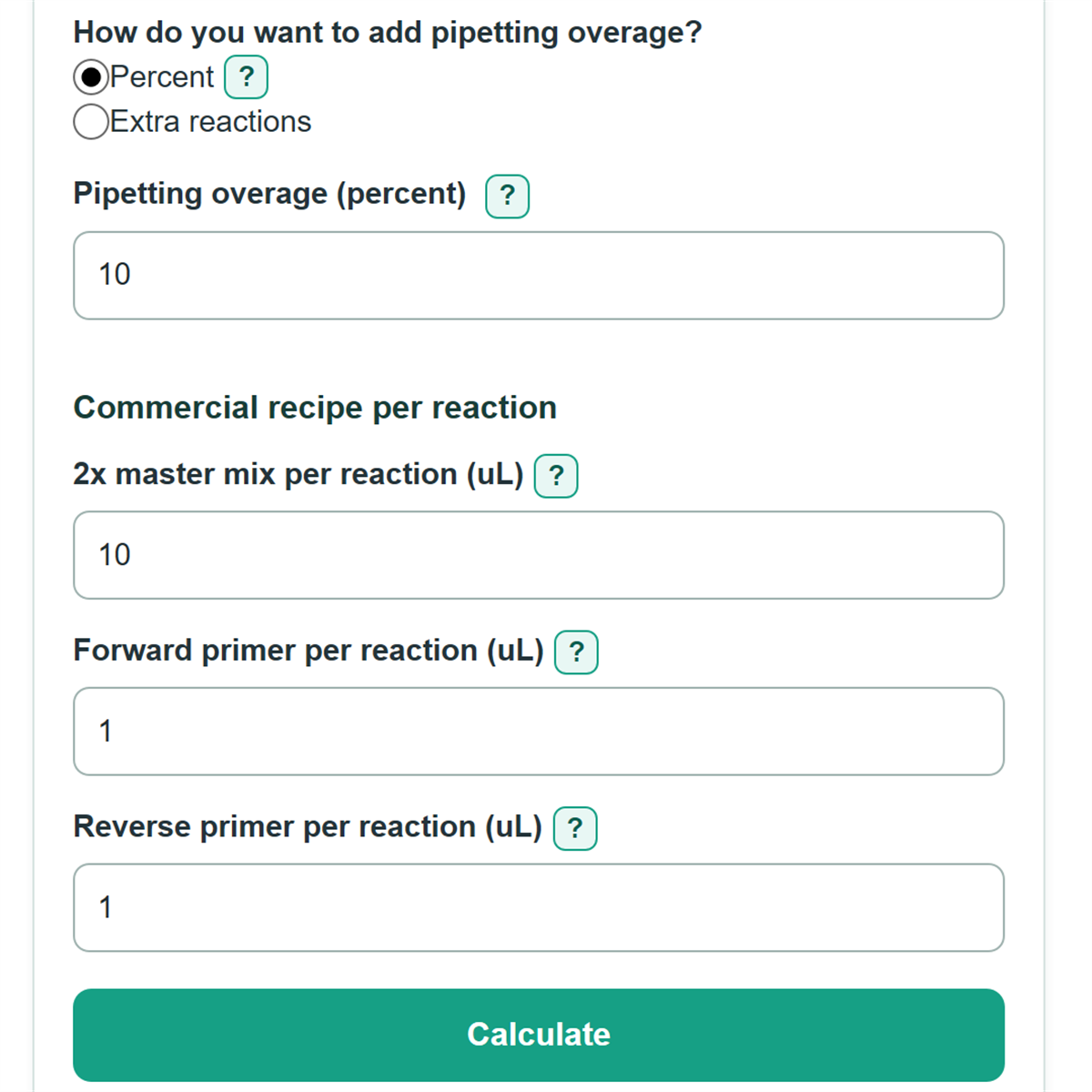
- Choose how to add pipetting overage, then enter either Pipetting overage or Extra reactions.
- Enter the reagent volumes for a commercial recipe, or the stock and final concentrations for a custom recipe, then select Calculate.
- Check that Planned sample and control reactions matches the plate map, that water is positive, and that Master-mix aliquot per reaction plus template equals the final reaction volume.
Definitions
Master mix: The shared liquid prepared in bulk before it is divided among reactions. This calculator excludes template from that shared mix.
Template: The DNA or cDNA sample material added separately to each reaction. Controls may have different template instructions.
Reaction-equivalent: One reaction's worth of liquid used for scaling a batch. It can be a decimal when overage is entered as a percent.
Pipetting overage: Extra master mix prepared to cover liquid left in tips, tubes, or reservoirs during dispensing.
2x master mix: A commercial mix used at double the intended final concentration, commonly diluted to 1x in the completed reaction according to its kit instructions.
Stock concentration: The concentration printed on a reagent label before dilution into the final reaction.
Final concentration: The target concentration of a reagent after all reaction components are combined.
U/uL: Enzyme activity units per microliter. It converts the requested polymerase activity per reaction into a liquid volume.
Common mistakes and quick fixes
Mistake: Leaving controls out of Control reactions because they are not samples.
Fix: Count every planned positive, negative, and no-template control that receives master mix.
Mistake: Adding Template per reaction into the shared master mix.
Fix: Keep template separate; use Master-mix aliquot per reaction first, then add template to each planned reaction as the assay requires.
Mistake: Entering a number of extra reactions in Pipetting overage while Percent is selected.
Fix: Choose Extra reactions before entering a reaction-equivalent allowance, or enter a true percent when Percent is selected.
Mistake: Mixing combined and per-nucleotide conventions between dNTP stock concentration and dNTP final concentration .
Fix: Use the same convention for both dNTP fields, exactly as stated by the protocol and reagent label.
Mistake: Using the forward-primer values for both primer directions when Reverse primer stock concentration differs.
Fix: Enter forward and reverse stock and final concentrations separately, then check both primer totals.
Mistake: Ignoring an error because 2x master mix per reaction and primer volumes do not fit within the aliquot.
Fix: Recheck the recipe table and reduce or correct component volumes before preparing the mix; water cannot be negative.
Limitations & Key Assumptions / Boundary Conditions
- This is a volume-planning tool. Use the exact kit insert, validated assay protocol, and lab SOP for reagent choices, cycling conditions, and handling steps.
- The calculator assumes every planned sample and control receives the same shared master-mix aliquot. It does not account for reactions that need different template volumes or recipe changes.
- Template is scaled only to planned physical reactions, not to pipetting overage. Follow the assay plan for individual templates and controls.
- For custom reagents, stock and final concentrations must use matching conventions. In particular, do not pair a combined dNTP concentration with a per-nucleotide concentration.
- The result does not round volumes to a pipette's usable range. If a component is below 0.5 uL per reaction, use a validated dilution or other approved lab procedure instead of changing the recipe by guesswork.
- Overage covers shared master mix only. Actual losses depend on the vessel, dispensing method, pipette, and local practice.
Methodology
Batch calculation
The calculator first adds samples and controls to get the number of physical reactions. It then applies either the selected percent overage or the selected extra reaction-equivalents. It does not round the reaction-equivalent count before scaling reagent volumes.
planned reactions = sample reactions + control reactions
effective reactions = planned reactions + (planned reactions x pipetting overage / 100)
effective reactions = planned reactions + extra reactions
The master-mix aliquot is the complete reaction volume minus the separately added template. Bulk master mix is that aliquot multiplied by effective reactions.
master-mix aliquot per reaction = final reaction volume - template per reaction
bulk master mix to prepare = master-mix aliquot per reaction x effective reactions
Recipe calculation
For a commercial recipe, the entered 2x mix and primer volumes are multiplied by effective reactions. Water is the remaining aliquot volume after those shared components. For a custom recipe, each dilution-based component uses stock concentration times added volume equals final concentration times final reaction volume.
component volume per reaction = final concentration x final reaction volume / stock concentration
polymerase volume per reaction = polymerase per reaction / polymerase stock
water per reaction = master-mix aliquot - sum of other shared components
Worked mini-example
For 10 sample reactions and 2 control reactions, there are 12 planned reactions. At 10 percent overage, the effective count is 13.2 reaction-equivalents. With a 20 uL final reaction and 2 uL template, the shared aliquot is 18 uL, so the bulk master mix is 237.6 uL. Template remains 24 uL because it is 2 uL for each of the 12 planned reactions.
Calculation boundaries
The calculator stops if the planned count is zero, a required stock value is zero or negative, final reaction volume is not greater than template volume, or the selected recipe would require negative water. These are recipe errors that must be corrected before preparation.