
Check your trailer trip against vehicle payload and entered towing limits using measured weights or a clearly labeled planning estimate.
Advanced options
Calculation details
Table of contents
How to use our Trailer Towing Capacity and Payload Calculator
- Choose Measured loaded weights if the trip-ready trailer and tongue or pin load were weighed; otherwise choose Planning estimate.
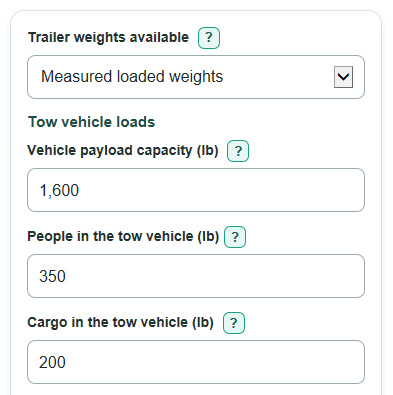
- Enter the door-label Vehicle payload capacity, then add the people, cargo, and hitch hardware carried in the tow vehicle.
- Enter the trailer weights for your selected method. For a planning estimate, include water, propane, batteries, equipment, and cargo in Weight added to the trailer.
- Open Advanced options only if you have configuration-specific tow, GCWR, or receiver ratings, and enter both GCWR and curb weight together.
- Check Smallest remaining capacity and Limiting weight check. A positive number is pounds remaining; a negative number is pounds over. Confirm planning estimates with loaded scale weights before towing.
Definitions
Payload capacity: The maximum combined weight of people and cargo the vehicle can carry. For towing, this calculator counts people, vehicle cargo, hitch hardware, and tongue or pin load against it. [2]
GVWR: Gross vehicle weight rating, the maximum total loaded vehicle weight. It is different from payload capacity and is not an input in this calculator.
GCWR: Gross combined weight rating, the maximum allowed weight of the loaded tow vehicle and loaded trailer together.
Tongue or pin weight: The downward trailer load carried by the tow vehicle hitch. Conventional trailers use tongue weight; fifth-wheel and gooseneck trailers use pin weight.
Receiver rating: The hitch receiver's separate maximum trailer-weight and vertical-load limits for the specific hitch setup.
Planning estimate: A calculation from trailer dry weight, added trip weight, and an estimated tongue or pin percentage. It is not a scale measurement.
Common mistakes and quick fixes
Mistake: Entering GVWR as Vehicle payload capacity .
Fix: Copy the occupants-and-cargo payload number from the driver-side door label instead.
Mistake: Using trailer dry weight as Measured loaded trailer weight .
Fix: Use a trip-ready scale weight, or choose Planning estimate and enter Trailer dry weight plus Weight added to the trailer .
Mistake: Leaving out people, pets, tools, or removable equipment from People in the tow vehicle , Cargo in the tow vehicle , or Hitch hardware in the vehicle .
Fix: Add every item carried by the tow vehicle because each one uses payload.
Mistake: Treating Estimated tongue or pin load as a measured value.
Fix: Use the estimate only for planning, then replace it with Measured tongue or pin weight from an appropriate scale measurement.
Mistake: Entering only Gross combined weight rating without Tow vehicle curb weight .
Fix: Enter both values for the combined-weight check, or leave both blank.
Mistake: Assuming a passing Trip weight check means every towing requirement passes.
Fix: Also verify axle, tire, hitch, braking, stability, legal, and manufacturer requirements for the exact vehicle and trailer setup.
Limitations & Key Assumptions / Boundary Conditions
- The check uses only the ratings entered. Blank manufacturer, GCWR, and receiver ratings are excluded, so an unentered limit could be lower.
- Planning results depend on the entered dry weight, added trailer weight, and estimated tongue or pin percentage. Cargo placement can change actual tongue or pin weight.
- Passing the entered checks does not verify axle ratings, tire load ratings, hitch component ratings, trailer GVWR, braking, sway control, stability, road grade, legal requirements, or manufacturer approval.
- GCWR is checked from entered curb weight plus people, vehicle cargo, hitch hardware, and loaded trailer weight. The calculator does not add tongue or pin weight a second time because it is already part of loaded trailer weight.
- Vehicle ratings must match the exact engine, cab, drivetrain, axle ratio, equipment, receiver setup, and towing method. A weight-distribution hitch does not raise the ratings entered here.
- Use loaded scale measurements before towing when the margin is small or the trip load differs from the estimate.
Methodology
How the weights are calculated
Measured mode uses the entered loaded trailer weight and measured tongue or pin weight. Planning mode adds trailer dry weight and added trailer weight, then estimates tongue or pin load from the entered percentage.
loaded trailer weight = measured loaded trailer weight, or trailer dry weight + weight added to the trailer
tongue or pin weight = measured tongue or pin weight, or loaded trailer weight x estimated tongue or pin load / 100
The suggested planning percentages are 10 percent for a conventional trailer and 15 percent for a fifth-wheel or gooseneck setup unless you edit the percentage. These are planning defaults, not measured requirements. [1]
vehicle payload used = people in the tow vehicle + cargo in the tow vehicle + hitch hardware in the vehicle + tongue or pin weight
vehicle payload remaining = vehicle payload capacity - vehicle payload used
A negative remaining value stays negative. For example, -80 lb means the setup is 80 lb over that entered limit.
Optional rating checks
Each optional rating is checked only when entered. GCWR requires both the gross combined weight rating and tow vehicle curb weight.
combined-weight rating remaining = GCWR - (tow vehicle curb weight + people + vehicle cargo + hitch hardware + loaded trailer weight)
receiver trailer-weight capacity remaining = receiver maximum trailer weight - loaded trailer weight
receiver vertical-load capacity remaining = receiver maximum tongue or pin load - tongue or pin weight
The calculator finds the smallest active margin across payload and any entered optional limits. That check becomes the limiting weight check. If margins tie, payload is listed first, followed by manufacturer trailer rating, GCWR, receiver trailer weight, and receiver vertical load.
Worked planning example
A trailer with 5,000 lb dry weight and 700 lb added weight has a planned loaded weight of 5,700 lb. At 10 percent, planned tongue weight is 570 lb. With 350 lb of people, 200 lb of vehicle cargo, and 100 lb of hitch hardware, payload used is 1,220 lb. Against a 1,600 lb payload capacity, 380 lb remains. Optional ratings are not included unless entered.