
Estimate roof runoff, practical tank storage, seasonal water shortages, annual bill savings, and simple payback using your monthly rainfall and demand.
Planned use and tank
Project and bill
Advanced options
Collection assumption
Wastewater bill savings
Ongoing cost and incentive
Calculation details
| Annual rainwater demand met | |
| Months needing supplemental water | |
| Annual potential roof collection | |
| Estimated avoided water supply charges | |
| Estimated avoided wastewater charges | |
| Net upfront project cost after rebate |
| Month | Potential harvest | Demand | Rainwater used | Supplemental need | Overflow | Ending storage |
|---|
Table of contents
How to use our Rainwater Harvesting System Size and Payback Calculator
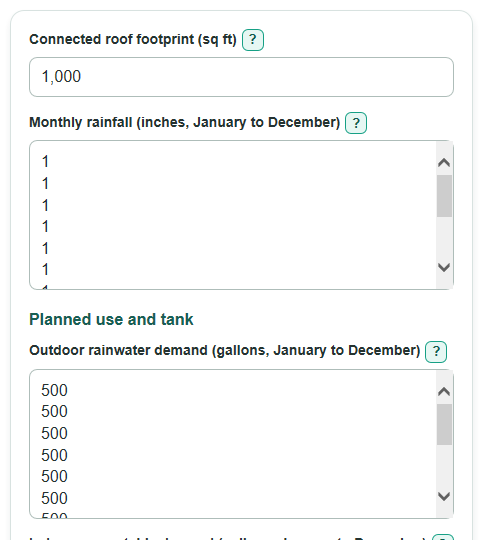
- Enter the horizontal area of roof sections connected to the planned tank in Connected roof footprint, then replace each working-example value in Monthly rainfall, January to December with local January-to-December rainfall.
- Enter the rainwater use you expect in Outdoor rainwater demand, January to December and Indoor non-potable demand, January to December. Enter 0 for any month with no planned use.
- Enter the usable, draw-able water volume in Usable tank capacity, plus your Upfront installed cost and Avoided water supply rate from the usage-charge part of your bill.
- Open Advanced options to adjust Collection efficiency, wastewater savings, Annual maintenance and operating cost, or a confirmed Rebate or incentive.
- Click Calculate, then check Months needing supplemental water and the January-to-December tank balance. A high annual coverage can still include dry-month shortfalls.
Definitions
Connected roof footprint: The horizontal area of roof sections that drain to the system, measured in square feet. It is not the larger sloped roof surface.
Collection efficiency: The share of rain on the connected roof that reaches usable storage after first-flush, filter, conveyance, and similar losses. The 85% starting value is a planning estimate within DOE guidance. [1]
Usable tank capacity: Water the system can actually deliver, after subtracting inaccessible or reserved tank volume.
Potential roof collection: Rainwater estimated to reach the tank system before tank overflow and before demand limits how much can be used.
Supplemental water: Purchased or other backup water needed when stored rainwater cannot meet that month's entered demand.
Usage-based rate: The part of a water or wastewater bill that changes with gallons used. Fixed fees are not included.
Simple payback: Net upfront project cost divided by yearly net bill savings. It estimates recovery time without financing or future price changes.
Common mistakes and quick fixes
Mistake: Using the sloped roof surface area for Connected roof footprint.
Fix: Enter the horizontal roof footprint of only the sections that drain to the planned tank.
Mistake: Entering one annual total or fewer than 12 values in Monthly rainfall, January to December.
Fix: Enter exactly 12 nonnegative values in January-through-December order so dry months can be modeled.
Mistake: Counting fixed meter, service, or account fees in Avoided water supply rate.
Fix: Enter only the usage-based charge per 1,000 gallons that falls when purchased water use falls.
Mistake: Assuming outdoor irrigation reduces sewer charges through Avoided wastewater rate.
Fix: Keep Avoided wastewater rate and Indoor use that reduces wastewater charges at 0 unless the utility confirms an eligible indoor use reduces billed wastewater volume.
Mistake: Using nominal tank volume as Usable tank capacity.
Fix: Subtract water below the pump inlet, sediment storage, and any operating reserve that cannot serve demand.
Mistake: Ignoring Annual maintenance and operating cost when judging Estimated simple payback.
Fix: Include recurring filters, cleaning, pump electricity, service, and expected repairs in the yearly cost.
Limitations & Key Assumptions / Boundary Conditions
- This is a planning estimate, not a plumbing, structural, water-quality, treatment, backflow, permit, or code review.
- The model uses one rainfall and demand value per month and assumes rainfall is available before demand within that month. It cannot model storm timing, dry days between storms, or daily tank autonomy.
- Monthly values repeat for three model years, and only the final year is reported to reduce the effect of starting with an empty tank.
- The recommended capacity is the smallest whole-gallon tank that reaches 95% of the modeled delivery from a large-storage case. It is not an engineering design requirement or a standard tank size.
- Bill savings include entered usage-based water charges and eligible usage-based wastewater charges only. Fixed charges, financing, inflation, rate changes, replacement costs, and taxes are excluded.
- Indoor non-potable use may require treatment, separate plumbing, backflow protection, and local approval. Confirm requirements with local authorities and qualified installers.
Methodology
Monthly water balance
For each January-to-December entry, the calculator estimates collection from the connected horizontal roof footprint, rainfall, and collection efficiency. One inch of rain on one square foot equals 144/231, or about 0.6234, gallons.
harvest = roof area x rainfall x (144 / 231) x collection efficiency / 100
It starts with empty storage, repeats the same 12-month pattern for three years, and reports the third year. In each month, harvested water is added before that month's demand. Storage cannot exceed Usable tank capacity, so excess becomes overflow.
available = min(tank capacity, prior storage + harvest)
delivered = min(available, outdoor demand + indoor demand)
ending storage = available - delivered
If both outdoor and indoor demand occur in a month with too little water, delivered rainwater is split in proportion to the two entered demands. A month counts toward Months needing supplemental water when delivered rainwater is less than total entered demand.
Tank recommendation
The calculator simulates a large-storage case equal to annual potential roof collection, then finds the smallest capacity that delivers at least 95% of that modeled amount. The result is rounded up to a whole gallon.
recommended capacity = ceil(smallest capacity delivering at least 95% of large-storage delivery)
Bill savings and payback
All delivered rainwater is valued at the entered Avoided water supply rate. Only the eligible share of delivered indoor rainwater is valued at the Avoided wastewater rate. Annual maintenance is then subtracted.
net savings = avoided water charges + avoided wastewater charges - annual maintenance
payback years = (upfront installed cost - rebate) / net savings
If annual net savings is zero or negative, Estimated simple payback is shown as N/A because yearly savings do not recover the net upfront cost.
Worked mini-example
A 1,000 sq ft connected roof with 1 inch of monthly rain and 100% collection efficiency has potential collection of about 623.38 gallons that month: 1,000 x 1 x 0.6233766. If demand is 500 gallons and usable storage is sufficient, 500 gallons are delivered and about 123.38 gallons remain available for storage.
Calculation choices
The 85% default Collection efficiency is a U.S. planning value within DOE's stated 75% to 90% collection-factor guidance. [1] Actual collection, overflow, water use, utility billing, and maintenance can differ from these inputs. Fixed water and sewer charges are excluded because they generally do not fall with lower usage.