
Compare robotic and suction pool cleaner costs using your prices, cleaning schedule, electricity rate, and only the pump time added by suction cleaning.
Cleaner prices
Energy details
Advanced options
One-time setup
Yearly parts and repairs
Calculation details
Table of contents
How to use our Robotic vs Suction Pool Cleaner Lifetime Cost Calculator
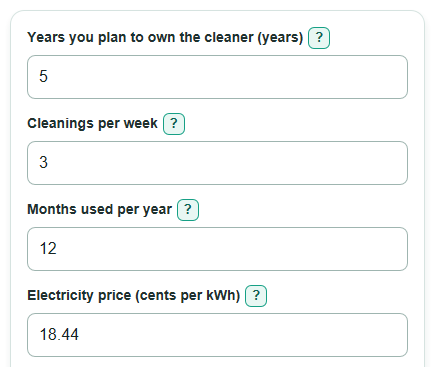
- Enter the number of years you plan to own the cleaner, your Cleanings per week, and Months used per year.
- Enter the Electricity price from your utility bill if possible, then enter the price and power details for each cleaner.
- For Extra suction pump time share, choose the portion of suction-cleaning time that makes the pool pump run beyond its normal filtration schedule.
- Open Advanced options to add one-time setup costs and yearly parts and repair estimates when they apply.
- Click Calculate, then check whether Robotic cost minus suction cost is negative or positive and confirm the annual cleaning count matches your actual routine.
Definitions
Added pump time: Pool-pump running time caused by suction cleaning that would not happen for normal filtration. Only this share is charged to the suction cleaner.
kWh: Kilowatt-hour, the unit your electric utility uses to bill energy. One kWh is 1,000 watts used for one hour.
Electricity price: Your delivered electricity cost in cents per kWh. The starter value is a US residential planning estimate and should be replaced with your bill's rate when available. [1]
Annual recurring cost: Electricity plus the entered yearly parts and repairs. It does not include the cleaner price or setup cost.
Break-even time: The estimated number of years until the cleaner with the higher upfront cost catches up because its annual cost is lower.
Common mistakes and quick fixes
Mistake: Entering total normal pool-pump runtime as Extra suction pump time share.
Fix: Choose only the portion of Suction cleaning time that is extra beyond normal filtration.
Mistake: Typing pump horsepower into Pool-pump power during suction cleaning.
Fix: Enter electrical input in watts from the pump controller, documentation, or a power measurement.
Mistake: Using battery capacity for Robotic cleaner power.
Fix: Enter wall power in watts from the cleaner manual, power supply label, or an energy monitor.
Mistake: Entering Electricity price as 0.1844 when the bill is in dollars per kWh.
Fix: Enter cents per kWh, such as 18.44 for $0.1844 per kWh.
Mistake: Leaving out Robotic setup cost, Suction setup cost, or yearly repair amounts when they are expected.
Fix: Add quotes or a reasonable planning allowance in Advanced options so ownership costs include those expenses.
Mistake: Treating a positive Robotic cost minus suction cost as robotic savings.
Fix: A positive amount means the robotic cleaner costs more; a negative amount means it costs less over the selected period.
Limitations & Key Assumptions / Boundary Conditions
- The estimate includes one cleaner purchase, one-time setup, electricity, and yearly parts and repairs. It does not add a replacement cleaner purchase.
- Keep Years you plan to own the cleaner within the expected service life of both options, or include likely replacement spending in the yearly repair allowance.
- Suction energy includes only the selected Extra suction pump time share. Normal filtration electricity is excluded even though the pump still uses power.
- Pool-pump power must be electrical watts at the speed used during suction cleaning. Horsepower alone is not a measured electrical power value.
- Electricity bills can include fixed charges, time-of-use prices, taxes, and other fees that are not modeled by one cents-per-kWh rate.
- Actual repairs, cleaning cycles, pump schedules, water conditions, and equipment compatibility can change real ownership costs.
Methodology
Cost calculation
The calculator first estimates annual cleaning cycles from your weekly schedule and active pool season.
annual_cleanings = cleanings_per_week * 52 * months_used_per_year / 12
It calculates each cleaner's electricity cost from power, hours per cleaning, annual cleanings, and Electricity price. The suction calculation also multiplies by Extra suction pump time share, so pump time already needed for filtration is not charged again.
robotic_energy_cost_per_year = robotic_power_watts / 1000 * robotic_cycle_hours * annual_cleanings * electricity_rate_cents / 100
suction_added_energy_cost_per_year = suction_pump_power_watts / 1000 * suction_cycle_hours * suction_added_time_share * annual_cleanings * electricity_rate_cents / 100
Yearly parts and repair allowances are added to electricity costs. Purchase price and setup cost are added once at the start of the ownership period.
ownership_cost = cleaner_price + setup_cost + annual_recurring_cost * ownership_years
robotic_cost_minus_suction_cost = robotic_ownership_cost - suction_ownership_cost
A negative comparison means robotic costs less. A positive comparison means suction costs less.
Worked example
With 3 cleanings per week for 12 months, the estimate is 156 cleanings per year. A 150-watt robotic cleaner running 2 hours per cleaning at 18.44 cents per kWh uses about $8.63 per year. A 1,000-watt pool pump running 2 hours per cleaning, with all time extra, uses about $57.53 per year for suction cleaning.
Break-even calculation
A break-even time is shown only when the option with the higher upfront cost has a lower annual recurring cost and the crossover occurs within the selected ownership period.
break_even_year = (robotic_upfront_cost - suction_upfront_cost) / (suction_annual_cost - robotic_annual_cost)
Calculation choices
The calculation uses 52 weeks per planning year, 12 months per year, 1,000 watts per kW, and 100 cents per dollar. It uses one electricity rate and does not model time-of-use pricing, tax changes, replacement purchases, or changes in power use over time.