
Estimate the pressure, flow, head, and electricity cost for a household water booster pump using your measured water and utility details.
Electricity use
Advanced options
Pump data
Schedule and bill
Calculation details
Table of contents
How to use our Domestic Water Booster Pump Size and Electricity Cost Calculator
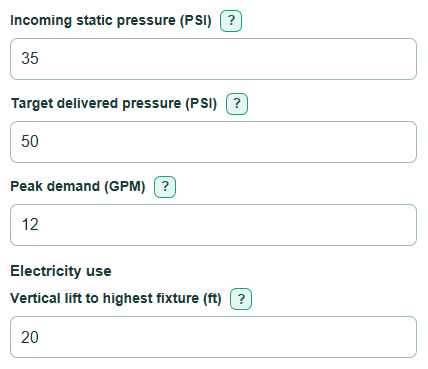
- Measure Incoming static pressure at a hose bib or inlet gauge with all fixtures off, then enter the pressure you want at the highest fixture as Target delivered pressure.
- Enter Peak demand as the combined GPM for fixtures likely to run together, plus the vertical distance to the highest fixture.
- Enter average pump-on time and the usage-based Electricity rate from your bill. Do not include a fixed account charge in the rate.
- Open Advanced options to add pipe friction, efficiency values, known running watts, seasonal operating days, or a fixed bill charge if you have them.
- Click Calculate, then check that one pump curve can provide the shown required GPM at the shown PSI or feet of head. Compare estimated kWh with an energy monitor after installation when possible.
Definitions
Incoming static pressure: Water pressure measured while fixtures are off. It can be higher than pressure available while water is flowing.
Peak demand: The combined water flow, in gallons per minute (GPM), needed when expected fixtures run at the same time.
Vertical lift: The vertical height from the pump to the highest fixture. Water loses about 0.4335275 PSI for each foot it is raised.
Pipe friction loss: Pressure lost as moving water passes through pipe, fittings, valves, and other parts of the system.
Head: A pressure measurement expressed as feet of water. Pump curves commonly show head instead of PSI.
Pump efficiency: The share of pump-shaft power that becomes useful power in the water.
Motor efficiency: The share of electrical input power that reaches the pump shaft.
Known running power: Electrical watts measured or listed while the pump operates. When entered, it replaces calculated electrical power for energy-cost estimates.
Common mistakes and quick fixes
Mistake: Using Incoming static pressure measured while no water is running as if it is guaranteed during peak use.
Fix: Treat it as a planning value and confirm flowing inlet pressure if pressure drops when fixtures run.
Mistake: Entering total daily household water use as Peak demand.
Fix: Enter the combined GPM of fixtures expected to run at the same time.
Mistake: Putting full pipe length into Vertical lift to highest fixture.
Fix: Enter only the vertical height; put the separate moving-water loss in Estimated pipe friction loss.
Mistake: Treating Estimated pump-shaft power needed as a motor size to buy.
Fix: Use it only as a planning estimate and select equipment from a manufacturer pump curve and motor data.
Mistake: Including a customer or service fee in Electricity rate.
Fix: Use only usage-based $/kWh charges there; enter a separate bill fee as Fixed electric account charge.
Mistake: Entering motor horsepower as Known running power.
Fix: Enter measured or listed electrical watts only, or leave it blank to calculate electrical power from the efficiency inputs.
Limitations & Key Assumptions / Boundary Conditions
- This is a planning estimate, not a pump selection or plumbing design. Confirm the selected pump can supply the required flow and pressure at the same point on its manufacturer pump curve.
- Incoming static pressure may be higher than available inlet pressure during peak flow. A flow-pressure test can give a better sizing input.
- Pipe friction is entered as one estimate. Actual loss changes with pipe diameter, length, material, fittings, valves, water temperature, and flow.
- The calculation uses water-pressure and hydraulic-power conversions for typical water-system planning. Water density changes slightly with temperature.
- Calculated power depends on the entered pump and motor efficiencies at the actual operating point. Measured Known running power is usually more direct for estimating electricity use.
- Monthly energy and cost are annual averages based on daily runtime and operating days. Individual billing months can differ.
- Variable cost includes only kWh multiplied by the entered electricity rate. Fixed account charges, taxes, demand charges, and time-of-use changes are excluded unless already included in the rate you enter.
Methodology
Pressure and flow requirement
The calculator starts with the target fixture pressure, subtracts incoming static pressure, then adds elevation and entered pipe friction. A booster cannot be required to add less than zero pressure, so a negative calculated need becomes 0 PSI.
required booster pressure = max(0, target delivered pressure - incoming static pressure + vertical lift x 0.4335275 + estimated pipe friction loss)
required booster head = required booster pressure / 0.4335275
The required pump flow is the entered Peak demand. Flow and pressure are a pair: check both values together on a pump curve rather than comparing separate maximum GPM and maximum PSI claims.
Power and electricity cost
Hydraulic horsepower is the useful power transferred to water [1]. The calculator divides it by pump efficiency to estimate pump-shaft power. If Known running power is blank, it then uses both efficiency values to estimate electrical input power. If known watts are entered, those watts are used only for energy and cost.
hydraulic horsepower = peak demand x required booster pressure / 1714
electrical kW = hydraulic horsepower x 745.699872 / pump efficiency / motor efficiency / 1000
yearly kWh = electrical kW x average pump run time x operating days
yearly variable cost = yearly kWh x electricity rate
The displayed monthly kWh and variable cost are yearly values divided by 12. A fixed electric account charge is shown separately as bill context and is not included in pump-caused cost. The starting electricity-rate planning value comes from the EIA residential price table [2].
Worked example
With 35 PSI incoming pressure, a 50 PSI target, 20 ft of lift, and 5 PSI friction loss, required booster pressure is 28.67 PSI. At 12 GPM with 60% pump efficiency and 85% motor efficiency, calculated electrical power is about 0.294 kW. Running one hour per day for 365 days at $0.1811 per kWh uses about 107.13 kWh per year and costs about $19.40 per year.