
Estimate ideal chiller capacity for your cold plunge and separate the fresh-fill cooldown cost from normal monthly holding electricity.
Electricity use
Table of contents
How to use our Cold Plunge Chiller Size and Electricity Cost Calculator
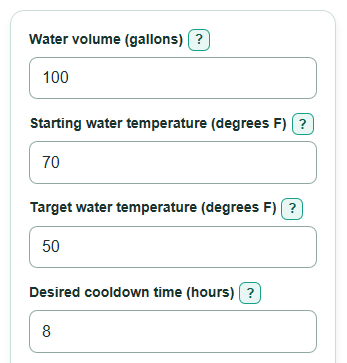
- Enter the water at your usual fill line in Water volume, then measure and enter the Starting water temperature.
- Enter a lower Target water temperature and the longest acceptable Desired cooldown time for a fresh fill.
- Copy the electrical watts and realistic daily run times for the chiller and any separate pump from labels, schedules, or a power meter.
- Replace Electricity price with the delivered per-kWh rate from your utility bill, then select Calculate.
- Check that the displayed cooldown time matches your goal, then compare the ideal cooling capacity with product BTU/h ratings under similar water and air conditions.
Definitions
BTU: A British thermal unit, a unit of heat. The calculator estimates how many BTU must be removed from the water.
BTU/h: BTU per hour, a cooling rate. Use this as the main number for comparing chiller cooling-capacity ratings.
Mechanical horsepower equivalent: A unit conversion from the calculated BTU/h rate. It is a secondary comparison only because product horsepower labels may not match delivered cooling capacity. [2]
kWh: Kilowatt-hour, the electricity used by a 1,000-watt load running for one hour.
Average chiller runtime: Daily hours when the compressor is actually operating, rather than the time the chiller is plugged in.
Holding electricity: Electricity used after the water is already cold, based on the separate chiller and pump daily run times.
Common mistakes and quick fixes
Mistake: Entering the tub's advertised maximum capacity instead of the water actually used in Water volume .
Fix: Use gallons at your normal fill line.
Mistake: Setting Target water temperature equal to or higher than Starting water temperature .
Fix: Enter a target that is lower than the starting water temperature.
Mistake: Using a chiller's BTU/h rating in Chiller power draw .
Fix: Enter electrical input watts from the label or a power meter; BTU/h is the cooling-capacity output.
Mistake: Treating plugged-in time as Average chiller runtime .
Fix: Enter hours when the compressor actually runs, ideally from a power meter or smart-plug history.
Mistake: Double-counting a built-in pump in Separate pump power draw .
Fix: Enter 0 when pump power is already included in the chiller wattage.
Mistake: Leaving the planning default in Electricity price when your utility rate differs.
Fix: Replace it with a blended usage rate that includes applicable supply and delivery charges.
Limitations & Key Assumptions / Boundary Conditions
- The cooling-capacity result is an ideal water-only estimate. It does not add heat from air, sun, the tub shell, hoses, plumbing, or people using the plunge.
- Actual chiller BTU/h can change with water temperature, air temperature, flow rate, and the manufacturer's test conditions. Compare the result with a product's rated cooling capacity under relevant conditions.
- First-cooldown electricity assumes the entered chiller and separate pump watts run continuously for the entered cooldown time.
- Monthly and annual holding costs use the daily run times you enter for all 365 days. Weather, insulation, cover use, and maintenance can change those run times.
- The electricity estimates include usage charges only. They exclude fixed utility charges, equipment purchase, water, sewer, filters, chemicals, ice, and fresh-fill cooldowns after the first one.
- The 8.34 lb per gallon water estimate is approximate because water density changes slightly with temperature. [3]
Methodology
Cooling capacity
The calculator first finds the temperature drop and estimates the water mass using 8.34 lb for each US gallon. It then treats 1 BTU as the heat removed to lower about 1 lb of water by 1 degree F. The result is an ideal water-only load, before outside heat gain. [3]
temperature_drop_f = starting_water_temp_f - target_water_temp_f
water_mass_lb = water_volume_gal * 8.34
cooldown_heat_btu = water_mass_lb * temperature_drop_f
required_cooling_btu_per_hour = cooldown_heat_btu / desired_cooldown_hours
required_cooling_hp = required_cooling_btu_per_hour / 2544.4336
cooldown_time_at_required_capacity_hours = cooldown_heat_btu / required_cooling_btu_per_hour
For example, 100 gallons cooled from 70 degrees F to 50 degrees F has a 20 degree F drop. The estimated heat removal is 100 * 8.34 * 20 = 16,680 BTU. Over 8 hours, the ideal capacity needed is 16,680 / 8 = 2,085 BTU/h, or about 0.8194 mechanical hp. The horsepower conversion is a unit conversion, not a product recommendation. [2]
Electricity and cost
Electrical energy uses watts, runtime, and electricity price. The initial cooldown is kept separate from daily holding so a fresh fill is not mistaken for normal operating cost.
initial_cooldown_kwh = ((chiller_power_w + pump_power_w) / 1000) * desired_cooldown_hours
initial_cooldown_cost = initial_cooldown_kwh * electricity_price_per_kwh
daily_holding_kwh = ((chiller_power_w * chiller_runtime_hours_day) + (pump_power_w * pump_runtime_hours_day)) / 1000
monthly_electricity_cost = daily_holding_kwh * 365 / 12 * electricity_price_per_kwh
annual_holding_kwh = daily_holding_kwh * 365
annual_electricity_cost = annual_holding_kwh * electricity_price_per_kwh
With an 800 W chiller, 50 W separate pump, 8-hour cooldown, and $0.1844 per kWh, the first cooldown uses 6.8 kWh and costs about $1.25. If the chiller runs 8 hours per day and the pump runs 24 hours per day, holding uses 7.6 kWh per day and costs about $42.63 per average month.
Calculation choices
The monthly estimate uses 365 / 12 days, so it is an average calendar month. The default electricity price is a US residential planning estimate; replace it with your bill's delivered usage rate. [1]