
Compare washable and disposable HVAC filter costs using your prices, schedules, service life, and planned years of use.
Advanced options
Table of contents
How to use our Washable vs Disposable HVAC Filter Lifetime Cost Calculator
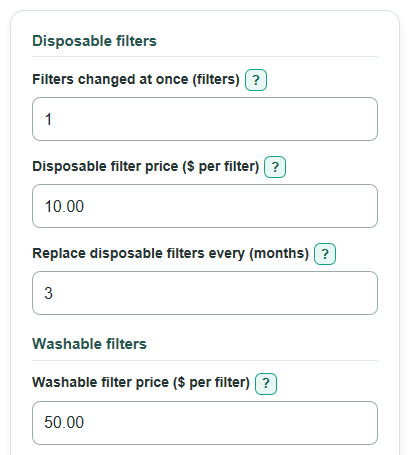
- Enter the total under Filters changed at once, then enter the price of one compatible filter under each filter-price field.
- Enter separate schedules for Replace disposable filters every and Clean washable filters every, plus the washable filter service life.
- Choose Compare costs for and set New filters installed on to the date both options would begin.
- Open Advanced options only if you want cleaning supplies, water, or your time included in the washable cost.
- Check the sign of Disposable cost minus washable cost: a positive number means washable costs less. Also check that the next cleaning and replacement dates match the schedules you intend to follow.
Definitions
Disposable cost minus washable cost: Disposable lifetime cost less washable lifetime cost. A positive amount means washable costs less; a negative amount means disposable costs less.
Service life: The years a washable filter is expected to be used before another set is purchased in this model.
Cleaning session: One cleaning visit for all filters counted under Filters changed at once.
Lasting washable break-even month: The first month when washable cumulative cost is no higher than disposable cumulative cost and does not rise above it again before the comparison ends.
MERV rating: A filter efficiency rating. Cost alone does not show that a filter rating is suitable for an HVAC system; choose a rating the system can accommodate. [1]
Common mistakes and quick fixes
Mistake: Entering a multipack total as the Disposable filter price.
Fix: Divide the package price by the number of filters in the package before entering the per-filter price.
Mistake: Setting Replace disposable filters every equal to Clean washable filters every without checking both products.
Fix: Enter each product's own schedule from its instructions or your actual maintenance routine.
Mistake: Entering one filter when several filters are maintained together.
Fix: Count all filters changed during one visit and enter that number under Filters changed at once.
Mistake: Treating Washable filter service life as the same as Compare costs for.
Fix: Enter the product's stated service life separately; the calculator adds another washable purchase if that life ends within the comparison.
Mistake: Assuming a negative Disposable cost minus washable cost is an error.
Fix: Keep the negative value. It means disposable filters cost less over the selected period.
Mistake: Entering a dollar value for Value of your time when you only want to track cleaning effort.
Fix: Leave it at $0 and enter Your time per cleaning session ; total active cleaning time will still be reported.
Limitations & Key Assumptions / Boundary Conditions
- Results compare entered purchase and optional cleaning costs only. They exclude shipping, installation, paid labor, disposal fees, and sales tax unless you include such amounts in an entered filter price or cleaning-session cost.
- The model does not estimate fan energy, airflow, pressure drop, runtime, or HVAC efficiency. Those effects need system-specific data and can change real ownership cost.
- Cleaning and replacement events occur in whole calendar months. Events on the comparison end month are excluded.
- The service-life input is a planning assumption. A washable filter may need earlier replacement because of damage, fit, cleaning method, or product instructions.
- This comparison does not confirm filter dimensions, MERV compatibility, airflow requirements, or manufacturer requirements for your HVAC equipment.
- A lasting break-even date is only a cost-timing result under the entered schedule. It is not a recommendation to use a filter that does not fit or meet system requirements.
Methodology
Cost timeline
The calculator turns the selected whole years into whole months. It charges a disposable set at installation and at each replacement interval before the comparison end. It charges a washable set at installation and again whenever its entered service life ends before the comparison end.
H (comparison months) = comparison years * 12
Disposable total cost = disposable purchase events * filters changed at once * disposable filter price
Washable cleanings occur at positive cleaning-interval months within each service-life segment. A cleaning is not charged in a month when a new washable set is purchased. Optional cleaning cost includes the entered supplies and water cost plus any user-chosen value for cleaning time.
Washable cleaning cost = cleaning sessions * (supplies and water per cleaning session + (your time per cleaning session / 60) * value of your time)
Washable total cost = washable purchase events * filters changed at once * washable filter price + washable cleaning cost
Disposable cost minus washable cost = disposable total cost - washable total cost
Break-even timing
The calculator builds cumulative costs for month 0 through the last month before the comparison ends. It reports the first month where washable cost is no higher and remains no higher for every later month. This avoids calling a short-lived crossing a break-even point. If no such month exists, it shows "Not reached in this period." Calendar dates add whole months to the installation date and use the last valid day when needed.
Mini-example
For one filter, a $10 disposable filter replaced every 3 months costs $200 over 5 years: 20 purchase events times $10. A $50 washable filter with a 5-year service life and no entered cleaning cost totals $50. The difference is $150, so washable costs less. Because disposable purchases happen every 3 months, the lasting washable break-even month is month 12.
Assumptions and limits
Yearly costs are lifetime totals divided by the selected comparison years, not a prediction that spending is equal every year. The calculation assumes each product is compatible with the HVAC system and that the entered maintenance schedules are followed. It does not model filter performance, MERV suitability, fan-energy changes, labor, disposal, or unentered fees.