
Estimate electric heated driveway costs per hour, snow event, and winter season using your coverage, runtime, and electricity rate.
Table of contents
How to use our Heated Driveway Operating Cost Calculator
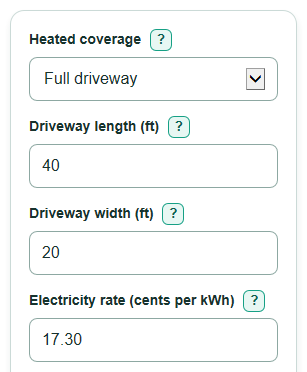
- Choose Heated coverage. Pick full driveway if the whole measured surface is heated, or tire tracks if only the vehicle paths are heated.
- Enter the visible dimensions for the selected layout, your Electricity rate from a recent bill, and Run time per snow event.
- Open Advanced options and replace System output with the W per sq ft listed in your installer quote, plan, or product documents. Adjust Snow events per season for your winter budget.
- Click Calculate. Check Calculated heated area against the actual planned heated surface before relying on the cost estimates.
Definitions
Heated coverage: The part of the driveway that contains heating: the whole driveway or only tire tracks.
Electricity rate: The usage-based price of electricity in cents per kilowatt-hour (kWh). A kWh is one kilowatt of power used for one hour. [2]
System output: Heating power density in watts per square foot (W per sq ft), supplied by the system design or product documents.
Connected heating load: The estimated total heating power in kilowatts (kW) for the calculated heated area.
Run time per snow event: Total hours the system operates for one event, including any planned preheating and after-storm operation.
Estimated current at selected voltage: Connected watts divided by 208 V or 240 V. It is a basic planning estimate, not a circuit-size recommendation.
Common mistakes and quick fixes
Mistake: Choosing full coverage while entering dimensions for only two tire paths.
Fix: Choose the correct Heated coverage setting, then use Heated track length and Width of each heated track for tire-track systems.
Mistake: Entering total system kilowatts in System output.
Fix: Enter watts per square foot in System output, then check the calculated Estimated connected heating load in kW.
Mistake: Using only the supply charge for Electricity rate when the bill also has a usage-based delivery charge.
Fix: Add applicable usage-based supply and delivery charges in cents per kWh. Do not add a fixed monthly customer charge.
Mistake: Treating Run time per snow event as snowfall duration only.
Fix: Include planned preheating and post-storm melting time if the system runs during those periods.
Mistake: Leaving Snow events per season at the example value without checking local use.
Fix: Replace Snow events per season with the number of times you expect to operate the system during a winter.
Mistake: Using Estimated current at selected voltage to choose a breaker.
Fix: Use it only for early planning. Have an electrician confirm circuit, conductor, control, service, and code requirements.
Limitations & Key Assumptions / Boundary Conditions
- This calculator is for electric resistance heated driveways. Hydronic systems need fuel use, boiler efficiency, and pump electricity inputs.
- It assumes the heating system draws its entered System output continuously for every operating hour.
- The seasonal estimate assumes every entered snow event has the same Run time per snow event. It is a budget scenario, not a weather forecast.
- Electricity pricing can vary by time of use, tier, season, taxes, and utility charges. Enter an all-in usage-based Electricity rate that fits your expected operating period.
- Fixed monthly customer charges, equipment purchase, maintenance, controller standby power, and electrical service upgrades are excluded.
- Estimated current at selected voltage does not account for circuit rules, continuous-load treatment, conductor sizing, controls, service capacity, or local electrical code.
Methodology
Area and heating load
The calculator uses only the dimensions for the chosen Heated coverage layout. Full-driveway coverage uses length times width. Tire-track coverage uses the length and width of one track, multiplied by the Number of heated tracks.
heated area (sq ft) = driveway length (ft) x driveway width (ft)
heated area (sq ft) = heated track length (ft) x width of each heated track (ft) x number of heated tracks
connected heating load (kW) = heated area (sq ft) x system output (W per sq ft) / 1,000
Operating cost
Electricity use is calculated from power and time. The Electricity rate is divided by 100 because it is entered in cents per kWh, while costs are shown in dollars.
cost per hour ($) = connected heating load (kW) x electricity rate (cents per kWh) / 100
cost per snow event ($) = cost per hour ($) x run time per snow event (hours)
estimated seasonal operating cost ($) = cost per snow event ($) x snow events per season
The 17.30 cents per kWh starting value is a 2025 U.S. residential planning average. Replace it with a local usage-based rate when possible. [1]
Current estimate
The current figure is a simple watts-divided-by-volts estimate for early planning only.
estimated current (A) = connected heating load (kW) x 1,000 / system voltage (V)
Worked example
A 40 ft by 20 ft full driveway has 800 sq ft of heated area. At 50 W per sq ft, the connected load is 40 kW. At 17.30 cents per kWh, it costs $6.92 per hour. Running 8 hours costs $55.36 for one event, and 10 equal events cost $553.60 for the season.
Calculation scope
The method assumes a constant heating load during runtime and does not model thermostat cycling, weather, snow depth, heat loss, time-of-use pricing, or fixed utility charges. It also does not size electrical equipment.