
Compare electric and hydronic radiant floor costs using your project quotes, yearly energy use, and local utility rates.
Table of contents
How to use our Hydronic vs Electric Radiant Floor Heating Cost Calculator
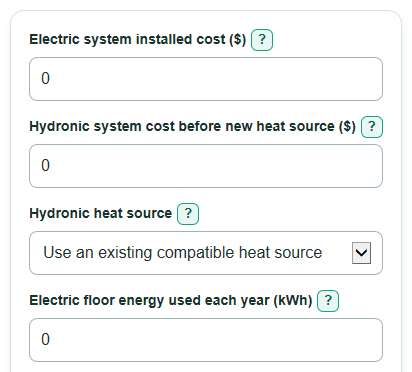
- Enter the full quote for Electric system installed cost and the separate quote for Hydronic system cost before new heat source.
- Choose the correct Hydronic heat source. Select a new heat source only if compatible equipment does not already exist, then enter its quoted cost.
- Enter yearly purchased energy use for each system. For hydronic heating, choose the energy source and fill in only the matching natural gas or electricity field.
- Replace Electricity rate and Natural gas rate with usage rates from your utility bills, then click Calculate.
- Check that the installed costs and yearly operating costs match your quotes and estimates before using the 5-year and 10-year comparison.
Definitions
MCF: One thousand cubic feet of natural gas. The calculator uses MCF per year for hydronic natural gas purchased each year.
Installed cost: A one-time project cost paid for equipment and installation, separate from yearly energy charges.
Compatible heat source: Existing heating equipment that an installer confirms can supply the radiant floor zone with suitable water temperature, flow, capacity, and controls.
Yearly operating cost: The estimated energy charge for one year. It is yearly purchased energy use multiplied by the matching utility rate.
Ownership cost: Installed cost plus the yearly operating cost repeated for either 5 or 10 years.
Hydronic cost minus electric cost after 10 years: The hydronic 10-year ownership cost minus the electric 10-year ownership cost. A negative value means hydronic costs less.
Common mistakes and quick fixes
Mistake: Entering a boiler or heat pump in both Hydronic system cost before new heat source and New hydronic heat-source cost.
Fix: Put the tubing, manifold, controls, and floor work in the first field. Put only newly purchased heat-source equipment and its installation in New hydronic heat-source cost.
Mistake: Selecting Use an existing compatible heat source without confirming it can serve the new radiant zone.
Fix: Check Electric system installed cost and then recalculate. Ask an installer to confirm water temperature, flow, capacity, and controls before treating the existing equipment as usable.
Mistake: Entering delivered heat or a boiler-efficiency-adjusted number in Hydronic natural gas used each year.
Fix: Enter purchased natural gas in MCF per year from an installer estimate, energy model, or measurement.
Mistake: Using the electricity rate for a natural-gas hydronic system.
Fix: Choose Natural gas under Hydronic energy source and enter the matching Natural gas rate from the gas bill.
Mistake: Leaving Electric system installed cost and Electric floor energy used each year at zero and reading the comparison as a real project estimate.
Fix: Replace zero entries with your quote and yearly energy estimate. Zero means that item is excluded from the calculation.
Mistake: Reading a negative Hydronic cost minus electric cost after 10 years as an error.
Fix: A negative amount means hydronic is cheaper by the absolute value. A positive amount means electric is cheaper.
Limitations & Key Assumptions / Boundary Conditions
- This is a planning comparison, not a contractor quote or a guarantee of actual bills.
- It assumes the entered yearly energy use and utility rates stay unchanged for 5 or 10 years. It does not model energy-price changes, financing, taxes, rebates, maintenance, repairs, or equipment replacement.
- Enter purchased electricity or purchased natural gas, not delivered heat after applying boiler efficiency or heat-pump performance.
- Fixed monthly utility charges are excluded because they may exist even without the radiant floor project.
- An existing boiler or heat pump is counted at $0 only when it is compatible with the radiant floor design. Confirm compatibility with an installer.
- Comfort, floor construction, zoning, floor-height changes, noise, and installation disruption can affect the best choice even when one system has a lower calculated cost.
Methodology
Cost calculation
The calculator keeps one-time project costs separate from recurring energy charges. Electric yearly operating cost uses the electric floor's yearly purchased electricity. Hydronic yearly operating cost uses either natural gas or electricity, based on the selected hydronic energy source.
electric yearly operating cost = electric floor energy used each year x electricity rate
hydronic yearly operating cost = hydronic natural gas used each year x natural gas rate
hydronic yearly operating cost = hydronic electricity used each year x electricity rate
Only the formula matching the selected hydronic energy source is used. If a new heat source is selected, its quoted cost is added once to the hydronic system cost. If an existing compatible heat source is selected, the new heat-source cost used is $0.
hydronic installed cost used = hydronic system cost before new heat source + new heat-source cost used
electric 5-year ownership cost = electric system installed cost + 5 x electric yearly operating cost
hydronic 5-year ownership cost = hydronic installed cost used + 5 x hydronic yearly operating cost
electric 10-year ownership cost = electric system installed cost + 10 x electric yearly operating cost
hydronic 10-year ownership cost = hydronic installed cost used + 10 x hydronic yearly operating cost
hydronic cost minus electric cost after 10 years = hydronic 10-year ownership cost - electric 10-year ownership cost
Worked example
Suppose electric installation is $10,000, electric use is 8,000 kWh per year, and electricity costs $0.20 per kWh. The yearly electric operating cost is $1,600 and the 10-year ownership cost is $26,000. If hydronic installation is $12,000 with an existing heat source, hydronic use is 5,000 kWh per year, and the same electricity rate applies, its yearly operating cost is $1,000 and its 10-year ownership cost is $22,000. The signed gap is -$4,000, so hydronic is lower in this example.
Rate defaults and assumptions
The electricity-rate default is a US residential planning estimate from the U.S. Energy Information Administration and should be replaced with the usage-based rate from your bill when available. [1] Natural gas rates also vary by utility, location, billing period, and rate plan. The calculation excludes fixed account charges, maintenance, financing, energy-price escalation, and replacement costs.