
Estimate the electricity and money you can avoid by line drying some or all loads that currently go into an electric dryer.
Advanced options
Table of contents
How to use our Clothesline vs Dryer Savings Calculator
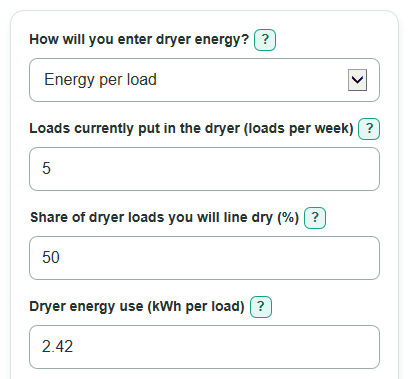
- Choose the dryer energy method that matches the number you have: energy per load, annual energy from the label, or dryer power and cycle time.
- Enter only the loads currently put in the dryer, then enter the share of those loads you expect to line dry.
- Enter your electricity price in cents per kWh from the usage-charge part of your electric bill; leave out fixed monthly charges.
- Open Advanced options if you line dry only part of the year or want to include a one-time clothesline and setup cost.
- Check that Dryer loads replaced per year fits your plan, then use Estimated dryer cost avoided per year as a yearly estimate rather than a guaranteed bill change.
Definitions
kWh (kilowatt-hour): A unit of electrical energy. Your utility charges for electricity based on kWh.
Energy per load: The electricity an electric dryer uses for one dryer cycle, shown as kWh/load.
Annual dryer energy from label: The dryer's listed yearly electricity use in kWh/year. The calculator divides it by 283 test cycles to estimate energy per load [2].
Usage-dependent electricity price: The cents per kWh charges that change when you use more or less electricity. Fixed account and meter charges are not included.
Simple payback time: The number of months for estimated avoided dryer cost to equal the one-time clothesline and setup cost.
Common mistakes and quick fixes
Mistake: Counting every washer load in Loads currently put in the dryer.
Fix: Count only loads that currently use the dryer before you start line drying.
Mistake: Entering 0.5 for Share of dryer loads you will line dry when you mean half.
Fix: Enter 50 for half of loads or 100 for all current dryer loads.
Mistake: Adding a fixed customer charge to Electricity price.
Fix: Use only charges that change when kWh use changes, such as energy and per-kWh delivery charges.
Mistake: Using a dryer nameplate rating as exact Dryer energy use.
Fix: Use Dryer energy use from a measurement or label when possible. If using Dryer power and Drying time per load, treat the result as a rough estimate.
Mistake: Leaving Weeks per year you will line dry at 52 for a seasonal plan.
Fix: Enter the realistic number of weeks you expect to use the clothesline.
Mistake: Expecting Clothesline and setup cost to reduce Estimated dryer cost avoided per year.
Fix: That one-time cost is used only for Estimated clothesline setup payback time, not yearly electricity savings.
Limitations & Key Assumptions / Boundary Conditions
- This calculator applies to electric dryers only. A gas dryer needs a separate fuel-cost calculation.
- Line drying is treated as having no ongoing energy charge. It does not include indoor humidity, cooling or heating effects, laundry time, maintenance, clothing wear, or replacement equipment.
- Only usage-dependent electricity charges are included. Fixed customer, meter, and account charges usually remain on the bill.
- Actual dryer energy can change with load size, fabric moisture, dryer settings, vent condition, and sensor behavior.
- The Dryer power and Drying time per load method uses rated watts for the full cycle. Because the heater can cycle on and off, it is a rough estimate.
- Estimated clothesline setup payback time is simple payback only. It does not include financing, repairs, or the useful life of the clothesline.
Methodology
Calculation method
The calculator first finds the electricity used by one dryer load. It uses only the energy method you select, so energy values from different methods are never added together.
energy per load = entered Dryer energy use
energy per load = Annual dryer energy from label / 283
energy per load = Dryer power * Drying time per load / 60 / 1000
The annual-label method uses 283 representative dryer cycles per year [2]. The default 2.42 kWh/load is a planning value from 684 kWh/year divided by 283 cycles [3].
Dryer loads replaced per year = Loads currently put in the dryer * (Share of dryer loads you will line dry / 100) * Weeks per year you will line dry
Dryer electricity avoided per year = Dryer loads replaced per year * energy per load
Estimated electricity cost per dryer load = energy per load * Electricity price / 100
Estimated dryer cost avoided per year = Dryer electricity avoided per year * Electricity price / 100
Average dryer cost avoided per month = Estimated dryer cost avoided per year / 12
Estimated clothesline setup payback time = Clothesline and setup cost / Estimated dryer cost avoided per year * 12
Worked example
For 5 dryer loads per week, a 50% line-dry share, 52 weeks, 2.42 kWh/load, and 17.30 cents/kWh, the plan replaces 130 loads and avoids 314.6 kWh per year. Estimated dryer cost avoided per year is $54.43, before any setup cost.
Calculation choices
Electricity price is converted from cents to dollars by dividing by 100. The default 17.30 cents/kWh is a replaceable 2025 US residential planning average [1]. A setup payback time appears only when Clothesline and setup cost is above $0 and yearly avoided cost is above $0. If the line-dry share is 0%, yearly avoided cost is $0 and a setup cost cannot pay back under that plan.