
Estimate annual heating fuel and bill savings from insulating your rim joist, then compare the savings with your project cost.
Advanced options
Table of contents
How to use our Rim Joist Insulation Savings Calculator
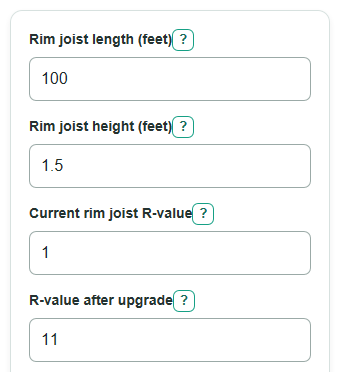
- Measure each exterior section you will insulate and enter the combined Rim joist length and Rim joist height.
- Enter the total existing Current rim joist R-value and the total R-value after upgrade.
- Enter local annual Heating degree days, base 65 F, choose Heating fuel, and enter its current Fuel price.
- Open Advanced options to enter Heating system efficiency and Installed project cost, then select Calculate.
- Sanity-check the Rim joist area used in estimate against the area you plan to cover; if it is too large or small, recheck the length and height.
Definitions
R-value: A measure of resistance to heat flow. A higher total R-value reduces conductive heat flow through the same area.
Heating degree days (HDD): A yearly measure of heating weather. More HDD means more time and temperature difference for heat to leave a home during the heating season.
Therm: A natural-gas billing unit equal to 100,000 Btu.
Btu: British thermal unit, a unit of heat energy.
Heating system efficiency: The percent of fuel energy that becomes useful heat indoors. The calculator uses it to convert useful heat saved into purchased fuel saved.
Simple payback: Installed project cost divided by estimated first-year heating bill savings.
Common mistakes and quick fixes
Mistake: Entering the whole basement wall perimeter as Rim joist length when only part of the rim joist will be insulated.
Fix: Add only the exterior sections included in the project and check Rim joist area used in estimate.
Mistake: Entering only the new insulation rating for R-value after upgrade.
Fix: Enter the total R-value after upgrade, including the existing assembly and new insulation.
Mistake: Using cooling degree days instead of Heating degree days, base 65 F.
Fix: Use an annual heating degree-day value with a 65 F base.
Mistake: Entering a per-gallon price after selecting natural gas under Heating fuel.
Fix: For natural gas, enter Fuel price in $ per therm; for propane and heating oil, enter $ per gallon.
Mistake: Treating Heating system efficiency as a decimal such as 0.80.
Fix: Enter a percent such as 80 for 80 percent efficiency.
Mistake: Leaving out labor or related materials from Installed project cost.
Fix: Include the full project amount you want to recover when reading Estimated simple payback.
Limitations & Key Assumptions / Boundary Conditions
- This is a steady-state conduction estimate for the entered rim-joist area and heating season only. It does not estimate cooling savings.
- The estimate does not include air-leakage savings, thermal bridges through framing, moisture effects, insulation gaps, or interactions with other parts of the home.
- Use total before-and-after R-values for the actual assembly. The model assumes the R-value is uniform across the entered area.
- Heating degree days, fuel price, and heating-system efficiency can vary from year to year, so actual fuel use and bills can differ.
- Simple payback uses the entered installed project cost and first-year estimated bill savings. It excludes financing, maintenance, rebates, taxes, and future fuel-price changes.
- For natural gas, fuel saved is shown in therms. For propane and heating oil, it is shown in gallons.
Methodology
Calculation method
The calculator first finds the area of the rim joist included in the project.
area_sqft = rim_length_ft * rim_height_ft
It estimates seasonal useful heat kept indoors from the area, annual heating degree days, 24 hours per day, and the change in total R-value.
heat_saved_btu = area_sqft * heating_degree_days * 24 * (1 / r_current - 1 / r_after)
It converts that useful heat into purchased fuel using the entered heating-system efficiency. Fuel heat content is 100,000 Btu per therm for natural gas, 91,452 Btu per gallon for propane, and 138,500 Btu per gallon for heating oil.
fuel_units_saved = heat_saved_btu / ((heating_efficiency_pct / 100) * fuel_heat_content_btu_per_unit)
Annual bill savings use the entered price for the selected fuel, and simple payback divides the entered project cost by those estimated first-year savings.
annual_bill_savings = fuel_units_saved * fuel_price
simple_payback_years = project_cost / annual_bill_savings
Mini example
With 100 feet of rim joist length, 1.5 feet of height, R-1 before, R-11 after, 6,000 HDD, 80 percent efficiency, natural gas, and $1 per therm, the area is 150 square feet. The estimate is about 19.64 million Btu of useful heat, 245.45 therms, and $245.45 saved per year. A $1,000 project has a simple payback of about 4.07 years.
Calculation choices
The after-upgrade R-value must be higher than the current R-value. A zero project cost produces a 0-year simple payback. If estimated annual bill savings are zero or less, simple payback is shown as N/A rather than dividing by zero.