
Compare air-source and ground-source heat pumps using your heating need, COPs, electricity price, rebates, and ownership years.
Advanced options
Table of contents
How to use our Air Source vs Ground Source Heat Pump Calculator
- Enter your Annual heating need in kWh of heat per year. This is delivered heat, not the electricity used by the heat pump.
- Enter the Air-source seasonal COP and Ground-source seasonal COP. Use seasonal estimates for your climate and system, not a single best-case rating.
- Enter your Electricity price and the GSHP price minus ASHP price before rebates. A positive price difference means the ground-source option costs more up front.
- Open Advanced options if you want to change Years you plan to compare, rebates or tax credits, or Extra yearly GSHP maintenance cost.
- Click Calculate, then sanity-check the results: higher COP should lower heating electricity use, and a longer comparison period should make yearly GSHP savings matter more.
Definitions
Annual heating need: The amount of heat your home needs in one year, measured as kWh of heat delivered indoors.
Air-source heat pump: A heat pump that moves heat between indoor air and outdoor air [1].
Ground-source heat pump: A heat pump, often called geothermal, that exchanges heat with the ground or groundwater [2].
Seasonal COP: Coefficient of performance averaged over the heating season. A COP of 3 means 1 kWh of electricity delivers about 3 kWh of heat.
Electricity price: The $ per kWh used to price the estimated heating electricity.
Net extra upfront cost for GSHP after rebates: The ground-source price premium after subtracting ground-source rebates and adding any air-source rebates.
Break-even years: The time it takes yearly net savings to pay back the net extra upfront cost.
Common mistakes and quick fixes
Mistake: Entering electric use in Annual heating need instead of heat delivered to the home.
Fix: Use Annual heating need as kWh of heat per year; the calculator divides that by each COP to estimate electricity use.
Mistake: Using a peak or brochure COP for Air-source seasonal COP or Ground-source seasonal COP.
Fix: Enter a seasonal COP estimate that reflects your climate, equipment, and normal operating conditions.
Mistake: Entering only the energy supply charge in Electricity price.
Fix: Use the all-in $ per kWh if delivery charges change with kWh used.
Mistake: Reversing GSHP price minus ASHP price before rebates.
Fix: Enter GSHP installed price minus ASHP installed price; use a positive number if GSHP costs more before rebates.
Mistake: Putting the same incentive in both Air-source rebates or tax credits and Ground-source rebates or tax credits.
Fix: Enter only the incentive amount that applies to each separate option.
Mistake: Treating Extra yearly GSHP maintenance cost as a total maintenance bill.
Fix: Enter only the yearly difference versus ASHP; use a negative number if GSHP is expected to cost less each year.
Limitations & Key Assumptions / Boundary Conditions
- This is a screening estimate. It does not size equipment, design ground loops, or replace contractor quotes.
- Annual heating need must be supplied by the user. If that number is wrong, all electricity and cost results move with it.
- The calculation uses one seasonal COP for each system. Real COP changes with outdoor temperature, ground temperature, airflow, water flow, defrost cycles, and controls.
- Costs include heating electricity, entered rebates, the entered upfront price difference, and the entered yearly maintenance difference only.
- Cooling, backup heat, demand charges, time-of-use rates, service life, financing, tax rules, repairs, and resale value are not modeled.
- Break-even is a simple payback in years. It does not discount future savings for inflation or investment returns.
- Rebates and tax credits depend on location, equipment, installation details, income rules, and current programs. Enter only amounts you expect to qualify for.
Methodology
Calculation steps
The calculator estimates the heating electricity for each heat pump from the same Annual heating need, then prices that electricity with the same Electricity price.
ashp_annual_electricity = annual_heating_need / ashp_season_cop
gshp_annual_electricity = annual_heating_need / gshp_season_cop
ashp_annual_operating_cost = ashp_annual_electricity * electricity_price
gshp_annual_operating_cost = gshp_annual_electricity * electricity_price
It then compares the two systems. Signed values are kept, so a negative net cost means the ground-source option is ahead by that amount.
annual_electricity_saved = ashp_annual_electricity - gshp_annual_electricity
annual_net_savings = (ashp_annual_operating_cost - gshp_annual_operating_cost) - gshp_extra_annual_maintenance
net_extra_upfront_after_rebates = price_difference_before_rebates - gshp_rebates + ashp_rebates
net_cost_after_horizon = net_extra_upfront_after_rebates - (annual_net_savings * ownership_years)
break_even_years = net_extra_upfront_after_rebates / annual_net_savings
Break-even handling
If the net extra upfront cost after rebates is zero or negative, the calculator shows break-even as 0 years because GSHP starts even or ahead. If the net extra upfront cost is positive and the yearly net savings are zero or negative, there is no numeric break-even because the entered savings do not pay back the extra upfront cost.
Mini-example
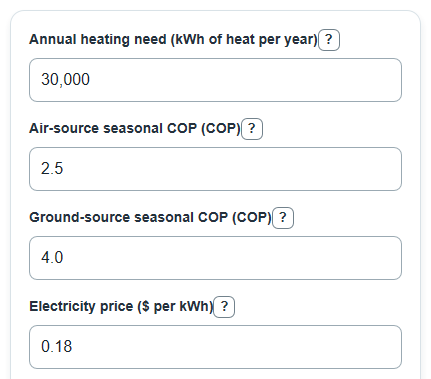
Suppose Annual heating need is 30,000 kWh of heat per year, Air-source seasonal COP is 2.5, Ground-source seasonal COP is 4.0, and Electricity price is $0.18 per kWh. ASHP uses 30,000 / 2.5 = 12,000 kWh per year, while GSHP uses 30,000 / 4.0 = 7,500 kWh per year. That saves 4,500 kWh per year, worth $810 per year before any maintenance difference. If GSHP costs $15,000 more before rebates and has a $4,000 ground-source rebate, the net extra upfront cost is $11,000. Over 15 years with no extra maintenance, net cost is $11,000 - ($810 * 15) = -$1,150, meaning GSHP is estimated to cost $1,150 less over that period.