
Estimate yearly heating fuel cost and compare fuels by the useful heat that reaches your home, not just the bill unit price.
Advanced options
Table of contents
How to use our Home Heating Fuel Cost Calculator
- Choose What do you want to calculate?, either Cost for one fuel or Compare two fuels.
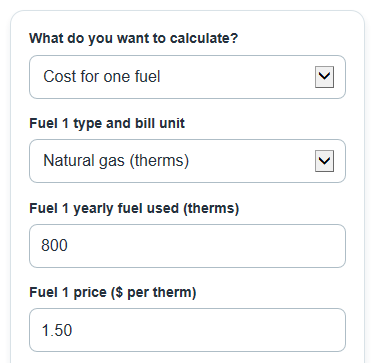
- For Fuel 1, choose Fuel 1 type and bill unit, then enter Fuel 1 yearly fuel used, Fuel 1 price, and Fuel 1 heat delivered to your home.
- If you choose Compare two fuels, enter the same kind of information for Fuel 2 so the two fuels are compared the same way.
- Open Advanced options only if you need to add Fuel 1 fixed fees, Fuel 2 fixed fees, or change Months to spread the cost over.
- Click Calculate, then sanity-check Fuel 1 delivered heat and Fuel 2 delivered heat; annual cost gaps are most fair when the two delivered heat amounts are close.
Definitions
MMBtu: One million British thermal units, a common way to compare heat from different fuels.
Delivered heat: The useful heat that reaches the home after the heating equipment loses some energy.
Cost per delivered MMBtu: The yearly fuel cost divided by delivered heat, shown as dollars for each useful MMBtu.
Therm: A natural gas billing unit equal to 0.1 MMBtu.
CCF: One hundred cubic feet of natural gas. This calculator uses 0.1037 MMBtu per CCF, but the exact heat content can vary by utility.
Heat delivered to your home: The efficiency percent you enter. For furnaces and boilers, this is often AFUE. For heat pumps, it can be above 100 percent.
Fixed fees: Yearly fuel charges that do not change with the amount used, such as tank rental or a delivery membership.
Common mistakes and quick fixes
Mistake: Entering a monthly amount in Fuel 1 yearly fuel used.
Fix: Use the total for the last 12 months, or add all deliveries for the year before entering Fuel 1 yearly fuel used.
Mistake: Mixing price units in Fuel 1 price, such as entering a monthly bill instead of $ per selected fuel unit.
Fix: Enter Fuel 1 price as dollars per therm, CCF, gallon, or kWh to match Fuel 1 type and bill unit.
Mistake: Using the wrong percent in Fuel 1 heat delivered to your home.
Fix: Enter the equipment efficiency percent, such as AFUE for a furnace or boiler; use 100 for electric resistance heat and a higher percent only when you mean heat pump performance.
Mistake: Adding delivery membership or tank rental into Fuel 1 fixed fees when it is already included in Fuel 1 price.
Fix: Put a fee in Fuel 1 fixed fees only if it is not already part of the unit price.
Mistake: Comparing Fuel 2 yearly heating fuel cost with Fuel 1 yearly heating fuel cost when Fuel 2 delivered heat is much higher or lower.
Fix: Use Fuel with lower delivered heat price for a fuel-price comparison, and use annual cost gaps only when the entered yearly heat amounts are similar.
Limitations & Key Assumptions / Boundary Conditions
- The calculator estimates fuel cost only. It does not include equipment purchase, repairs, rebates, financing, chimney work, duct changes, or comfort differences.
- Fuel heat content is treated as a fixed average. Real natural gas heat content can vary by utility, and delivered fuel quality can vary.
- Efficiency is user-entered and simplified as one yearly percent. Heat pump performance can change with outdoor temperature and equipment settings.
- Fuel 2 minus Fuel 1 yearly heating fuel cost is based on the yearly usage amounts you enter. If the two fuels do not deliver about the same heat, the yearly cost gap is not a like-for-like heat comparison.
- Months to spread the cost over only changes the monthly display. It does not change yearly cost or cost per delivered MMBtu.
- Fixed fees should be entered only when they are not already included in the unit price. Double-counting fees will overstate cost.
Methodology
How the fuel comparison is calculated
The calculator first converts the entered fuel use into source heat in MMBtu, then applies the entered efficiency percent to estimate useful delivered heat. This is the standard idea behind comparing fuels by heat content instead of by gallon, therm, CCF, or kWh price alone [1][2].
Heat content used: natural gas therm, 0.1 MMBtu per therm; natural gas CCF, 0.1037 MMBtu per CCF; No. 2 heating oil, 0.1385 MMBtu per gallon; propane, 0.091333 MMBtu per gallon; electricity, 0.003412141633 MMBtu per kWh. One MMBtu is 1,000,000 Btu.
source_mmbtu = usage * heat_content_mmbtu_per_unit
delivered_mmbtu = source_mmbtu * (efficiency_percent / 100)
annual_cost = usage * unit_price + fixed_fee
monthly_cost = annual_cost / season_months
cost_per_delivered_mmbtu = annual_cost / delivered_mmbtu
In compare mode, the calculator keeps signed gaps so lower Fuel 2 costs show as negative numbers.
delivered_heat_price_gap = fuel2_cost_per_delivered_mmbtu - fuel1_cost_per_delivered_mmbtu
annual_cost_gap = fuel2_annual_cost - fuel1_annual_cost
Worked mini-example
If Fuel 1 is 800 therms of natural gas at $1.50 per therm, 95 percent efficiency, and $120 in fixed fees, the source heat is 80 MMBtu and the delivered heat is 76 MMBtu. The yearly cost is $1,320, the cost per delivered MMBtu is $17.37, and spreading the cost over 6 months gives $220 per chosen month.
If Fuel 2 is 600 gallons of heating oil at $4.00 per gallon and 85 percent efficiency with no fixed fee, its delivered heat is 70.635 MMBtu and its cost per delivered MMBtu is $33.98. Fuel 2 minus Fuel 1 is $16.61 per delivered MMBtu and $1,080 per year, so Fuel 2 is higher on both measures in that example.
Input checks
Usage and efficiency must be greater than 0, efficiency cannot be above 500 percent, prices and fixed fees cannot be negative, and months must be a whole number from 1 to 12. Conventional comma grouping such as 12,000 is accepted, but malformed commas such as 1,20 are rejected so the number is not misread.
Sources
- How do I compare the cost of heating fuels? - Frequently Asked Questions (FAQs) - U.S. Energy Information Administration (EIA) - EIA
- Comparing Fuel Costs | Integrated Pest Management | College of Agriculture, Health and Natural Resources | University of Connecticut - Uconn
- Home-heating energy sources and their costs: How to decide what's best | Newsroom | Oregon State University - Oregonstate
- Table Definitions, Sources, and Explanatory Notes - EIA