
Estimate monthly and yearly lighting cost from light count, watts, weekly hours, electricity price, and optional peak/off-peak rates.
Advanced options
Table of contents
How to use our Lighting Energy Cost Calculator
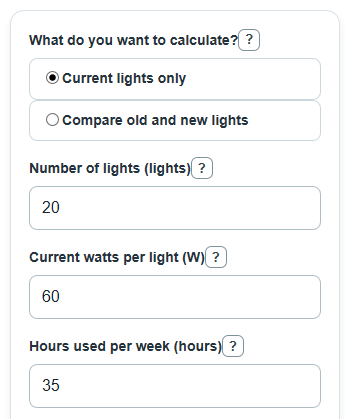
- Choose What do you want to calculate? Use Current lights only for one lighting setup, or Compare old and new lights to see savings and payback.
- Enter Number of lights, Current watts per light, Hours used per week, and Electricity price. Use the rated watts for one light and the energy price from your bill.
- If you choose Compare old and new lights, enter New watts per light and Total new-light project cost so the calculator can estimate Annual savings after switching lights and Simple payback time.
- Open Advanced options only if you use peak/off-peak prices or want to include Added system loss. Peak-price hours per week must be less than or equal to Hours used per week.
- Sanity-check the answer: Annual energy used by current lights should go up when watts, light count, or hours go up, and Average monthly cost for current lights should be about Annual cost for current lights divided by 12.
Definitions
Current watts per light: The power draw of one current bulb, lamp, or fixture, measured in watts (W).
Kilowatt-hour (kWh): A unit of energy. A 1 kilowatt load running for 1 hour uses 1 kWh.
Electricity price: The energy charge in dollars per kWh. This calculator uses it to turn energy use into cost.
Peak-price hours per week: The part of your weekly lighting time charged at the higher peak price on a time-of-use plan.
Off-peak electricity price: The price used for the remaining weekly lighting hours after peak-price hours are removed.
Added system loss: Extra energy use added as a percent for ballast, driver, or standby losses.
Simple payback time: Total new-light project cost divided by annual savings. It estimates how many years it takes energy savings to equal the project cost.
Common mistakes and quick fixes
Mistake: Entering total room wattage in Current watts per light instead of watts for one light.
Fix: Use the rated wattage for one light in Current watts per light, then put the fixture count in Number of lights.
Mistake: Putting daily hours into Hours used per week.
Fix: Multiply daily hours by the number of days used each week, then enter that total in Hours used per week.
Mistake: Using cents in Electricity price, such as 16 for 16 cents per kWh.
Fix: Enter dollars per kWh, so 16 cents becomes 0.16 in Electricity price.
Mistake: Making Peak-price hours per week larger than Hours used per week.
Fix: Count only the weekly hours charged at Peak electricity price, and keep Peak-price hours per week at or below Hours used per week.
Mistake: Expecting Simple payback time when Annual savings after switching lights is zero or negative.
Fix: Check New watts per light and Total new-light project cost; payback is only reached when yearly savings are positive.
Mistake: Typing malformed commas in Total new-light project cost or Electricity price, such as 1,01.
Fix: Use commas only as thousands separators, such as 1,000, and use a decimal point for cents.
Limitations & Key Assumptions / Boundary Conditions
- The estimate uses one normal weekly schedule multiplied by 52 weeks. It does not model seasonal changes, vacations, or lights used on different schedules.
- Peak/off-peak mode uses two energy prices only. It does not include demand charges, taxes, fixed service fees, tiered rates, minimum bills, or utility credits.
- Added system loss applies one percent to the lighting power. If current and new lights have different driver or ballast losses, run separate scenarios.
- Compare mode uses the same Number of lights and Hours used per week for current and new lights.
- Simple payback time ignores rebates, maintenance changes, financing, taxes, disposal costs, and future electricity price changes.
- The calculator requires valid nonnegative numbers. Peak-price hours per week cannot be greater than Hours used per week.
Methodology
Calculation method
The calculator first turns weekly use into yearly use. It uses 52 weeks per year, 1000 watts per kilowatt, 12 months per year, and 100 as the percent divisor.
annual_hours = hours_per_week * 52
It then finds adjusted lighting power. Added system loss increases the power by the entered percent.
power_kw = light_count * watts_per_light * (1 + loss_percent / 100) / 1000
Annual energy is power times yearly hours.
annual_energy_kwh = power_kw * annual_hours
If Peak-price hours per week is blank or 0, the calculator uses the flat Electricity price.
annual_cost = annual_energy_kwh * flat_rate
If Peak-price hours per week is above 0, the calculator prices peak hours at Peak electricity price and the remaining weekly hours at Off-peak electricity price.
annual_cost = power_kw * 52 * (peak_hours_per_week * peak_rate + (hours_per_week - peak_hours_per_week) * offpeak_rate)
Average electricity price used is the yearly cost divided by yearly energy. If yearly energy is 0 kWh, the calculator shows N/A instead of dividing by 0.
average_rate = annual_cost / annual_energy_kwh
For compare mode, the same steps are run for Current watts per light and New watts per light. Annual savings stays signed, so a negative value means the new lights cost more to run.
annual_savings = annual_cost_current - annual_cost_replacement
Simple payback time is shown only when annual savings are positive.
simple_payback_years = project_cost / annual_savings
Average monthly cost and average monthly energy are the annual values divided by 12.
Mini example
Suppose you have 20 current lights, each using 60 W, and they run 35 hours per week at $0.16 per kWh with 0 percent added loss. Adjusted power is 20 * 60 / 1000 = 1.2 kW. Annual hours are 35 * 52 = 1820 hours. Annual energy is 1.2 * 1820 = 2184 kWh. Annual cost is 2184 * $0.16 = $349.44, and the average monthly cost is $349.44 / 12 = $29.12.