
Estimate EV battery health from dashboard range, charge-session data, or both methods side by side.
Table of contents
How to use our Battery Degradation Calculator
- Choose Data to use based on the numbers you have: Range shown by the car, Charge session, or Compare both.
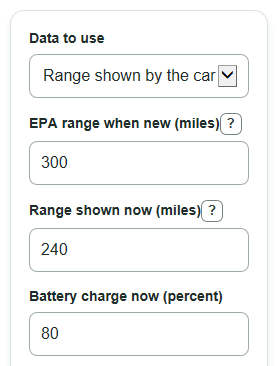
- For the range method, enter EPA range when new, Range shown now, and Battery charge now from the same dashboard moment.
- For the charge method, enter Battery size when new, Energy added in session, Start charge, and End charge from one charging session.
- Click Calculate and read Best estimate of battery health first, then check Best estimate of battery degradation and the matching range or capacity details.
- If you use Compare both, sanity-check the Gap between the two battery health estimates. A large gap means you should recheck driving conditions, percent values, or whether charger energy includes losses.
Definitions
Battery health: The estimated usable battery left compared with the new baseline, shown as a percent. This is often called state of health, or SoH.
Battery degradation: The estimated loss compared with the new baseline. It is calculated as 100 percent minus battery health.
EPA range when new: The rated driving range the vehicle had when new, used as the baseline for the dashboard-range method.
Range shown now: The miles shown by the car at the current battery charge. It is not always the same as lab-measured range.
Battery charge now: The battery percent shown by the car at the same time as Range shown now.
Battery size when new: The new usable battery capacity in kilowatt-hours, or kWh. A kWh is a unit of energy used for EV batteries [1].
Energy added in session: The energy added during one charge session, in kWh. Battery-side energy is better than wall energy for this calculator.
Gap between the two battery health estimates: The difference, in percentage points, between the dashboard-range estimate and the charge-session estimate.
Common mistakes and quick fixes
Mistake: Using a trip estimate or old photo for Range shown now while Battery charge now comes from a different time.
Fix: Enter Range shown now and Battery charge now from the same dashboard screen or the same moment.
Mistake: Entering a zero or blank Battery charge now because the car is nearly empty.
Fix: Enter the actual Battery charge now as a percent greater than 0 and at most 100.
Mistake: Using wall power for Energy added in session when the charger number includes charging losses.
Fix: Use energy added to the battery if available, or expect Charge-session estimates to read higher than real battery size.
Mistake: Swapping Start charge and End charge or entering the same percent twice.
Fix: Start charge must be lower than End charge for the charge-session method to work.
Mistake: Mixing gross pack size with usable capacity for Battery size when new.
Fix: Use the usable Battery size when new when you can, so Current usable battery size today compares to the same kind of number.
Mistake: Treating Best estimate of battery degradation as exact when Do the two estimates agree? says the methods do not match.
Fix: Recheck the inputs and repeat the measurement under normal temperature and driving conditions before trusting the number.
Limitations & Key Assumptions / Boundary Conditions
- This is an estimate from user-entered numbers, not a lab battery test or a vehicle diagnostic scan.
- The dashboard-range method can be skewed by recent speed, temperature, wind, tires, roof racks, road grade, and climate control use.
- The charge-session method can be skewed if Energy added in session is measured at the wall instead of at the battery, because charging has losses.
- EPA range when new and Battery size when new must match the same vehicle and trim. Using the wrong baseline changes every percent result.
- Battery size when new should be usable capacity when possible. Gross pack size can make degradation look larger or smaller than it is.
- Results above 100 percent battery health, negative degradation, negative miles lost, or negative capacity loss are not blocked. They usually mean conditions were unusually favorable or an input baseline does not match the measurement.
- The 5 percentage-point close-match rule is only a practical input-quality check. It is not a manufacturer warranty rule or an industry pass-fail standard.
Methodology
Range shown by the car method
The range method first scales the current dashboard range to a full-battery estimate, then compares that estimate with EPA range when new.
current_full_range_miles = displayed_range_miles / (battery_percent / 100)
range_soh_percent = (current_full_range_miles / epa_range_miles) * 100
miles_lost = epa_range_miles - current_full_range_miles
Charge-session method
The charge method uses the energy added and the battery percent gained to estimate today's usable battery size. EV battery capacity is commonly tracked as energy in kWh [1].
current_capacity_kwh = energy_added_kwh / ((end_charge_percent - start_charge_percent) / 100)
charge_soh_percent = (current_capacity_kwh / original_capacity_kwh) * 100
capacity_loss_kwh = original_capacity_kwh - current_capacity_kwh
Best estimate and agreement check
In range mode, Best estimate of battery health equals Battery health from dashboard range. In charge mode, it equals Battery health from charge session. In Compare both mode, it is the average of the two estimates.
best_estimate_soh_percent = (range_soh_percent + charge_soh_percent) / 2
best_estimate_degradation_percent = 100 - best_estimate_soh_percent
soh_gap_percent = abs(range_soh_percent - charge_soh_percent)
The agreement status says the two estimates agree when the gap is 5 percentage points or less. A larger gap is reported as a mismatch to check.
Mini-example
If EPA range when new is 300 miles, Range shown now is 216 miles, and Battery charge now is 80 percent, the estimated full-battery range today is 216 / 0.80 = 270 miles. The range-based battery health is 270 / 300 * 100 = 90 percent, and the estimated full-range miles lost is 30 miles.
If Battery size when new is 75 kWh, Energy added in session is 26.25 kWh, Start charge is 20 percent, and End charge is 60 percent, the percent gained is 40 percent. The estimated usable battery size today is 26.25 / 0.40 = 65.625 kWh. The charge-session battery health is 65.625 / 75 * 100 = 87.5 percent.
In Compare both mode, the best estimate is (90 + 87.5) / 2 = 88.75 percent battery health. The degradation estimate is 100 - 88.75 = 11.25 percent, and the agreement gap is 2.5 percentage points.
Sources
- Alternative Fuels Data Center: Batteries for Electric Vehicles - Energy
- [2408.01127] Relax, Estimate, and Track: a Simple Battery State-of-charge and State-of-health Estimation Method - Arxiv
- [2502.19586] Battery State of Health Estimation and Incremental Capacity Analysis under Dynamic Charging Profile Using Neural Networks - Arxiv