
Enter your load, runtime, battery size, and cost assumptions to compare LiFePO4 and lead acid battery banks side by side.
Table of contents
How to use our LiFePO4 vs Lead Acid Battery Calculator
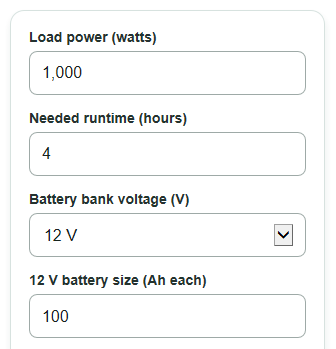
- Enter Load power, Needed runtime, Battery bank voltage, and 12 V battery size for the battery bank you want to size.
- Open Advanced options if you want to change usable charge, system efficiency, battery prices, cycle life, cycles per year, ownership years, charger upgrade cost, or battery weights.
- Click Calculate to see the battery counts, usable energy, estimated runtime, weight difference, upfront costs, and total ownership costs.
- Use LiFePO4 cost advantage over ownership period first: a positive dollar amount means LiFePO4 is cheaper over the entered years, while a negative amount means lead acid is cheaper.
- Sanity-check the output by confirming that LiFePO4 usable energy from sized bank and Lead acid usable energy from sized bank are both at least as high as Usable energy needed by the load.
Definitions
LiFePO4: Lithium iron phosphate, a lithium battery chemistry often used for deep-cycle battery banks.
Lead acid: A battery family that includes flooded, AGM, and gel batteries. Product behavior can vary by design, age, temperature, and charge method.
Usable charge: The percent of the battery rating you plan to use before recharging. A 100 Ah battery at 50 percent usable charge gives 50 Ah before losses.
System efficiency: The percent of battery energy that reaches the load after inverter, wiring, and other losses.
Usable energy: The watt-hours the load can actually use after usable charge and efficiency are applied.
Cycle life: The number of charge and discharge cycles you enter for a battery before counting a replacement set.
Series string: A group of 12 V batteries wired end to end to reach Battery bank voltage, such as two 12 V batteries for a 24 V string.
Total ownership cost: Battery replacement set costs over the entered years, plus LiFePO4 charger upgrade cost for the LiFePO4 side.
Common mistakes and quick fixes
Mistake: Entering surge watts instead of steady watts in Load power.
Fix: Use the normal running wattage for Load power, or run a separate check for startup surge with your inverter specs.
Mistake: Treating Needed runtime as days instead of hours.
Fix: Convert days to hours before entering Needed runtime, such as 2 days = 48 hours.
Mistake: Choosing Battery bank voltage that does not match the system you will build.
Fix: Pick the actual bank voltage, because 24 V, 36 V, and 48 V results must round up to full 12 V battery strings. Check that the selected batteries permit the required series connection.
Mistake: Using the same high LiFePO4 usable charge for Lead acid usable charge.
Fix: Enter the usable share you really plan to use for Lead acid usable charge, because a lower percent often means more lead acid batteries are needed.
Mistake: Leaving LiFePO4 charger upgrade cost at $0 when your charger must be replaced.
Fix: Add the one-time charger, converter, or controller cost to LiFePO4 charger upgrade cost so LiFePO4 total ownership cost is not understated.
Mistake: Comparing only Lead acid first purchase cost with LiFePO4 first purchase cost after charger upgrade.
Fix: Also compare Lead acid total ownership cost and LiFePO4 total ownership cost, because replacements can change the lower-cost choice.
Limitations & Key Assumptions / Boundary Conditions
- The calculator assumes the bank is built from 12 V batteries with the same 12 V battery size for both battery types.
- Battery counts are rounded up to whole series strings, so the sized bank often has more usable energy than the exact target.
- Results use steady Load power. They do not check inverter surge limits, motor startup loads, or short high-power bursts.
- Costs do not include tax, shipping, installation labor, maintenance, financing, recycling fees, or resale value.
- Cycle life is treated as a simple entered number. Real battery life can change with temperature, depth of discharge, charge settings, storage, and discharge rate.
- The calculator does not check charger compatibility, low-temperature LiFePO4 charging protection, battery management system limits, cable size, fuse size, or code requirements.
- Battery voltage is treated as nominal voltage for sizing. Actual voltage changes during discharge and charging.
Methodology
Energy target
The calculator starts with the load-side energy target. Watt-hours are power times time.
usable_energy_needed_wh = load_watts * runtime_hours
Battery bank sizing
Because the calculator uses 12 V batteries, the number of batteries in one series string is based on the selected bank voltage.
series_count = system_voltage / 12
For each battery type, the needed nominal battery energy is increased when usable charge or system efficiency is lower.
required_nominal_wh = usable_energy_needed_wh / ((usable_percent / 100) * (efficiency_percent / 100))
One full series string has nominal energy equal to bank voltage times the amp-hour rating of one 12 V battery. The calculator rounds up to whole strings, then multiplies by the number of 12 V batteries in each string.
strings_needed = ceil(required_nominal_wh / (system_voltage * battery_size_ah))
batteries_needed = strings_needed * series_count
After rounding, usable energy from the sized bank is calculated for each chemistry.
bank_usable_wh = strings_needed * system_voltage * battery_size_ah * (usable_percent / 100) * (efficiency_percent / 100)
runtime_from_bank_hours = bank_usable_wh / load_watts
Cost and replacement math
The first bank cost is the number of 12 V batteries times the entered price per battery. The charger upgrade cost is added only to the LiFePO4 side.
lifepo4_bank_cost = lifepo4_batteries_needed * lifepo4_price_each
lead_bank_cost = lead_batteries_needed * lead_price_each
lifepo4_upfront_cost_after_charger = lifepo4_bank_cost + charger_upgrade_cost
lead_upfront_cost = lead_bank_cost
Replacement sets are based on total cycles over the ownership period. At least one set is always counted because the bank has to be bought before it can be used.
total_cycles = cycles_per_year * ownership_years
sets_needed = max(1, ceil(total_cycles / cycle_life))
lifepo4_total_ownership_cost = lifepo4_sets * lifepo4_bank_cost + charger_upgrade_cost
lead_total_ownership_cost = lead_sets * lead_bank_cost
The main comparison keeps its sign. Positive means LiFePO4 is cheaper over the entered ownership period. Negative means LiFePO4 is more expensive over that period.
lifepo4_cost_advantage = lead_total_ownership_cost - lifepo4_total_ownership_cost
The weight comparison also keeps its sign.
weight_saved_lb = lead_batteries_needed * lead_weight_each_lb - lifepo4_batteries_needed * lifepo4_weight_each_lb
Mini-example
For a 1000 W load that must run 4 hours, the load needs 4000 Wh. With a 12 V, 100 Ah battery size, 80 percent LiFePO4 usable charge, and 95 percent LiFePO4 efficiency, the LiFePO4 side needs 5 batteries and has 4560 Wh usable energy. With 50 percent lead acid usable charge and 85 percent lead acid efficiency, the lead acid side needs 8 batteries and has 4080 Wh usable energy. If LiFePO4 batteries cost $700 each, lead acid batteries cost $200 each, and the comparison is 100 cycles per year for 5 years, the LiFePO4 total ownership cost is $3500 and the lead acid total ownership cost is $1600, so the LiFePO4 cost advantage is -$1900.