
Estimate battery backup days or the battery size you need from daily energy use, battery use percent, efficiency, capacity, and load.
Table of contents
How to use our Battery Autonomy Days Calculator
- Choose What do you want to calculate? based on your data: home backup uses kWh per day, and device runtime uses mAh and mA.
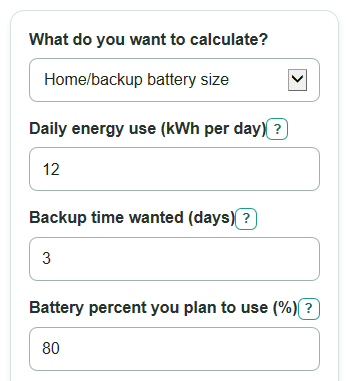
- For home backup, enter Daily energy use, Backup time wanted, Battery percent you plan to use, and System efficiency.
- For device runtime, enter Battery capacity and Average load, then use Usable battery rating if you want to allow for real-world losses.
- Open Advanced options if you want to change Extra reserve to add or Number display before you calculate.
- Sanity-check the answer: if Recommended installed battery size with reserve looks huge, recheck that Daily energy use is only for the loads you plan to run.
Definitions
Daily energy use: The energy your selected loads use in one day, measured in kWh per day.
kWh: Kilowatt-hour, a unit of energy used for home batteries and electric bills.
Backup time wanted: The number of days you want the battery to run the loads without recharging.
Battery percent you plan to use: The share of rated battery capacity you allow the system to use. It is often called depth of discharge.
System efficiency: The percent of stored energy that reaches the loads after inverter, wiring, and conversion losses.
Extra reserve to add: Extra installed battery capacity added after the minimum size is calculated.
mAh: Milliamp-hour, a small-battery capacity unit used by power banks and device batteries.
mA: Milliamp, a unit of electric current used for a device load.
Usable battery rating: The percent of rated mAh that is expected to be usable after battery and converter losses.
Common mistakes and quick fixes
Mistake: Entering whole-house usage in Daily energy use when only a few loads need backup.
Fix: Put only the backed-up loads in Daily energy use unless you want whole-home backup.
Mistake: Typing 0 or leaving Backup time wanted blank.
Fix: Enter the number of days the battery must cover without recharging.
Mistake: Setting Battery percent you plan to use above 100 or treating it like energy used per day.
Fix: Enter the percent of the battery capacity you plan to use, such as 80.
Mistake: Using 100 for System efficiency when the battery output passes through an inverter or long wiring.
Fix: Use a lower System efficiency if energy is lost in conversion or wiring.
Mistake: Mixing Battery capacity in mAh with Average load in watts.
Fix: In device mode, enter Battery capacity in mAh and Average load in mA for the same voltage system.
Mistake: Reading Minimum installed battery size before reserve as the final buying target.
Fix: Use Recommended installed battery size with reserve when you want room for aging, weather, or small load changes.
Limitations & Key Assumptions / Boundary Conditions
- Home mode sizes battery storage only. It does not size solar panels, generators, inverters, charge controllers, or battery wiring.
- Daily energy use is treated as constant for every backup day. Real loads can change with weather, habits, and appliance cycles.
- System efficiency is a single percent. The calculator does not model separate inverter, charger, wiring, or temperature losses.
- Battery percent you plan to use must be greater than 0 and no more than 100. The calculator does not choose a safe depth of discharge for a specific battery chemistry.
- Device runtime assumes Battery capacity and Average load are for the same voltage system. It does not convert between volts, watts, Wh, and mAh.
- Device runtime uses average current. It does not model startup surges, sleep modes, cutoff voltage, cold temperature, battery age curves, or Peukert effect.
- Number display can change how many decimals you see, but it should not be treated as product-level precision.
Methodology
Home backup size
The home mode first finds the energy the selected loads need over the full backup time.
usable_energy_needed_kwh = daily_energy_kwh * target_days
It then divides by the usable battery percent and system efficiency, because the installed battery must be larger than the energy the loads actually receive.
minimum_installed_capacity_kwh = usable_energy_needed_kwh / ((max_discharge_percent / 100) * (system_efficiency_percent / 100))
The practical target adds the reserve percent after the minimum size is found.
recommended_installed_capacity_kwh = minimum_installed_capacity_kwh * (1 + reserve_buffer_percent / 100)
Device runtime
The device mode reduces the rated mAh by the usable battery rating, then divides by the average load current.
device_usable_capacity_mah = battery_capacity_mah * (device_efficiency_percent / 100)
device_runtime_hours = device_usable_capacity_mah / average_load_ma
device_autonomy_days = device_runtime_hours / 24
Worked example
For home backup, 12 kWh per day for 3 days needs 36 kWh of usable energy. With Battery percent you plan to use at 80% and System efficiency at 90%, the minimum installed size is 36 / (0.80 * 0.90) = 50 kWh. With Extra reserve to add at 20%, the Recommended installed battery size with reserve is 60 kWh.
For a device, a 10,000 mAh Battery capacity with an 85% Usable battery rating gives 8,500 mAh usable. At a 250 mA Average load, runtime is 8,500 / 250 = 34 hours, or about 1.42 days.
Sources
- [1901.11389] Battery selection for optimal grid-outage resilient photovoltaic and battery systems - Arxiv
- [2603.02687] Optimum Battery Depth of Discharge of Stand-alone Hybrid System Using the MOPSO Method - Arxiv
- [1607.07362] Quasi-dynamic Load and Battery Sizing and Scheduling for Stand-Alone Solar System Using Mixed-integer Linear Programming - Arxiv