
Compare heat pump and electric resistance heating costs, annual savings, yearly kWh use, and simple payback after rebates.
Advanced options
Table of contents
How to use our Heat Pump vs Electric Resistance Heating Calculator
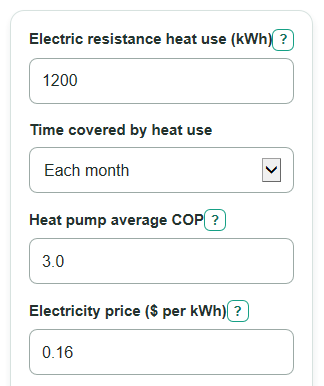
- Enter Electric resistance heat use in kWh, then choose whether that number covers Each month or One full year.
- Enter the Heat pump average COP and your Electricity price in $ per kWh from your electric bill.
- Open Advanced options only if you want payback. Enter Heat pump installed cost and Rebates or tax credits.
- Click Calculate, then compare Annual operating savings, Average monthly operating savings, and Simple payback time.
- Sanity-check the result: if COP is 3, Heat pump electricity use should be about one-third of the resistance heating kWh for the same time period.
Definitions
Electric resistance heat use: The kWh used by baseboards, electric furnaces, space heaters, or other resistance heating for the time period you choose.
kWh: Kilowatt-hour. It is the energy unit shown on electric bills.
COP: Coefficient of performance. It tells how many kWh of heat the heat pump moves for each 1 kWh of electricity it uses. A COP of 3 means 3 kWh of heat moved per 1 kWh of electricity.
Electricity price: The cost per kWh used in the calculator. For bill savings, the best input is the per-kWh price that changes when your usage changes.
Annual operating savings: Annual electric resistance cost minus annual heat pump electricity cost. Positive means the heat pump costs less to run.
Net up-front cost after rebates: Heat pump installed cost minus rebates or tax credits. It can be negative if rebates are larger than the installed cost entered.
Simple payback time: Net up-front cost divided by annual operating savings. It is shown only when both numbers are above zero.
Common mistakes and quick fixes
Mistake: Entering total winter bill kWh as Electric resistance heat use without removing normal lights, appliances, and water heating.
Fix: Use heating-only kWh if you have it, or subtract a normal non-heating month before entering the kWh.
Mistake: Choosing the wrong Time covered by heat use , such as entering one month of kWh but selecting one full year.
Fix: Pick Each month for a typical heating month, or One full year only for yearly heating kWh.
Mistake: Using a rated best-case number for Heat pump average COP when your winter weather is much colder.
Fix: Enter a seasonal average COP that fits your climate and system, not just the highest catalog value.
Mistake: Entering only the energy-supply charge for Electricity price and leaving out per-kWh delivery charges.
Fix: Use the all-in $ per kWh that changes when you use more or less electricity.
Mistake: Putting the after-rebate price into Heat pump installed cost and also entering Rebates or tax credits .
Fix: Enter the installed cost before rebates, then enter rebates separately so Net up-front cost after rebates is not double-counted.
Mistake: Treating Simple payback time as a full financial forecast.
Fix: Use it as a quick screen only; it does not include repairs, financing, equipment life, or future electricity price changes.
Limitations & Key Assumptions / Boundary Conditions
- The calculator assumes the heat pump provides the same yearly heat as the electric resistance system.
- Electric resistance heat is treated as a 1.0 COP baseline: 1 kWh of electricity becomes about 1 kWh of heat inside the home.
- The heat pump COP is a user-entered average. Real COP changes with outdoor temperature, system type, duct losses, defrost cycles, thermostat settings, and backup heat use.
- The electricity price is held constant for both systems. Tiered rates, time-of-use rates, demand charges, and fixed bill fees can change actual savings.
- Simple payback ignores maintenance, repairs, financing, tax details, equipment life, comfort changes, and resale value.
- If rebates are larger than installed cost, the calculator keeps the negative Net up-front cost after rebates and does not show a numeric payback.
- If Annual operating savings is zero or negative, there is no positive operating-cost payback in this simple model.
Methodology
How the comparison is calculated
The calculator starts with your electric resistance heating kWh. If the input is monthly, it multiplies by 12. If the input is yearly, it uses the number as entered.
annual_resistance_kwh = resistance_kwh * period_factor
period_factor is 12 for a monthly entry and 1 for a yearly entry.
The heat pump is assumed to deliver the same heat. Since COP means heat moved per 1 kWh of electricity, the heat pump electricity use is the resistance heating kWh divided by COP.
annual_heat_pump_kwh = annual_resistance_kwh / heat_pump_cop
Annual costs use the same electricity price for both systems.
annual_resistance_cost = annual_resistance_kwh * electricity_rate
annual_heat_pump_cost = annual_heat_pump_kwh * electricity_rate
Operating savings are the baseline cost minus the heat pump cost. The calculator keeps negative savings because a negative number means the heat pump costs more to run with the inputs entered.
annual_operating_savings = annual_resistance_cost - annual_heat_pump_cost
monthly_operating_savings = annual_operating_savings / 12
The heating electricity use cut shows the percent reduction in heating kWh compared with resistance heat.
electricity_use_cut_percent = (1 - annual_heat_pump_kwh / annual_resistance_kwh) * 100
Payback calculation
The up-front cost is the installed cost after subtracting rebates or tax credits. It is not clamped to zero.
net_upfront_cost = install_cost - rebates
Simple payback is calculated only when net up-front cost is above $0 and annual operating savings is above $0.
simple_payback_years = net_upfront_cost / annual_operating_savings
Mini-example
Suppose electric resistance heat uses 1,200 kWh each month, COP is 3.0, electricity is $0.16 per kWh, installed cost is $8,000, and rebates are $2,000. Yearly resistance use is 14,400 kWh. Heat pump use is 4,800 kWh. Resistance cost is $2,304 per year, heat pump cost is $768 per year, and annual operating savings are $1,536. Net up-front cost is $6,000, so simple payback is about 3.91 years.
Sources
- Purchasing Energy-Efficient Residential Air-Source Heat Pumps | Department of Energy - Energy
- Heat Pump Water Heaters Achieve Significant Peak Reduction and Energy Savings | Department of Energy - Energy
- [2402.07032] Field demonstration of predictive heating control for an all-electric house in a cold climate - Arxiv
- Electricity use in homes - U.S. Energy Information Administration (EIA) - EIA