
Compare heat pump and propane heating costs using last year's propane gallons, your fuel prices, furnace AFUE, and average heat pump COP.
Table of contents
How to use our Heat Pump vs Propane Calculator
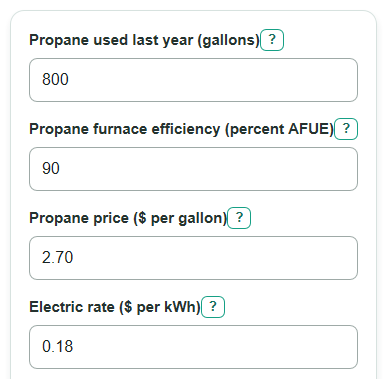
- Enter Propane used last year for space heating only, in gallons. If the same tank also runs water heating, cooking, a dryer, or a pool heater, subtract those uses first if you can.
- Enter Propane furnace efficiency, Propane price, and Electric rate. Use your delivered propane price and your all-in electric rate from the bill when possible.
- Enter Heat pump average efficiency as COP. A higher COP means the heat pump uses less electricity to deliver the same home heat.
- Click Calculate and read Estimated yearly savings with heat pump first. A positive number means the heat pump is cheaper for the values entered; a negative number means propane is cheaper.
- Sanity-check Home heat estimated from propane use and Estimated heat pump electricity use. If either looks far too high, recheck whether the propane gallons included non-heating uses or whether a price was typed in the wrong unit.
Definitions
AFUE: Annual Fuel Utilization Efficiency. It is the percent of fuel heat a furnace turns into useful home heat over a heating season.
COP: Coefficient of performance. It is useful heat delivered divided by electricity used. A COP of 3 means 3 units of heat are delivered for each 1 unit of electric energy used.
Btu: British thermal unit, a small unit of heat energy.
MMBtu: One million Btu. The calculator uses MMBtu/year so yearly home heat is easier to read.
Delivered heat: The heat that actually reaches the home after furnace efficiency is applied to the propane fuel heat.
Break-even COP: The heat pump COP needed for heat pump energy cost per delivered MMBtu to equal propane energy cost per delivered MMBtu.
Common mistakes and quick fixes
Mistake: Entering total tank deliveries in Propane used last year when propane also heats water or runs appliances.
Fix: Use space-heating gallons only if you can, because Home heat estimated from propane use is based on those gallons.
Mistake: Typing 0.90 in Propane furnace efficiency for a 90 percent AFUE furnace.
Fix: Enter 90, not 0.90, because the field is in percent AFUE.
Mistake: Using a monthly bill total in Electric rate instead of dollars per kWh.
Fix: Divide the full electric bill by total kWh, then enter that $ per kWh value.
Mistake: Putting a full propane bill total in Propane price instead of $ per gallon.
Fix: Divide the delivered propane charge by delivered gallons, then enter the price per gallon.
Mistake: Treating Heat pump average efficiency as a fixed number for every outdoor temperature.
Fix: Use a seasonal average COP that matches your climate and heat pump type when you have it.
Mistake: Reading a negative Estimated yearly savings with heat pump as an error.
Fix: A negative value is valid; it means the propane furnace is estimated to cost less for the entered prices and COP.
Limitations & Key Assumptions / Boundary Conditions
- The calculator assumes Propane used last year is for space heating. Water heating, cooking, clothes drying, pool heat, and fireplaces can make the estimated heating load too high.
- It compares heating energy cost only. It does not include equipment price, installation, service upgrades, maintenance, rebates, financing, or backup heat controls.
- Heat pump average efficiency is entered as one seasonal COP. Real heat pump COP changes with outdoor temperature, indoor setpoint, defrost cycles, duct losses, and equipment sizing.
- The propane furnace is treated as having one steady Propane furnace efficiency. Actual performance can differ because of cycling, duct losses, maintenance, and venting condition.
- The calculator does not size a heat pump, estimate peak winter capacity, choose a dual-fuel switch temperature, or model hourly weather.
- Prices are treated as constant for the year. Tiered electric rates, demand charges, seasonal propane pricing, delivery fees, and taxes can change the real bill.
Methodology
How the comparison is calculated
The calculator first turns last year's propane use into an estimated yearly home heat need. AFUE is applied because not all fuel heat becomes useful heat indoors [1]. Then the same heat need is priced two ways: once as propane furnace heat and once as heat pump heat.
delivered_heat_btu = annual_propane_gallons * 91452 * (furnace_afue_percent / 100)
implied_annual_heat_mmbtu = delivered_heat_btu / 1000000
propane_annual_cost = annual_propane_gallons * propane_price_per_gallon
heat_pump_electricity_kwh = delivered_heat_btu / (heat_pump_cop * 3412.141633)
heat_pump_annual_cost = heat_pump_electricity_kwh * electric_rate
annual_savings = propane_annual_cost - heat_pump_annual_cost
The savings value is signed. If it is positive, the heat pump is estimated to cost less per year. If it is negative, the propane furnace is estimated to cost less per year.
Cost per delivered heat
Cost per delivered MMBtu compares the price of the same useful heat from each system. This is helpful because it removes the size of the house from the comparison.
propane_cost_per_mmbtu = propane_price_per_gallon / ((91452 * (furnace_afue_percent / 100)) / 1000000)
heat_pump_cost_per_mmbtu = electric_rate * 1000000 / (heat_pump_cop * 3412.141633)
break_even_cop = electric_rate * 91452 * (furnace_afue_percent / 100) / (propane_price_per_gallon * 3412.141633)
If the entered heat pump COP is above the break-even COP, heat pump energy is cheaper than propane energy for the entered prices.
Mini-example
With 800 gallons of propane, 90 percent AFUE, propane at $2.70 per gallon, electricity at $0.18 per kWh, and heat pump COP of 3.0, the estimated delivered home heat is 65.85 MMBtu/year. The propane cost is $2,160/year. The heat pump uses about 6,432 kWh/year and costs about $1,158/year. Estimated yearly savings with the heat pump are about $1,002. The break-even COP is about 1.61.
Calculation choices
The propane heat content used is 91,452 Btu per gallon. The electric energy conversion used is 3,412.141633 Btu per kWh. The calculator blocks blank, zero, negative, or non-numeric required inputs, and it requires AFUE to be greater than 0 and no more than 100 percent.