
Enter your nightly rate, costs, fees, and monthly occupancy plan to estimate break-even occupancy and slow-month cash needs.
Table of contents
How to use our Short-Term Rental Break-Even Occupancy Calculator
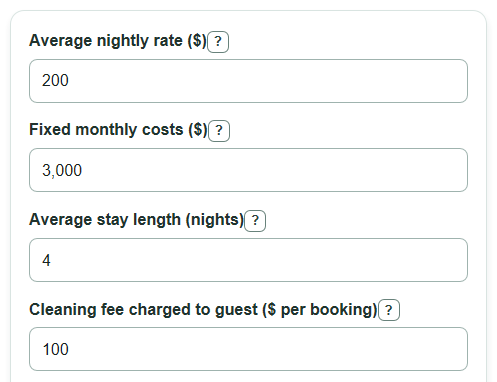
- Enter Average nightly rate, Fixed monthly costs, Average stay length, Cleaning fee charged to guest, and Turnover cost to you.
- Open Advanced options if you want to change Platform fee, Other cost per booked night, or the 12 monthly occupancy assumptions.
- Click Calculate to see Cash reserve needed for slow months, Annual profit or loss from your monthly plan, and Break-even occupancy needed each year.
- Sanity-check the result: if Break-even occupancy needed each year is over 100% or Annual profit or loss from your monthly plan looks impossible, review your rate, fixed costs, and turnover inputs first.
Definitions
Occupancy: The percent of available nights that are booked. For example, 15 booked nights out of 30 available nights is 50% occupancy.
Average nightly rate: The average rent amount for one booked night. Short-term rental reports often call this ADR, or average daily rate [1].
Average stay length: The average number of nights in one booking. This helps estimate how many cleanings or turnovers happen.
Turnover cost: The work and cost after a guest leaves, such as cleaning, laundry, supplies, and restocking.
Net contribution per booked night: The amount from each booked night left to cover Fixed monthly costs after platform fees, booked-night costs, and per-booking cleaning economics.
Cash reserve needed for slow months: The starting cash needed so the month-by-month plan does not go below $0 before later profits can help.
Common mistakes and quick fixes
Mistake: Putting cleaning fees inside Average nightly rate.
Fix: Keep Average nightly rate to rent per booked night, and put the separate guest charge in Cleaning fee charged to guest.
Mistake: Leaving owner-paid cleaning, laundry, or supplies out of Turnover cost to you.
Fix: Add the full per-booking cost to Turnover cost to you so short stays are not overstated.
Mistake: Using an unrealistically long Average stay length.
Fix: Use your expected nights per booking because Average stay length spreads cleaning economics across booked nights.
Mistake: Treating Fixed monthly costs as only the mortgage or rent.
Fix: Include recurring bills in Fixed monthly costs, such as insurance, utilities, internet, HOA dues, subscriptions, and required permits if they recur monthly.
Mistake: Setting every monthly occupancy input the same when the market has slow months.
Fix: Edit January occupancy through December occupancy to match your expected seasonality, then compare Cash reserve needed for slow months with your available cash.
Mistake: Ignoring a negative Annual profit or loss from your monthly plan because Break-even occupancy needed each year looks close.
Fix: Use the monthly plan result as the cash-flow check, and change the inputs until Annual profit or loss from your monthly plan matches your target.
Limitations & Key Assumptions / Boundary Conditions
- The plan uses 365 available nights and the standard non-leap-year month lengths. It does not subtract owner stays, maintenance blocks, or local booking caps.
- Platform fee is applied to Average nightly rate only, not to Cleaning fee charged to guest.
- Taxes, lodging taxes, income taxes, financing paydown, depreciation, owner draws, and property appreciation are not modeled.
- Monthly occupancy inputs are assumptions. Actual bookings can differ because of pricing, reviews, regulations, events, weather, and competition.
- Fractional bookings and fractional nights in outputs are planning averages, not a claim that a real guest can book part of a booking.
- Cash reserve needed for slow months starts in January with $0 saved from the property and does not roll December cash needs into the next year.
Methodology
How the break-even math works
The calculator first turns nightly rent, platform fees, booked-night costs, and cleaning economics into one net contribution per booked night. That number is the amount available to cover Fixed monthly costs.
net contribution per booked night = Average nightly rate * (1 - Platform fee / 100) - Other cost per booked night + (Cleaning fee charged to guest - Turnover cost to you) / Average stay length
Then it finds the yearly occupancy that would make profit about $0.
Break-even occupancy needed each year = Fixed monthly costs * 12 / (net contribution per booked night * 365) * 100
If net contribution per booked night is 0 or negative, occupancy cannot cover fixed costs. If the break-even percent is over 100%, the calculator keeps the computed percent but shows that all available nights would still not be enough.
How the monthly plan is checked
For each month, booked nights are based on that month's day count and the monthly occupancy percent.
booked nights for month = days in month * monthly occupancy percent / 100
monthly profit = booked nights for month * net contribution per booked night - Fixed monthly costs
Annual profit or loss is the total of the 12 monthly profit amounts. Average occupancy from your monthly plan is total booked nights divided by 365. The cash reserve is found by adding monthly profit from January through December and recording the lowest running cash balance.
Cash reserve needed for slow months = max(0, -lowest running cash balance)
Mini-example
With Average nightly rate of $200, Fixed monthly costs of $3,000, Average stay length of 4 nights, Cleaning fee charged to guest of $100, Turnover cost to you of $120, Platform fee of 3%, and Other cost per booked night of $10, net contribution per booked night is $179. If every month is set to 50% occupancy, annual booked nights are 182.5, Annual profit or loss from your monthly plan is -$3,332.50, Cash reserve needed for slow months is $3,332.50, and Break-even occupancy needed each year is about 55.10%.