
Estimate how reinvesting some, all, or none of your dividends can change future value, cash kept, and shares owned.
Advanced options
| Year | Ending value | Shares owned | Dividends | Cash kept | Reinvested |
|---|
Table of contents
How to use our Dividend Reinvestment Calculator
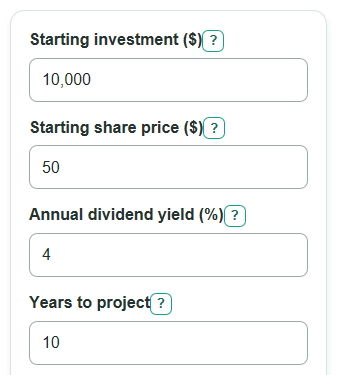
- Enter Starting investment, Starting share price, Annual dividend yield, Years to project, and Dividend reinvested.
- Use Dividend reinvested as the split for each after-tax dividend: 0 keeps dividends as cash, 100 buys shares with all after-tax dividends.
- Open Advanced options if you want to change Dividend payout frequency, Dividend growth each year, Share price growth each year, Yearly added investment, or Dividend tax rate.
- Click Calculate and compare Ending account value with Cash dividends kept outside the account to see the tradeoff between more shares and more cash.
- Sanity-check the Year-by-year dividend and share table: with 0% dividend yield, no shares should be bought with reinvested dividends; with 100% reinvestment, cash kept should be $0 before rounding.
Definitions
Dividend reinvestment: Using dividend payments to buy more shares instead of keeping the payment as cash. Many dividend reinvestment plans can buy fractional shares [2].
Annual dividend yield: Yearly dividends as a percent of the share price. In this calculator, it sets the starting annual dividend per share.
Dividend reinvested: The percent of each after-tax dividend used to buy more shares. The rest becomes Cash dividends kept outside the account.
Dividend payout frequency: How often dividends are paid during the year, such as monthly or quarterly.
Dividend growth each year: The assumed yearly change in dividend per share. A negative value means the dividend per share shrinks.
Share price growth each year: The assumed yearly change in share price. It affects the price used for reinvestment purchases and ending account value.
Ending account value: The projected value of shares still owned at the end. It does not include cash dividends kept outside the account.
Total gain including kept cash: Ending account value plus kept dividend cash, minus Starting investment and all Yearly added investment amounts.
Common mistakes and quick fixes
Mistake: Entering total account value in Starting share price instead of the price for one share.
Fix: Put the full dollar amount in Starting investment and the price of one share in Starting share price.
Mistake: Typing Annual dividend yield as a dollar dividend per share.
Fix: Enter Annual dividend yield as a percent per year, such as 4 for 4%.
Mistake: Setting Dividend reinvested to 100 when you plan to spend or save part of each dividend.
Fix: Use Dividend reinvested for the percent of each after-tax dividend used to buy more shares.
Mistake: Forgetting that Dividend tax rate reduces both Cash dividends kept outside the account and Dividend cash used to buy shares.
Fix: Use 0 for a tax-free account, or enter a rough percent if dividends are taxed.
Mistake: Putting a negative number in Yearly added investment to model withdrawals.
Fix: Use Yearly added investment only for added money; this calculator does not model withdrawals.
Mistake: Treating Estimated dividend income next year as guaranteed income.
Fix: Read Estimated dividend income next year as a projection based on the dividend yield and growth inputs you entered.
Limitations & Key Assumptions / Boundary Conditions
- The projection is an estimate, not a prediction of actual stock returns, dividend changes, taxes, or market prices.
- Dividends are assumed to grow once per year, while reinvestment purchases happen at the selected Dividend payout frequency.
- Yearly added investment is assumed to buy shares at the start of each year. The calculator does not model withdrawals, trading fees, bid-ask spreads, or missed reinvestment dates.
- Dividend tax rate is a simple flat percent. Real taxes can depend on account type, qualified dividend rules, income level, state taxes, and holding period.
- Share price growth is smoothed across payout periods for reinvestment purchases. Real prices move unevenly.
- Fractional shares are allowed in the math. If your broker only allows whole shares, actual reinvested shares and cash balances can differ.
- Growth rates at or below -100% are not allowed because they would make dividend per share or share price zero or negative.
Methodology
Projection steps
The calculator first turns Starting investment into a starting share count using Starting share price.
starting_shares = starting_investment / starting_share_price
It then turns Annual dividend yield into an annual dividend per share.
initial_annual_dividend_per_share = starting_share_price * annual_dividend_yield_percent / 100
For each projected year, Yearly added investment buys shares at the start of the year. Then each dividend payout is calculated from shares owned just before that payout.
gross_dividend = shares_before_payout * annual_dividend_per_share / payouts_per_year
after_tax_dividend = gross_dividend * (1 - dividend_tax_rate_percent / 100)
reinvest_cash = after_tax_dividend * dividend_reinvested_percent / 100
cash_kept = after_tax_dividend - reinvest_cash
shares_added = reinvest_cash / payout_price
Dividend payout frequency uses 12 payouts for monthly, 4 for quarterly, 2 for twice a year, and 1 for yearly. Dividend growth changes the annual dividend per share once per year. Share price growth changes the payout price smoothly by payout period.
Final outputs
After the last payout, Ending account value is the ending share count times the projected ending share price. Cash dividends kept outside the account is tracked separately.
ending_account_value = ending_shares_owned * ending_share_price
total_return_dollars = ending_account_value + cash_dividends_kept - starting_investment - total_added_investment
total_return_percent = 100 * total_return_dollars / total_money_invested
next_year_dividend_income = ending_shares_owned * next_year_dividend_per_share
Mini-example
Suppose Starting investment is $1,000, Starting share price is $100, Annual dividend yield is 12%, Years to project is 1, Dividend payout frequency is quarterly, Dividend tax rate is 0%, and growth rates are 0%. The starting share count is 10 shares, and the starting annual dividend per share is $12. If Dividend reinvested is 0%, the projection keeps $120 in cash and ends with 10 shares worth $1,000. If Dividend reinvested is 100%, each quarterly payout buys more shares, so the projection ends with about 11.2551 shares and an Ending account value of about $1,125.51.
Calculation notes
Total gain including kept cash is signed. A negative value means Ending account value plus kept dividend cash is less than the Starting investment plus added investments. Estimated dividend income next year is before any future tax or reinvestment split.