
Estimate the rent, occupancy, monthly cash flow, and payback time a rental property needs to break even.
Table of contents
How to use our Rental Property Break-Even Calculator
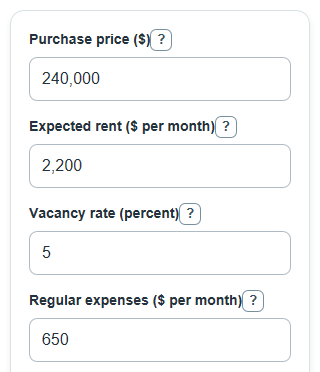
- Enter the Purchase price, Expected rent, Vacancy rate, and Regular expenses for the property. Regular expenses should not include the loan payment.
- Enter the Down payment, Loan interest rate, and Loan length so the calculator can estimate the fixed monthly loan payment.
- Open Advanced options if you want Closing costs, Repairs before renting, or a Discount rate included in the payback math.
- Click Calculate and read the first cards first: Discounted time to get your cash back, Rent needed to break even, Occupancy needed to break even, and Estimated monthly cash flow.
- Sanity-check the output by comparing Rent needed to break even with local market rent and checking whether Occupancy needed to break even is over 100 percent.
Definitions
Expected rent: The rent collected in a full occupied month before subtracting vacancy, expenses, or loan payment.
Vacancy rate: The percent of time you expect the property to be empty or not collecting rent.
Regular expenses: Monthly owner-paid costs other than the loan payment, such as taxes, insurance, management, HOA dues, utilities you pay, and routine repairs.
Estimated monthly loan payment: The fixed principal and interest payment based on loan amount, interest rate, and loan length.
Estimated monthly cash flow: Rent after vacancy minus regular expenses and the estimated monthly loan payment.
Rent needed to break even: The full monthly rent needed so rent after vacancy covers regular expenses and the loan payment.
Occupancy needed to break even: The percent of time the property must collect rent to cover regular expenses and the loan payment [1].
Discount rate: A yearly rate used to reduce the value of future cash flow in discounted payback.
Upfront cash counted for payback: Down payment plus Closing costs plus Repairs before renting.
Common mistakes and quick fixes
Mistake: Putting property tax, insurance, or repairs into Expected rent instead of Regular expenses.
Fix: Keep Expected rent as rent only, and put normal owner-paid costs in Regular expenses.
Mistake: Including the loan payment in Regular expenses.
Fix: Leave the loan payment out of Regular expenses because Estimated monthly loan payment is calculated from Down payment, Loan interest rate, and Loan length.
Mistake: Entering Vacancy rate as 0.05 when you mean 5 percent.
Fix: Enter 5 in Vacancy rate for 5 percent vacancy.
Mistake: Leaving Closing costs or Repairs before renting at 0 when those costs will be paid in cash.
Fix: Add them in Advanced options so Upfront cash counted for payback is not understated.
Mistake: Treating Simple time to get your cash back as the only payback view.
Fix: Check Discounted time to get your cash back when you want future cash flow valued less than cash today.
Mistake: Ignoring a negative Estimated monthly cash flow.
Fix: A negative Estimated monthly cash flow means the property needs extra cash each month under the inputs you entered.
Limitations & Key Assumptions / Boundary Conditions
- The calculator uses a fixed-rate principal and interest loan payment. It does not model adjustable rates, interest-only loans, balloon payments, or refinancing.
- Regular expenses are treated as one steady monthly amount. Real tax bills, insurance premiums, repairs, utilities, HOA dues, and management fees can change over time.
- Expected rent and Vacancy rate are held constant. Rent increases, seasonality, tenant turnover, concessions, and unpaid rent can change cash flow.
- Payback is based on monthly cash flow only. It does not include tax effects, depreciation, appreciation, sale price, selling costs, or loan payoff at sale.
- Discounted time to get your cash back assumes the same cash flow arrives at the end of each month. If cash flow is uneven, the discounted payback will be only a rough screen.
- If Occupancy needed to break even is over 100 percent, the entered rent cannot cover the entered monthly costs under these assumptions.
- If Estimated monthly cash flow is zero or negative, payback from monthly cash flow is not reached.
Methodology
Core monthly math
The calculator first estimates the loan amount from the purchase price and down payment.
loan_amount = purchase_price * (1 - down_payment_percent / 100)
It then computes the fixed monthly loan payment. The monthly rate is the yearly loan interest rate divided by 100 and then divided by 12. The number of loan months is loan length in years times 12.
if monthly_rate = 0: monthly_debt_payment = loan_amount / loan_months
if monthly_rate > 0: monthly_debt_payment = loan_amount * monthly_rate * (1 + monthly_rate)^loan_months / ((1 + monthly_rate)^loan_months - 1)
Rent is reduced by the vacancy rate before expenses and loan payment are subtracted.
effective_rent = monthly_rent * (1 - vacancy_rate_percent / 100)
monthly_cash_flow = effective_rent - monthly_operating_expenses - monthly_debt_payment
Break-even answers
Rent needed to break even is the full occupied-month rent needed so the vacancy-adjusted rent equals regular expenses plus the loan payment.
break_even_rent = (monthly_operating_expenses + monthly_debt_payment) / (1 - vacancy_rate_percent / 100)
Occupancy needed to break even compares required monthly income with the rent you expect in an occupied month.
break_even_occupancy_percent = ((monthly_operating_expenses + monthly_debt_payment) / monthly_rent) * 100
The calculator does not cap this at 100 percent. A result over 100 percent means the entered rent is too low to break even with the entered costs.
Payback and cash return
Upfront cash counted for payback is the cash put into the deal before rent starts.
upfront_cash_for_payback = purchase_price * down_payment_percent / 100 + closing_costs + repair_budget
Simple payback divides upfront cash by monthly cash flow.
simple_payback_months = upfront_cash_for_payback / monthly_cash_flow
Discounted payback reduces future monthly cash flow using the discount rate. This estimates whether discounted future monthly cash flow can recover the upfront cash.
discount_monthly = annual_discount_rate_percent / 100 / 12
if discount_monthly = 0: discounted_payback_months = simple_payback_months
if discount_monthly > 0: discounted_payback_months = -ln(1 - upfront_cash_for_payback * discount_monthly / monthly_cash_flow) / ln(1 + discount_monthly)
If monthly cash flow is zero or negative, payback is not reached from monthly cash flow. If upfront cash times the monthly discount rate is greater than or equal to monthly cash flow, discounted payback is also not reached because the discounted value of future cash flow never catches the upfront cash.
Yearly cash flow and cash return are calculated after monthly cash flow is known.
annual_cash_flow = monthly_cash_flow * 12
cash_on_cash_return_percent = annual_cash_flow / upfront_cash_for_payback * 100
Mini-example
Suppose the purchase price is $200,000, expected rent is $2,600 per month, vacancy is 5 percent, regular expenses are $500 per month, down payment is 20 percent, loan interest rate is 6 percent per year, loan length is 30 years, closing costs are $5,000, repairs before renting are $5,000, and the discount rate is 8 percent per year. The loan amount is $160,000 and the estimated monthly loan payment is about $959.28. Effective rent is $2,470, so estimated monthly cash flow is about $1,010.72. Upfront cash counted for payback is $50,000. Simple payback is about 49.47 months, while discounted payback is about 60.23 months because future cash flow is reduced by the discount rate.