
Estimate your 2026 HSA tax savings and see the split between federal, state, and payroll tax.
Advanced options
Table of contents
How to use our HSA Tax Savings Calculator
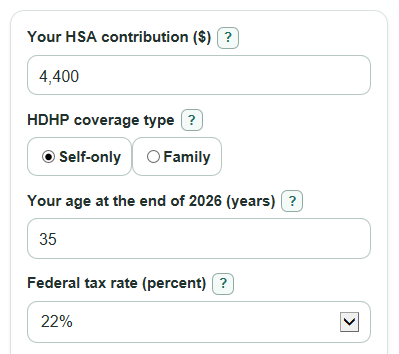
- Enter Your HSA contribution ($), choose HDHP coverage type, and enter Your age at the end of 2026 (years).
- Choose Federal tax rate (percent) and How you add the money. Use Payroll deduction if the money comes out of your paycheck before taxes.
- Open Advanced options if you want to add State tax rate (percent), W-2 wages before HSA ($), Employer HSA money ($), growth settings, or Show savings per paycheck.
- Click Calculate and read Estimated first-year tax savings first, then check HSA limit check and Amount over the HSA limit.
- Sanity-check the answer: if Contribution counted for tax savings is lower than Your HSA contribution ($), your plan is capped by the 2026 HSA limit.
Definitions
HSA: A health savings account, which is a tax-favored account used with an eligible high deductible health plan.
HDHP coverage type: The HSA limit category. Self-only covers only you. Family covers you plus at least one other person.
Federal tax rate (percent): The marginal federal income tax rate you choose for the next dollar of taxable income.
Payroll deduction: HSA money taken from pay before taxes. It can lower federal income tax, state income tax if allowed, and employee payroll tax.
Direct contribution: HSA money you add outside payroll, usually claimed on your tax return. It normally does not reduce Social Security and Medicare tax.
FICA: The employee Social Security and Medicare payroll taxes used in this estimate.
Social Security wage base: The yearly wage limit where Social Security tax stops applying. Medicare tax continues after that point.
Catch-up amount: Extra HSA contribution room for an eligible person age 55 or older.
Contribution counted for tax savings: The part of your own HSA contribution that fits under the annual HSA limit after employer money.
Common mistakes and quick fixes
Mistake: Using the total family HSA deposit in Your HSA contribution ($) when some of it is Employer HSA money ($).
Fix: Put only your own planned deposit in Your HSA contribution ($) and put employer money in Employer HSA money ($).
Mistake: Choosing Direct contribution under How you add the money when the HSA deposit will come from paycheck deductions.
Fix: Choose Payroll deduction so Social Security and Medicare tax savings can be included.
Mistake: Leaving W-2 wages before HSA ($) blank even though your wages are near the Social Security wage base.
Fix: Enter W-2 wages before HSA ($) for a better payroll tax estimate; blank uses the simple 7.65% estimate.
Mistake: Entering your average tax rate in Federal tax rate (percent).
Fix: Use the marginal rate for your next dollar of income, because the HSA deduction usually reduces that top slice first.
Mistake: Entering a State tax rate (percent) without checking whether your state follows federal HSA rules.
Fix: Enter 0 for State tax rate (percent) if the deduction does not apply or if you want a federal-only estimate.
Mistake: Treating Projected HSA value from these deposits as a guaranteed balance.
Fix: Adjust Expected yearly growth (percent) and Years to grow, and remember the projection ignores spending, fees, and losses.
Limitations & Key Assumptions / Boundary Conditions
- The calculator uses 2026 HSA limits: $4,400 for self-only coverage, $8,750 for family coverage, and a $1,000 catch-up amount for age 55 or older.
- It estimates tax savings using the tax rates you enter. It does not prepare a full federal or state tax return.
- State income tax treatment of HSAs can vary. Enter 0 for State tax rate (percent) if the deduction does not apply to you.
- If W-2 wages before HSA ($) is blank, payroll tax savings use the simple 7.65% estimate. That can overstate savings for wages near or above the Social Security wage base.
- The payroll calculation includes employee Social Security tax and Medicare tax, but it does not model Additional Medicare Tax because that depends on filing status and total Medicare wages.
- Employer HSA money counts toward the HSA limit check, but it is not counted as your own tax-deductible contribution.
- Projected HSA value from these deposits assumes one deposit grows for the chosen number of years with no withdrawals, fees, future deposits, or investment losses.
- The calculator does not verify that you are HSA-eligible for every month of the year or that you meet other HSA rules.
Methodology
Limit check
The calculator first finds the 2026 HSA limit from HDHP coverage type and Your age at the end of 2026 (years). Self-only coverage starts at $4,400. Family coverage starts at $8,750. Age 55 or older adds a $1,000 catch-up amount.
hsa_limit = base_limit + catchup_amount
remaining_limit = hsa_limit - employer_contribution
eligible_user_contribution = min(hsa_contribution, max(0, remaining_limit))
amount_over_limit = hsa_contribution + employer_contribution - hsa_limit
Contribution counted for tax savings is capped at the amount that fits under the limit after Employer HSA money ($). Amount over the HSA limit is signed: a positive value means the plan appears over the limit, and a negative value means room remains.
Income tax savings
Federal income tax savings and State income tax savings use the eligible part of your own contribution, not employer money.
federal_income_tax_savings = eligible_user_contribution * (federal_rate / 100)
state_income_tax_savings = eligible_user_contribution * (state_rate / 100)
Payroll tax savings
If How you add the money is Direct contribution, Social Security and Medicare tax savings is $0 for the main result. If How you add the money is Payroll deduction and W-2 wages before HSA ($) is blank, the calculator uses 6.2% Social Security plus 1.45% Medicare.
fica_tax_savings = eligible_user_contribution * (0.062 + 0.0145)
If W-2 wages before HSA ($) is entered, the Social Security part is capped by the 2026 Social Security wage base of $184,500. This avoids giving Social Security savings on wages that were already above the wage base.
ss_saved_wages = min(annual_wages, ss_wage_base) - min(max(annual_wages - eligible_user_contribution, 0), ss_wage_base)
medicare_saved_wages = min(eligible_user_contribution, annual_wages)
fica_tax_savings = ss_saved_wages * 0.062 + medicare_saved_wages * 0.0145
Extra savings from payroll is the FICA savings for the same eligible contribution. For direct contributions, it shows the extra payroll tax savings that might be available if the same eligible contribution went through payroll.
Total and paycheck view
The main answer adds the federal, state, and payroll pieces.
total_first_year_savings = federal_income_tax_savings + state_income_tax_savings + fica_tax_savings
If Show savings per paycheck is not Annual only, the calculator divides the total by 52 weekly, 26 biweekly, 24 twice-a-month, or 12 monthly pay periods.
per_paycheck_tax_savings = total_first_year_savings / pay_periods
Growth projection
The projection uses eligible total HSA deposits, including eligible employer money, and compounds once per year.
eligible_total_deposits = min(hsa_contribution + employer_contribution, hsa_limit)
projected_hsa_value = eligible_total_deposits * (1 + expected_return / 100) ^ years_to_grow
Worked example
Suppose Your HSA contribution ($) is $4,400, HDHP coverage type is Self-only, Your age at the end of 2026 (years) is 35, Federal tax rate (percent) is 22%, State tax rate (percent) is 5%, How you add the money is Payroll deduction, and W-2 wages before HSA ($) is $80,000. The contribution fits the $4,400 self-only limit, so Contribution counted for tax savings is $4,400. Federal savings are $4,400 * 22% = $968. State savings are $4,400 * 5% = $220. FICA savings are $4,400 * 7.65% = $336.60 because the wages are below the Social Security wage base. Estimated first-year tax savings are $968 + $220 + $336.60 = $1,524.60.