
Compare escrow shortage payment choices and see how each one changes your monthly mortgage payment.
Table of contents
How to use our Escrow Shortage Calculator
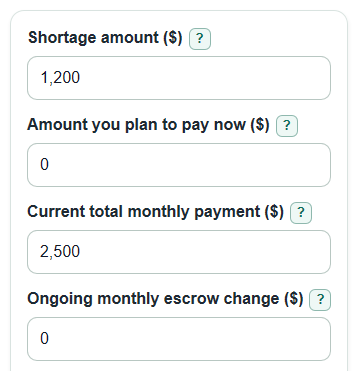
- Enter the Shortage amount ($) from your escrow notice.
- Enter the Amount you plan to pay now ($), even if that amount is 0.
- Enter your Current total monthly payment ($), the Ongoing monthly escrow change ($), and the Spread shortage over (months) from your notice or plan.
- Click Calculate and compare Monthly payment with your plan with the no-upfront and full-payoff payment amounts.
- Sanity-check the result: if you pay the full shortage now, Monthly catch-up amount should be $0, but the payment can still change when Ongoing monthly escrow change ($) is not $0.
Definitions
Escrow shortage: The amount your mortgage servicer says is missing from your escrow account after comparing expected tax and insurance payments with the balance needed.
Shortage amount ($): The one-time shortage shown on your notice, not the full yearly cost of taxes or insurance.
Amount you plan to pay now ($): The upfront payment you want to apply to the shortage before spreading any leftover amount over months.
Ongoing monthly escrow change ($): The recurring monthly increase or decrease caused by changed tax or insurance costs. It is separate from the temporary shortage repayment.
Monthly catch-up amount: The temporary amount added each month to repay the shortage left after your upfront payment.
Spread shortage over (months): The number of monthly payments used to repay the remaining shortage.
Common mistakes and quick fixes
Mistake: Putting the full annual tax or insurance bill in Shortage amount ($) .
Fix: Use only the shortage amount shown on the escrow analysis or shortage notice.
Mistake: Leaving Amount you plan to pay now ($) blank when you plan to spread the shortage out.
Fix: Enter 0 so the calculator can compare your plan with paying nothing upfront.
Mistake: Entering only principal and interest in Current total monthly payment ($) .
Fix: Enter your full current mortgage payment, including escrow for taxes and insurance.
Mistake: Treating Ongoing monthly escrow change ($) as part of the shortage catch-up.
Fix: Enter the recurring escrow increase or decrease separately, because it may remain after the shortage is repaid.
Mistake: Using years in Spread shortage over (months) .
Fix: Enter months, such as 12 for one year.
Mistake: Assuming Monthly payment if you pay the full shortage now must equal your old payment.
Fix: Check Ongoing monthly escrow change ($) ; higher taxes or insurance can keep the payment higher even after the shortage is paid.
Limitations & Key Assumptions / Boundary Conditions
- The calculator uses the shortage, payment, escrow change, and repayment months you enter. It does not rebuild your servicer's full escrow analysis month by month.
- It assumes your servicer applies the Amount you plan to pay now ($) directly to the shortage and spreads only the remaining shortage over the chosen months.
- It does not add interest, fees, late charges, or investment earnings. Escrow shortage repayment plans commonly do not work like loans, but your notice controls your real payment.
- The Ongoing monthly escrow change ($) may be positive or negative. If taxes or insurance change again, the actual payment can differ from the estimate.
- The calculator blocks a repayment period under 1 month or over 60 months because very short or very long plans are usually not useful for this budgeting comparison.
- If your mortgage has a payment change outside escrow, such as an adjustable-rate change or loan modification, add that separately before relying on the monthly payment estimate.
Methodology
How the payment plan is calculated
The calculator separates the one-time shortage catch-up from the ongoing escrow change. This matters because paying the full shortage can lower the temporary catch-up amount, but the monthly payment may still rise if taxes or insurance increased [1].
Money inputs are cleaned by removing commas, spaces, and a leading dollar sign. The calculator rejects formulas, ranges, blank required fields, negative shortage values, an upfront payment above the shortage, and repayment months outside 1 to 60.
remaining_shortage = shortage_amount - pay_now_amount
monthly_catch_up = remaining_shortage / repayment_months
new_monthly_payment = current_monthly_payment + ongoing_escrow_change + monthly_catch_up
payment_if_no_upfront = current_monthly_payment + ongoing_escrow_change + shortage_amount / repayment_months
payment_if_paid_full = current_monthly_payment + ongoing_escrow_change
monthly_savings_from_upfront = pay_now_amount / repayment_months
payment_after_repayment_ends = current_monthly_payment + ongoing_escrow_change
Mini-example
Suppose the shortage is $1,800, you pay $600 now, your current total monthly payment is $3,200, the ongoing escrow change is +$75 per month, and the shortage is spread over 12 months. The remaining shortage is $1,200, so the monthly catch-up is $100. Your monthly payment with your plan is $3,200 + $75 + $100 = $3,375. Paying nothing now would be $3,425, while paying the full shortage now would be $3,275.