
Estimate monthly escrow from your yearly bills and compare your balance with a chosen cushion. This simple planning check cannot determine an actual escrow shortage or the payment your servicer will require.
Table of contents
How to use our Mortgage Escrow Calculator
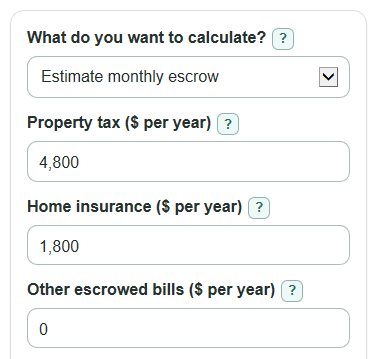
- Choose What do you want to calculate?: Estimate monthly escrow for a simple monthly amount, or Check my current escrow balance if you have a balance from your mortgage statement.
- Enter Property tax ($ per year), Home insurance ($ per year), and Other escrowed bills ($ per year) as yearly amounts only.
- If you choose the balance check, enter Current escrow balance ($), including a negative amount if your statement shows a deficit.
- Open Advanced options only if you want to change Target cushion (months of escrow) or Spread shortage over (months).
- Check the result by comparing Total escrowed bills with your real annual bills; if it looks too high, you may have entered a monthly bill as a yearly bill.
Definitions
Escrow account: A mortgage account used to collect part of your monthly payment for bills such as property tax and homeowners insurance [1].
Property tax ($ per year): The yearly property tax amount you expect the escrow account to pay.
Home insurance ($ per year): The yearly homeowners insurance premium you expect the escrow account to pay.
Other escrowed bills ($ per year): Other yearly bills paid from escrow, such as PMI or flood insurance, if your servicer includes them.
Base monthly escrow for bills: The yearly escrowed bills divided by 12 months.
Target cushion amount: Extra escrow money you want the account to hold above the monthly bill deposits. Federal escrow rules describe a cushion of up to two months of escrow payments, unless a smaller amount applies [3].
Cushion gap: Target cushion amount minus Current escrow balance ($). A positive number means the balance is below target; a negative number means it is above target.
Cushion-gap top-up: The positive Cushion gap divided by the selected number of months. This is an optional cushion-planning amount, not a calculation of an actual escrow shortage.
Common mistakes and quick fixes
Mistake: Entering a monthly tax amount in Property tax ($ per year).
Fix: Enter the full yearly tax amount, or add all county tax bills for the year.
Mistake: Including HOA dues in Other escrowed bills ($ per year) when the mortgage servicer does not pay them from escrow.
Fix: Include only bills actually paid from the escrow account.
Mistake: Using Estimate monthly escrow when you want to test Current escrow balance ($).
Fix: Change What do you want to calculate? to Check my current escrow balance.
Mistake: Treating Cushion gap as a charge every month.
Fix: Use Cushion-gap top-up to see the monthly add-on, and remember a negative Cushion gap means the balance is above the target cushion.
Mistake: Setting Target cushion (months of escrow) above 2.
Fix: Use a value from 0 to 2 months in this calculator.
Mistake: Treating Spread shortage over (months) as a way to reproduce a servicer's shortage notice.
Fix: This field spreads the cushion gap only. Use your servicer's stated shortage amount and repayment period when checking a notice.
Limitations & Key Assumptions / Boundary Conditions
- This calculator estimates the escrow part of a mortgage payment only. It does not include principal, interest, HOA dues, utilities, maintenance, closing costs, or local tax lookup data.
- Results depend on the yearly bills you enter. If your tax bill or insurance premium changes, Base monthly escrow for bills and Monthly escrow planning amount will change.
- The current-balance check compares only your balance with a cushion. An official escrow analysis also projects deposits and bill payments throughout the year. Being above the cushion does not establish a surplus, and being below it does not establish a shortage.
- Target cushion (months of escrow) is limited to 0 through 2 months in this calculator because two months matches the federal maximum cushion described in Regulation X for many escrow accounts.
- Cushion-gap top-up is optional planning arithmetic. Use your servicer's escrow analysis for an actual shortage and required payment; this calculator does not reproduce that analysis.
- A negative Current escrow balance ($) is allowed because some statements show an escrow deficit. A negative Cushion gap is not a problem by itself; it means the balance is above the selected target.
- Displayed dollar amounts are rounded to cents, so tiny differences can happen if you compare against a lender statement that rounds at different steps.
Methodology
How the estimate is calculated
The calculator first adds the yearly bills that the escrow account is expected to pay. Escrow money is separate from principal and interest, even though it is often collected with the total monthly mortgage payment [2].
annual_escrow_bills = annual_property_tax + annual_home_insurance + annual_other_escrow
It then divides the yearly total by 12 to get the normal monthly escrow deposit for bills.
base_monthly_escrow = annual_escrow_bills / 12
The cushion target is based on the selected Target cushion (months of escrow).
target_cushion = base_monthly_escrow * cushion_months
In balance-check mode, the calculator compares that target with Current escrow balance ($). This signed gap is kept as positive or negative because both directions matter.
balance_gap = target_cushion - current_escrow_balance
Only a positive cushion gap is spread into an optional monthly top-up. A balance above the chosen cushion does not create a negative top-up and does not establish an official surplus.
shortage_repayment_monthly = max(balance_gap, 0) / shortage_spread_months
The monthly planning amount is the base deposit for annual bills plus any optional cushion-gap top-up. It is not a forecast of the payment required by your servicer.
estimated_monthly_escrow = base_monthly_escrow + shortage_repayment_monthly
Worked example
If Property tax ($ per year) is $6,000, Home insurance ($ per year) is $2,400, and Other escrowed bills ($ per year) is $1,200, Total escrowed bills is $9,600. The base monthly escrow is $9,600 / 12 = $800. With a 2-month cushion, Target cushion amount is $1,600. If Current escrow balance ($) is $500, Cushion gap is $1,100. Spread over 12 months, Cushion-gap top-up is $91.67 per month, so Monthly escrow planning amount is $891.67.
Calculation choices
In Estimate monthly escrow mode, Current escrow balance ($) is not used, Cushion-gap top-up is $0, and the main result equals Base monthly escrow for bills. In Check my current escrow balance mode, the calculator uses the entered balance and keeps Cushion gap signed so a negative amount clearly shows that the balance is above the selected target.
Sources
- What is an escrow or impound account? | Consumer Financial Protection Bureau - Consumerfinance
- On a mortgage, what's the difference between my principal and interest payment and my total monthly payment? | Consumer Financial Protection Bureau - Consumerfinance
- 1024.17 Escrow accounts. | Consumer Financial Protection Bureau - Consumerfinance