
Estimate a rental property's ROI, monthly cash flow, break-even rent, and projected sale profit from one set of deal assumptions.
Table of contents
How to use our Real Estate ROI Calculator
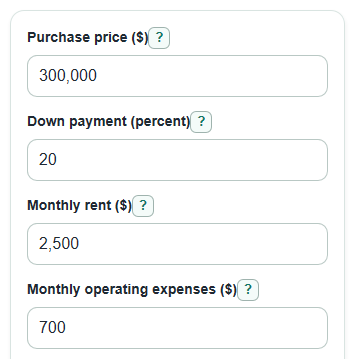
- Enter Purchase price ($), Down payment (percent), Monthly rent ($), Monthly operating expenses ($), Loan rate (percent per year), and Vacancy and missed rent (percent).
- Open Advanced options if you want to change Closing costs ($), Repair or startup costs ($), Loan term (years), Years you plan to hold, growth rates, or Selling costs (percent of sale price).
- Click Calculate and read Total ROI over your hold time first, then check Average yearly ROI and Projected profit after sale.
- Compare First-year monthly cash flow with Rent needed to break even. If rent needed is above Monthly rent ($), the property may need extra cash each month.
- Sanity-check the results by asking if First-year NOI, Cap rate before loan payments, and Loan balance at sale match what you expect from the rent, expenses, and loan size.
Definitions
ROI: Return on investment. In this calculator, it is projected profit divided by your starting cash invested.
NOI: Net operating income. It is rent after vacancy and operating expenses, before loan payments and income tax.
Cap rate: First-year NOI divided by Purchase price ($). It ignores the loan, so it is mainly a property-level comparison number.
Cash-on-cash return: First-year cash flow divided by starting cash invested. It includes debt payments, so financing changes it.
Vacancy and missed rent: The percent of rent not collected because the unit is empty, rent is unpaid, or you expect collection loss.
Break-even rent: The Monthly rent ($) needed for first-year cash flow to be zero after vacancy, operating expenses, and mortgage payments.
Loan balance at sale: The estimated principal still owed when the property is sold after Years you plan to hold.
Common mistakes and quick fixes
Mistake: Putting the mortgage payment inside Monthly operating expenses ($).
Fix: Leave mortgage principal and interest out of Monthly operating expenses ($); the calculator uses Loan rate (percent per year), Down payment (percent), and Loan term (years) to estimate the loan payment.
Mistake: Entering Vacancy and missed rent (percent) as 100 or leaving it unrealistically low for your market.
Fix: Use a value from 0 up to, but not including, 100 for Vacancy and missed rent (percent), because Rent needed to break even divides by the rented share of the year.
Mistake: Reading Total ROI over your hold time as a monthly affordability number.
Fix: Use First-year monthly cash flow and Cash flow warning to see whether the deal needs extra cash before you focus on the long-term sale result.
Mistake: Forgetting Closing costs ($) or Repair or startup costs ($).
Fix: Add those cash costs so First-year cash-on-cash return and Total ROI over your hold time are based on your real starting cash invested.
Mistake: Comparing Cap rate before loan payments across deals with different expense assumptions.
Fix: Make sure Monthly operating expenses ($) includes the same kinds of costs for each property before comparing Cap rate before loan payments.
Mistake: Treating Average yearly ROI as a guaranteed market return.
Fix: Change Home value growth (percent per year), Rent growth (percent per year), Expense growth (percent per year), and Selling costs (percent of sale price) to test how sensitive Average yearly ROI is.
Limitations & Key Assumptions / Boundary Conditions
- The calculator estimates a rental property deal. It does not handle flip-only profit, refinance cash-out, partnership splits, depreciation, income tax, or insurance claim events.
- Monthly operating expenses ($) should include property tax, insurance, repairs, HOA, management, and reserves, but not the mortgage payment.
- The mortgage payment is principal and interest only. It assumes a fixed-rate loan with the same payment each month.
- Growth inputs apply once per year. Real rent increases, repair costs, and market prices can happen unevenly.
- Average yearly ROI is not IRR. It uses the total money returned over the hold period and does not time each cash flow within the year.
- If starting cash invested is zero, Total ROI over your hold time and First-year cash-on-cash return are not meaningful and should be shown as N/A.
- If total money returned is zero or negative, Average yearly ROI is not useful because the root formula cannot describe a normal positive yearly growth rate.
- Selling costs, vacancy, and expense estimates can change the answer a lot. Test conservative values before relying on a deal that barely breaks even.
Methodology
Calculation flow
The calculator first converts percent entries to decimal rates by dividing by 100 and converts years to months by multiplying by 12.
down_payment = purchase_price * down_payment_percent / 100
loan_amount = max(0, purchase_price - down_payment)
If there is no loan, the monthly mortgage payment is 0. If the loan rate is 0, the payment is straight-line principal repayment. Otherwise, it uses the standard fixed-payment loan formula.
monthly_rate = loan_apr / 100 / 12
monthly_payment = loan_amount * monthly_rate * (1 + monthly_rate)^loan_term_months / ((1 + monthly_rate)^loan_term_months - 1)
First-year NOI measures the property's income before financing choices.
first_year_noi = monthly_rent * 12 * (1 - vacancy_rate / 100) - monthly_operating_expenses * 12
First-year cash flow subtracts loan payments from NOI. Negative cash flow is kept as a negative number because it means the owner must add cash.
annual_cash_flow_year_1 = first_year_noi - monthly_payment * 12
monthly_cash_flow = annual_cash_flow_year_1 / 12
initial_cash_invested = down_payment + closing_costs + repair_costs
cap_rate_percent = first_year_noi / purchase_price * 100
cash_on_cash_return_percent = annual_cash_flow_year_1 / initial_cash_invested * 100
The break-even rent solves for the monthly rent that makes first-year cash flow equal zero.
break_even_rent = (monthly_operating_expenses * 12 + monthly_payment * 12) / (12 * (1 - vacancy_rate / 100))
For the hold period, each year grows rent and expenses, keeps the loan payment level, and adds that year's cash flow.
cash_flow_y = monthly_rent * 12 * (1 + rent_growth_rate / 100)^(y - 1) * (1 - vacancy_rate / 100) - monthly_operating_expenses * 12 * (1 + expense_growth_rate / 100)^(y - 1) - monthly_payment * 12
The sale estimate grows the property value, subtracts selling costs, then subtracts the remaining loan balance.
sale_price = purchase_price * (1 + value_growth_rate / 100)^holding_period_years
net_sale_proceeds = sale_price - sale_price * selling_cost_percent / 100 - ending_loan_balance
projected_profit = sum_cash_flows + net_sale_proceeds - initial_cash_invested
total_roi_percent = projected_profit / initial_cash_invested * 100
annualized_roi_percent = ((sum_cash_flows + net_sale_proceeds) / initial_cash_invested)^(1 / holding_period_years) - 1
Mini example
With a $300,000 purchase price, 20% down, $2,500 monthly rent, $700 monthly operating expenses, 6.5% loan rate, 5% vacancy, $9,000 closing costs, and a 5-year hold, the first-year NOI is $20,100. The estimated first-year monthly cash flow is about $158, and the rent needed to break even is about $2,334 per month. Using 3% yearly home value growth, 2% rent growth, 2% expense growth, and 6% selling costs, the projected profit after sale is about $46,832 and the total ROI is about 67.9%.