
Estimate the yearly cost of a fixed-rate loan after required fees, then compare APR with the stated interest rate.
Advanced options
Table of contents
How to use our Loan APR Calculator
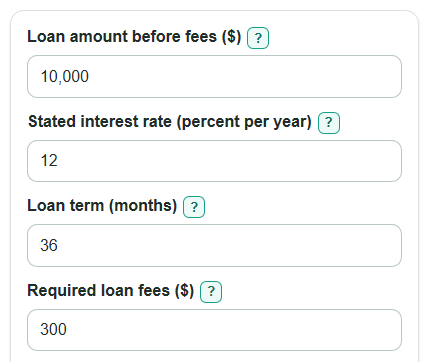
- Enter the Loan amount before fees ($), Stated interest rate (percent per year), and Loan term (months).
- Enter Required loan fees ($), then choose How are those fees handled? so the calculator knows whether fees reduce the cash you receive or increase the balance you repay.
- Open Advanced options only if you need Extra required monthly cost ($ per month) or an Optional payoff check (months).
- Click Calculate and review APR with fees first, then compare Fees add this much to the rate with the stated rate.
- Sanity-check the output: if fees are 0 and extra monthly cost is 0, APR with fees should be very close to the stated interest rate.
Definitions
APR with fees: The yearly cost rate after interest and required fees are included. APR can be higher than the stated interest rate when mandatory fees apply [4].
Stated interest rate: The loan rate used to calculate the scheduled payment before required fees are included in the APR.
Required loan fees: Fees required to get the loan, such as lender or origination fees. Optional add-ons should be included only if you want them counted in this estimate.
Paid upfront or taken out of cash: A fee setup where the loan balance is based on the loan amount, but the borrower effectively receives less cash at the start.
Added to the loan balance: A fee setup where the fee increases the balance used to calculate the scheduled payment.
Total finance charge: The dollar cost of the credit in this calculator, including total interest, required fees, and any extra required monthly cost entered.
Percentage points: The direct difference between two percent rates. For example, 14 percent APR minus 12 percent interest is 2 percentage points.
Common mistakes and quick fixes
Mistake: Putting the amount you receive after fees into Loan amount before fees ($) .
Fix: Enter the loan amount before fees, then put the fee in Required loan fees ($) .
Mistake: Choosing the wrong answer for How are those fees handled? .
Fix: Choose "Paid upfront or taken out of cash" if the fee lowers the cash you receive, or "Added to the loan balance" if you repay the fee over time.
Mistake: Entering 0.12 in Stated interest rate (percent per year) for a 12 percent loan.
Fix: Enter 12, not 0.12.
Mistake: Adding optional products to Required loan fees ($) when you only want the APR for required credit costs.
Fix: Include only fees required to get the loan unless you intentionally want those optional costs in the estimate.
Mistake: Using Optional payoff check (months) with a month equal to or greater than Loan term (months) .
Fix: Leave it blank for the full-term APR, or enter a whole number from 1 to one less than the loan term.
Mistake: Treating Monthly loan payment as the full monthly cash need when Extra required monthly cost ($ per month) is entered.
Fix: Use Monthly cash outflow with extra costs when extra required monthly costs are included.
Limitations & Key Assumptions / Boundary Conditions
- This calculator is for fixed-rate loans with equal monthly payments. It is not for credit cards, variable-rate loans, interest-only loans, or loans with uneven payment schedules.
- The APR is an estimate from monthly cash flows. Official lender disclosures can differ because of legal rounding rules, exact payment dates, prepaid interest, odd first periods, or fees not entered here.
- Required loan fees ($) should include required credit costs only. Taxes, title charges, insurance, or optional products may be treated differently in real disclosures.
- If How are those fees handled? is wrong, the APR and total paid can be wrong because the calculator changes both cash received and the balance repaid.
- Optional payoff check (months) assumes normal scheduled payments through that month, then payoff of the remaining balance at the same time. It does not model prepayment penalties or lender payoff quote fees.
- APR solving can fail when inputs create impossible or unusual cash flows, such as paid-upfront fees equal to or greater than the loan amount.
Methodology
Calculation method
The calculator first decides which balance is repaid and how much value the borrower effectively receives at the start. APR is then solved from the timing of the amount received and the monthly payments, which matches the actuarial cash-flow idea used for closed-end credit APR computations [3].
balance_for_payment = loan_amount + upfront_fees if fees are added to the loan balance; otherwise balance_for_payment = loan_amount
amount_received = loan_amount - upfront_fees if fees are paid upfront or taken out of cash; otherwise amount_received = loan_amount
The stated yearly interest rate is converted to a monthly note rate by dividing by 12 months per year.
monthly_note_rate = stated_interest_rate_percent / 100 / 12
The scheduled loan payment uses the standard fixed-payment loan formula. If the stated rate is 0 percent, the payment is the repayable balance divided by the number of months.
monthly_payment = balance_for_payment * monthly_note_rate / (1 - (1 + monthly_note_rate)^(-loan_term_months))
if monthly_note_rate = 0, monthly_payment = balance_for_payment / loan_term_months
APR is found by solving for the monthly APR rate that makes the present value of all monthly cash outflows equal the amount received. The calculator then multiplies the monthly APR rate by 12 and by 100 to show a nominal yearly percent.
amount_received = sum from m = 1 to loan_term_months of (monthly_payment + extra_monthly_cost) / (1 + monthly_apr_rate)^m
apr_percent = monthly_apr_rate * 12 * 100
The fee impact is the solved APR minus the stated interest rate. It is not forced to zero because unusual cash flows can produce a lower solved APR.
fee_impact_points = apr_percent - stated_interest_rate_percent
Full-term totals are based on the scheduled payment, the number of months, required fees, and any extra required monthly cost entered.
total_interest = monthly_payment * loan_term_months - balance_for_payment
total_finance_charge = total_interest + upfront_fees + extra_monthly_cost * loan_term_months
total_paid = monthly_payment * loan_term_months + upfront_fees_paid_outside_balance + extra_monthly_cost * loan_term_months
For an early payoff check, the calculator finds the remaining balance after the entered payoff month, then solves a second APR using the scheduled payments through that month plus the payoff amount.
remaining_balance_after_k = balance_for_payment * (1 + monthly_note_rate)^k - monthly_payment * (((1 + monthly_note_rate)^k - 1) / monthly_note_rate)
if monthly_note_rate = 0, remaining_balance_after_k = balance_for_payment - monthly_payment * k
amount_received = sum from m = 1 to k of (monthly_payment + extra_monthly_cost) / (1 + early_monthly_rate)^m + remaining_balance_after_k / (1 + early_monthly_rate)^k
early_apr_percent = early_monthly_rate * 12 * 100
Mini example
For a $10,000 loan, 12 percent stated interest, 36 months, and a $300 fee paid upfront, the scheduled payment is about $332.14 per month. The borrower effectively receives $9,700, so the solved APR is about 14.12 percent. The fee adds about 2.12 percentage points to the stated rate, total interest is about $1,957.17, and total finance charge is about $2,257.17.
Sources
- What is the difference between a loan interest rate and the APR? | Consumer Financial Protection Bureau - Consumerfinance
- 1026.22 Determination of annual percentage rate. | Consumer Financial Protection Bureau - Consumerfinance
- 12 CFR Appendix J to Part 226 - Annual Percentage Rate Computations for Closed-End Credit Transactions | Electronic Code of Federal Regulations (e-CFR) | US Law | LII / Legal Information Institute - Cornell
- What is a Truth-in-Lending disclosure for an auto loan? | Consumer Financial Protection Bureau - Consumerfinance