
Estimate the buydown fund, first-year payment, payment jumps, and credit gap for a temporary mortgage rate buydown.
Advanced options
Table of contents
How to use our Mortgage Rate Buydown Calculator
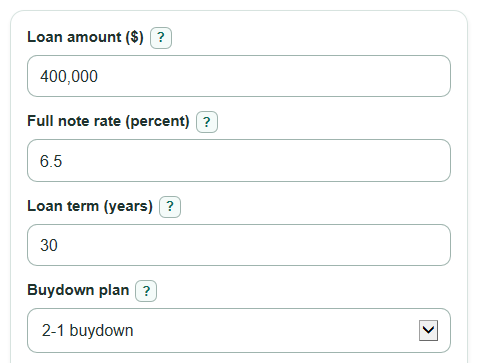
- Enter the Loan amount ($), Full note rate (percent), Loan term (years), and Buydown plan from your loan quote.
- Open Advanced options if you want to test Seller or lender credit available ($), an Expected payoff or refinance month, monthly extras, or a Permanent reduced rate (percent) offer.
- Click Calculate and start with Estimated buydown fund needed, then compare Year 1 buyer payment with Full note-rate payment.
- Use Payment schedule by year to check the math: each row should show a lower buyer payment early, then the payment should step up toward the full note-rate payment.
- If you entered credit or an exit month, review Credit left or extra cash needed and Estimated unused subsidy at that time before comparing offers.
Definitions
Full note rate: The regular yearly interest rate on the mortgage before temporary buydown help.
Temporary buydown: A setup where money is placed in a buydown account and released monthly so the borrower pays as if the rate is lower during early years [2].
Buydown plan: The pattern of rate reductions in percentage points. A 2-1 plan means 2 points lower in year 1 and 1 point lower in year 2.
Estimated buydown fund needed: The total payment gap between the full note-rate payment and the temporary reduced payments during the buydown period.
Full note-rate payment: The principal and interest payment based on the full note rate and the full loan term.
Largest monthly payment jump: The biggest step up from one buydown payment level to the next payment level.
Seller or lender credit available: Money offered toward the buydown. In this calculator, credit left or extra cash needed equals credit minus the estimated buydown fund.
Permanent reduced rate: A lower rate that lasts for the loan, unlike a temporary buydown.
Common mistakes and quick fixes
Mistake: Entering the home price in Loan amount ($).
Fix: Use the mortgage amount after the down payment, not the purchase price.
Mistake: Treating Full note rate (percent) as the lowered first-year rate.
Fix: Enter the regular note rate before the temporary buydown reduction.
Mistake: Picking a Buydown plan that makes the reduced rate below 0%.
Fix: Keep the actual Full note rate (percent) from your quote. Confirm the offered Buydown plan with your lender; a plan that implies a negative rate is outside the supported scope of this calculator. You can still compare deliberately hypothetical terms.
Mistake: Using Taxes, insurance, HOA, and other monthly costs ($) to estimate the buydown fund.
Fix: Enter monthly extras only to see the all-in displayed payment; they do not change Estimated buydown fund needed.
Mistake: Entering only Permanent reduced rate (percent) or only Permanent rate cost ($).
Fix: Enter both fields for the permanent-rate comparison, or leave both blank.
Mistake: Reading a negative Credit left or extra cash needed as bad formatting.
Fix: A negative number means the Seller or lender credit available ($) is short by that amount.
Limitations & Key Assumptions / Boundary Conditions
- The calculator estimates principal and interest payment changes only. Taxes, insurance, HOA dues, mortgage insurance, escrow rules, and fees can change the real monthly bill.
- The buydown fund is estimated as the total monthly payment gap during the temporary buydown period. Your lender's agreement controls the exact funding, accounting, and any unused funds.
- Expected payoff or refinance month is a timing estimate. Actual unused subsidy treatment can differ if the loan is sold, refinanced, paid off, or subject to special contract terms.
- The permanent-rate comparison is a simple break-even calculation. It does not estimate tax effects, points rules, future refinance rates, APR, or how long you will keep the loan.
- If the loan term is shorter than the selected buydown schedule, only months that exist inside the loan term are counted.
- Results depend on the entered loan amount, note rate, term, and plan. Small rate or loan amount changes can move the buydown fund by hundreds or thousands of dollars.
Methodology
Payment formula
The calculator uses the standard fixed-rate principal and interest payment formula for the full note-rate payment and for each reduced buydown rate. Mortgage payments commonly separate principal and interest from other housing costs [1].
monthly_rate = annual_rate_percent / 100 / 12
term_months = loan_term_years * 12
if monthly_rate = 0, payment = loan_amount / term_months
otherwise, payment = loan_amount * monthly_rate / (1 - (1 + monthly_rate)^(-term_months))
Temporary buydown fund
The selected Buydown plan sets the yearly rate reductions in percentage points: 1-0 uses 1, 2-1 uses 2 then 1, 3-2-1 uses 3 then 2 then 1, and 1-1-1 uses 1 in each of the first 3 years. The reduced rate for each year is the full note rate minus that year's reduction.
reduced_rate_y = note_rate_percent - reduction_points_y
monthly_subsidy_y = full_note_payment - reduced_payment_y
months_y = min(12, max(0, term_months - 12 * (y - 1)))
yearly_subsidy_y = monthly_subsidy_y * months_y
total_buydown_fund = add all yearly_subsidy_y
For a $400,000 loan, 30-year term, 6.5% full note rate, and 2-1 buydown, the full note-rate payment is about $2,528.27 per month. The year 1 payment at 4.5% is about $2,026.74, and the year 2 payment at 5.5% is about $2,271.16. The estimated buydown fund is 12 times the year 1 gap plus 12 times the year 2 gap, or about $9,103.76.
Payment jump, credit, and exit timing
The payment path starts with the buydown-year payments and ends with the full note-rate payment. The largest monthly payment jump is the biggest positive step between neighboring payments. If an exit month is entered during the buydown period, the calculator also compares that month's reduced payment with the full note-rate payment.
max_payment_jump = largest positive value of next_payment - current_payment
If Seller or lender credit available ($) is entered, the calculator keeps the signed difference.
credit_surplus_or_gap = available_credit - total_buydown_fund
If Expected payoff or refinance month is entered, the calculator counts only subsidy months used before that month, with each buydown year capped from 0 to 12 months.
used_subsidy_by_exit = add monthly_subsidy_y * min(12, max(0, expected_exit_month - 12 * (y - 1)))
unused_subsidy_at_exit = total_buydown_fund - used_subsidy_by_exit
Extras and permanent-rate comparison
Taxes, insurance, HOA, and other monthly costs ($) are added to the displayed year 1 payment only. They do not change the buydown fund.
all_in_year_1_payment = year_1_payment + monthly_extra_costs
For a permanent-rate offer, the calculator computes the payment at the Permanent reduced rate (percent). If that payment is lower than the full note-rate payment, break-even time is the Permanent rate cost ($) divided by the monthly savings.
permanent_payment = payment(loan_amount, permanent_rate_percent, term_months)
if full_note_payment - permanent_payment > 0, permanent_breakeven_months = permanent_cost / (full_note_payment - permanent_payment)
otherwise, permanent_breakeven_months = N/A
Sources
- How do mortgage lenders calculate monthly payments? | Consumer Financial Protection Bureau - Consumerfinance
- Loan Delivery Job Aids: Overview of Temporary Buydown - Fanniemae
- How should I use lender credits and points (also called discount points)? | Consumer Financial Protection Bureau - Consumerfinance