
Estimate how a shared EV charger limit splits across cars, then see amps, power, energy, miles, and low-current warnings.
Table of contents
How to use our EV Charger Load Sharing Calculator
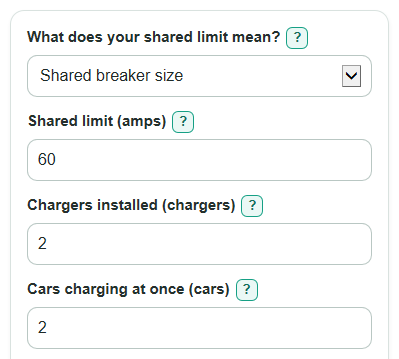
- Choose What does your shared limit mean?, then enter Shared limit (amps). Use breaker size only when the number is the actual circuit breaker amps.
- Enter Chargers installed (chargers), Cars charging at once (cars), and Max each charger can use (amps). The last one is the charger output setting, not the breaker size.
- Open Advanced options if you want to change How to split power, Charging voltage (volts), Charging time (hours), Energy that reaches the battery (percent), Car efficiency (miles per kWh), Minimum useful current per car (amps), or Number display.
- Click Calculate and read Slowest car charging current first. Then compare Estimated miles added per car with the driving you need before the next charge window.
- Sanity-check the result: Total EV charging current should not be higher than the shared charging limit after the breaker adjustment, and Amps above or below your minimum should make sense for the number of cars.
Definitions
EVSE: Electric vehicle supply equipment, which is the wall charging equipment that sends power to the car.
Load sharing: A setup where multiple chargers take turns or split one shared amp limit instead of each charger using its full power at the same time.
Shared limit (amps): The current limit for all active chargers together. It may be a breaker size or an already-set EV charging limit, depending on What does your shared limit mean?.
Continuous load: A load that may run for hours. For breaker-size entries, this calculator uses 80% of the breaker amps as the shared charging current.
Charging voltage (volts): The electrical pressure used for Level 2 charging. Common choices in this calculator are 240 V and 208 V.
kWh: Kilowatt-hour, a unit of energy. EV battery energy is often measured in kWh.
Minimum useful current per car (amps): The current you want each active car to get before you consider the split too low for practical charging.
Common mistakes and quick fixes
Mistake: Picking EV charging limit in What does your shared limit mean? when Shared limit (amps) is really the breaker size.
Fix: Choose Shared breaker size so the calculator applies the 80% continuous-load planning adjustment.
Mistake: Entering breaker amps in Max each charger can use (amps).
Fix: Enter the charger output setting, such as 32, 40, or 48 amps.
Mistake: Making Cars charging at once (cars) higher than Chargers installed (chargers).
Fix: Lower Cars charging at once (cars) or raise Chargers installed (chargers) to match the real setup.
Mistake: Leaving Charging time (hours) at 8 when the cars are only plugged in for a short stop.
Fix: Enter the actual charging window before using Estimated battery energy per car or Estimated miles added per car.
Mistake: Treating Estimated miles added per car as guaranteed range.
Fix: Adjust Car efficiency (miles per kWh) to match your vehicle and remember that weather, speed, tires, and hills can change real miles.
Mistake: Ignoring Amps above or below your minimum when it is negative.
Fix: Reduce Cars charging at once (cars), raise the shared charging limit if allowed, or use a lower Minimum useful current per car (amps) only if your equipment supports it.
Limitations & Key Assumptions / Boundary Conditions
- This is a planning calculator, not an electrical permit or code approval. Local code, equipment instructions, permits, and a licensed electrician decide the final installation.
- If What does your shared limit mean? is Shared breaker size, the calculator multiplies Shared limit (amps) by 0.80. If it is EV charging limit, the calculator does not apply that adjustment again.
- Estimated battery energy per car uses the average current per active car. With Fill first in order, earlier cars may get more energy and later cars may get less.
- Estimated miles added per car depends on Car efficiency (miles per kWh). Real driving range changes with speed, temperature, tire pressure, cabin heat or air conditioning, hills, and battery condition.
- The calculator does not model whole-home service load, solar, batteries, utility demand limits, or automatic systems that change the limit minute by minute.
- Minimum useful current per car (amps) is only a planning warning. Your charger and vehicle manuals decide the true minimum current and behavior at low current.
Methodology
How the split is calculated
The calculator first turns the entered Shared limit (amps) into the charging current available to all active cars. If you chose Shared breaker size, it uses 80% of that breaker size. If you chose EV charging limit, it treats the number as already being the shared EV charging current.
shared_continuous_amps = shared_limit_amps * 0.80 when limit_type = breaker
shared_continuous_amps = shared_limit_amps when limit_type = ev_limit
Next it limits the total EV current so the active chargers cannot draw more than their own installed output settings.
total_ev_current_amps = min(shared_continuous_amps, active_chargers * max_each_amps)
For Even split, every active car gets the same current.
slowest_car_amps = total_ev_current_amps / active_chargers
average_car_amps = total_ev_current_amps / active_chargers
For Fill first in order, earlier cars can take up to Max each charger can use (amps) before later cars get what remains. The slowest car is the last car in that order.
average_car_amps = total_ev_current_amps / active_chargers
slowest_car_amps = max(0, min(max_each_amps, shared_continuous_amps - max_each_amps * (active_chargers - 1)))
Power, energy, and miles
Total EV charging power is wall power for all active chargers combined. The calculator converts volts times amps into kilowatts by dividing by 1000.
total_ev_power_kw = total_ev_current_amps * system_voltage / 1000
Estimated battery energy per car uses the average current per active car, the selected Charging voltage (volts), the Charging time (hours), and Energy that reaches the battery (percent).
energy_per_car_kwh = average_car_amps * system_voltage / 1000 * charge_hours * charging_efficiency_percent / 100
Estimated miles added per car multiplies battery energy by Car efficiency (miles per kWh).
miles_per_car = energy_per_car_kwh * miles_per_kwh
The minimum-current check stays signed, so a negative value shows how many amps short the shared setup is for the selected number of cars.
minimum_amp_margin = shared_continuous_amps - active_chargers * minimum_each_amps
Mini example
For two cars sharing a 60 amp breaker with 48 amp chargers, the shared charging current is 60 * 0.80 = 48 amps. With Even split, each car gets 24 amps. At 240 volts, total EV charging power is 48 * 240 / 1000 = 11.52 kW. Over 8 hours at 90% energy-to-battery efficiency, each car gets 24 * 240 / 1000 * 8 * 0.90 = 41.472 kWh. At 3.5 miles per kWh, that is about 145 miles per car.