
Calculate a 555 one-shot pulse time, or find the resistor or capacitor needed for your target delay.
Table of contents
How to use our 555 Monostable Timer Calculator
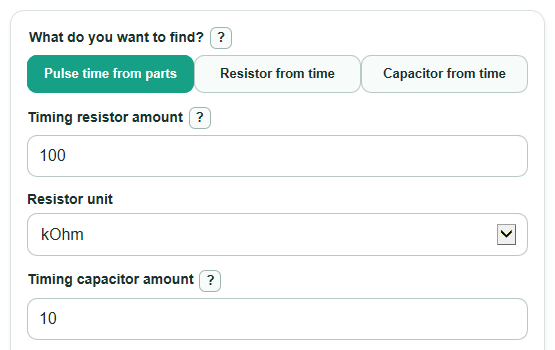
- Choose What do you want to find?: Pulse time from parts, Resistor from time, or Capacitor from time.
- Enter the visible part values: Timing resistor amount with Resistor unit, Timing capacitor amount with Capacitor unit, or Target pulse time amount with Time unit.
- Open Advanced options if you want the Shortest likely pulse and Longest likely pulse to reflect your Resistor tolerance and Capacitor tolerance.
- Click Calculate, then read Answer first and use Pulse time in seconds to double-check the formula or compare with a datasheet.
- Sanity-check the output: if the result is extremely tiny, very long, or uses an unusual Needed resistor or Needed capacitor, pick a practical part value and recalculate.
Definitions
Monostable: A one-shot timer mode that makes one output pulse after a valid trigger, then returns to its resting state.
Timing resistor amount: The resistor value that helps set how long the timing capacitor charges.
Timing capacitor amount: The capacitor value that charges during the output pulse and helps set the pulse length.
Target pulse time amount: The pulse length you want when the calculator is solving for a missing resistor or capacitor.
Resistor tolerance: How far the real resistor may be above or below its marked value, shown as a percent.
Capacitor tolerance: How far the real capacitor may be above or below its marked value, shown as a percent.
Fastest repeat rate with no overlap: One divided by the pulse time; triggers faster than this may arrive before the one-shot pulse is finished.
Common mistakes and quick fixes
Mistake: Entering 100 for Timing resistor amount while Resistor unit is set to ohm when you meant 100 kOhm.
Fix: Set Resistor unit to kOhm, or enter 100000 if you really want ohms.
Mistake: Mixing up uF and nF in Timing capacitor amount or Capacitor unit.
Fix: Check the capacitor marking, then choose the matching Capacitor unit before you calculate.
Mistake: Using Target pulse time amount in Pulse time from parts mode and expecting it to change the Answer.
Fix: Choose Resistor from time or Capacitor from time when Target pulse time amount is the value you already know.
Mistake: Leaving Resistor tolerance or Capacitor tolerance at values that do not match your real parts.
Fix: Enter the percent printed on the part or datasheet so Shortest likely pulse and Longest likely pulse are more useful.
Mistake: Treating Fastest repeat rate with no overlap as a guarantee that every trigger circuit will behave perfectly.
Fix: Use it as a simple timing guide, then check the trigger signal and the exact 555 circuit you are building.
Limitations & Key Assumptions / Boundary Conditions
- The calculator uses the ideal 555 monostable timing equation, so real NE555, LM555, CMOS 555, and board layouts can differ.
- Very short pulses can be affected by propagation delay, wiring, trigger edge shape, and breadboard stray capacitance.
- Very long pulses can drift because electrolytic capacitor leakage, capacitor tolerance, and the 555 input currents become more important.
- The tolerance range only combines resistor and capacitor tolerances. It does not include temperature drift, leakage, supply voltage effects, or 555 chip variation.
- Needed resistor and Needed capacitor are ideal values. In a real build, choose the nearest practical part value, then recalculate with that value.
- Fastest repeat rate with no overlap is a simple 1 divided by pulse time check. It does not model retriggerable versions or extra trigger-conditioning circuits.
Methodology
Core timing formula
A 555 monostable pulse is set mainly by the resistor-capacitor timing network. In the usual ideal model, the timing capacitor charges until the 555 threshold level ends the output pulse. The calculator uses the common rounded timing factor 1.1, which is close to ln(3) = 1.0986122886681098.
T = 1.1 * R * C
In this formula, T is pulse time in seconds, R is resistance in ohms, and C is capacitance in farads.
Solving backward
When you know the pulse time you want, the same equation is rearranged to find the missing part.
R = T / (1.1 * C)
C = T / (1.1 * R)
R is reported in ohms and C is reported in farads. The Answer card may also show a friendlier unit so the value is easier to read.
Tolerance range
The Shortest likely pulse uses the low end of both part tolerances. The Longest likely pulse uses the high end of both part tolerances.
T_min = 1.1 * R * (1 - Rtol / 100) * C * (1 - Ctol / 100)
T_max = 1.1 * R * (1 + Rtol / 100) * C * (1 + Ctol / 100)
Rtol is Resistor tolerance as a percent, and Ctol is Capacitor tolerance as a percent.
Repeat-rate check
The fastest no-overlap rate is calculated from the ideal pulse time.
rate = 1 / T
This gives hertz, meaning pulses per second.
Mini-example
For Timing resistor amount = 100 kOhm and Timing capacitor amount = 10 uF, the converted values are R = 100000 ohms and C = 0.00001 F.
T = 1.1 * 100000 * 0.00001 = 1.1 seconds
With Resistor tolerance = 5 percent and Capacitor tolerance = 20 percent, the estimated range is 0.836 seconds to 1.386 seconds. The fastest no-overlap rate is 1 / 1.1 = 0.9091 Hz.