
Estimate heat pump savings, electricity use, payback time, and break-even rates using last season's heating fuel bill.
Table of contents
How to use our Heat Pump Savings Calculator
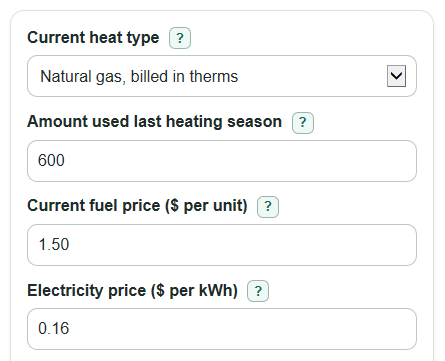
- Pick Current heat type, then enter Amount used last heating season and Current fuel price from your bill.
- Enter Electricity price and Heat pump COP, using all-in rates when you can.
- Open Advanced options if you want to change Current heater efficiency, Heat replaced by the heat pump, Net upfront cost after rebates, or Avoided old-fuel fixed charge.
- Select Calculate, then compare Estimated yearly savings, New heating energy cost, Heat pump electricity use, and Simple payback time.
- Sanity-check the result: if Heat pump electricity use seems much higher than your whole-home annual kWh, recheck the fuel amount, COP, and whether the bill includes non-heating uses.
Definitions
COP: Coefficient of performance. It tells how many units of heat the heat pump delivers for each unit of electricity it uses.
Heat pump: A heating system that uses electricity to move heat instead of making all heat directly from electricity or burning fuel [2].
Btu: British thermal unit, a small unit of heat energy used to compare fuels.
Million Btu: One million Btu. The calculator uses this so natural gas, propane, oil, electricity, and heat pump output can be compared on the same heat basis.
Therm: A common natural gas billing unit equal to 100,000 Btu in this calculator.
Current heater efficiency: The percent of fuel heat that becomes useful heat in the home.
Heat replaced by the heat pump: The percent of your heating load handled by the heat pump instead of the old heating system.
Simple payback time: The number of years it takes yearly savings to equal the net upfront cost, before financing, repairs, or future price changes.
Common mistakes and quick fixes
Mistake: Using a total gas or electric bill as Amount used last heating season when the bill also includes water heating, cooking, or cooling.
Fix: Use heating-only fuel if you can, or lower Amount used last heating season to remove non-heating use.
Mistake: Mixing units between Current heat type and Current fuel price.
Fix: If Current heat type is propane in gallons, enter Current fuel price as $ per gallon, not $ per therm or $ per tank.
Mistake: Treating Electricity price as only the supply charge.
Fix: Use your total electric bill divided by kWh for Electricity price when delivery charges change with use.
Mistake: Entering a best-case lab value for Heat pump COP when your winter climate or equipment will average lower.
Fix: Use a seasonal or quote-based Heat pump COP if you have one, then compare the COP needed to break even.
Mistake: Leaving Heat replaced by the heat pump at 100 percent for a dual-fuel setup.
Fix: Lower Heat replaced by the heat pump to match the share the heat pump will actually cover.
Mistake: Putting the full quote in Net upfront cost after rebates even when rebates or tax credits are likely.
Fix: Enter the expected out-of-pocket cost after rebates in Net upfront cost after rebates.
Limitations & Key Assumptions / Boundary Conditions
- The estimate is only as good as last season's heating fuel amount. A warmer or colder winter can change real savings.
- Fuel heat content values are fixed in the calculator. Actual fuel quality can vary slightly.
- Heat pump COP is treated as one average number. Real COP changes with outdoor temperature, duct losses, thermostat settings, and defrost cycles.
- Heat replaced by the heat pump assumes the replaced and unreplaced heat have the same average cost per delivered heat.
- The calculator includes variable heating energy costs and any Avoided old-fuel fixed charge you enter. It does not include maintenance, financing, panel upgrades, repairs, or cooling savings.
- Simple payback time is shown as N/A when Estimated yearly savings are zero or negative, or when Net upfront cost after rebates is zero or blank.
- For electric resistance, using 100 percent Current heater efficiency is usually the closest match to the formula. Changing it changes the delivered heat estimate.
Methodology
What the formulas do
The calculator starts with last season's fuel use, converts that fuel to useful heat delivered to the home, then estimates how much electricity a heat pump would need for the selected share of that heat.
delivered_mmbtu = annual_fuel_used * heat_content_btu_per_unit * (current_heater_efficiency / 100) / 1000000
current_annual_cost = annual_fuel_used * current_fuel_price
heat_pump_kwh = delivered_mmbtu * (heat_pump_share / 100) * 1000000 / 3412.141633 / heat_pump_cop
The new cost includes heat pump electricity plus any part of the old heating system that still remains.
new_annual_energy_cost = heat_pump_kwh * electricity_price + current_annual_cost * (1 - heat_pump_share / 100)
annual_savings = current_annual_cost - new_annual_energy_cost + avoided_fixed_charge * 12
simple_payback_years = net_upfront_cost / annual_savings
Simple payback is only shown when both net upfront cost and yearly savings are positive.
Cost comparison and break-even checks
The calculator also converts both systems to cost per million Btu of useful heat. That makes unlike fuels easier to compare.
current_cost_per_mmbtu = current_fuel_price / (heat_content_btu_per_unit / 1000000 * current_heater_efficiency / 100)
heat_pump_cost_per_mmbtu = electricity_price * (1000000 / 3412.141633) / heat_pump_cop
break_even_cop = electricity_price * (1000000 / 3412.141633) / current_cost_per_mmbtu
break_even_electricity_price = heat_pump_cop * current_cost_per_mmbtu / (1000000 / 3412.141633)
If your entered Heat pump COP is above the break-even COP, the heat pump is cheaper per unit of useful heat. If your Electricity price is below the break-even electric price, the heat pump is cheaper per unit of useful heat.
Mini-example
With 600 therms of natural gas at $1.50 per therm, 90 percent Current heater efficiency, $0.16 per kWh Electricity price, Heat pump COP of 3.0, and full replacement, the calculator estimates 54.0 million Btu of useful heat, 5,275 kWh of Heat pump electricity use, $844 New heating energy cost, about $56 Estimated yearly savings, and about 143 years of Simple payback time for an $8,000 Net upfront cost after rebates.