
Estimate your heat pump replacement cost before and after confirmed rebates, then compare a contractor quote with the model.
Table of contents
How to use our Heat Pump Replacement Cost Calculator
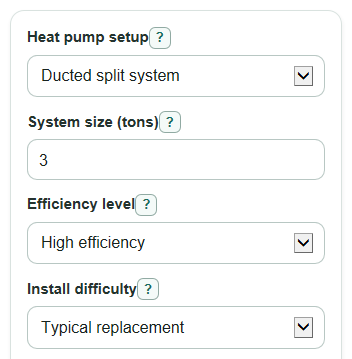
- Choose the Heat pump setup that best matches the equipment being replaced, such as a ducted split system or ductless mini-split.
- Enter System size in tons, then choose the Efficiency level and Install difficulty that fit the job.
- Open Advanced options if needed, then add Local price level, Ductwork changes, Electrical work, Permits and local fees, Confirmed rebates or credits, and any Contractor quote before rebates.
- Select Calculate and read Estimated cost after rebates first, then compare it with the before-rebate range.
- Sanity-check the result by making sure the Before-rebate price per ton and Your quote compared with the estimate make sense for the size, difficulty, and local market you entered.
Definitions
Heat pump setup: The equipment layout being replaced, such as a ducted split system, packaged ducted unit, or ductless mini-split.
System size: The heat pump's heating or cooling capacity in tons. Tons are capacity, not equipment weight; 1 ton equals 12,000 Btu per hour.
Efficiency level: A rough cost tier for the equipment. Higher efficiency or cold-climate units usually cost more up front.
Install difficulty: How hard the job is for the crew, including access, equipment moves, line-set changes, airflow fixes, and other site work.
Local price level: A multiplier for local labor, permit, overhead, and travel costs compared with an average US area.
Confirmed rebates or credits: Dollar incentives you enter because you believe the project qualifies, such as a utility rebate or tax credit.
Before-rebate price per ton: The modeled contractor price before rebates divided by System size, useful for comparing different sized quotes.
Common mistakes and quick fixes
Mistake: Picking Heat pump setup based on brand instead of equipment layout.
Fix: Choose the setup that matches the job: ducted, packaged, one-room ductless, or multi-room ductless.
Mistake: Entering home square footage or equipment weight in System size.
Fix: Enter heat pump capacity in tons; tons mean heating or cooling capacity, not how heavy the unit is.
Mistake: Putting hoped-for incentives in Confirmed rebates or credits.
Fix: Enter only rebate, tax credit, or utility credit dollars you believe you qualify for, and verify the rules before budgeting.
Mistake: Double-counting Ductwork changes, Electrical work, or Permits and local fees when those costs are already included in a contractor bid.
Fix: Add those lines only if they are extra costs outside the base replacement price you want to model.
Mistake: Typing an after-rebate bid in Contractor quote before rebates.
Fix: Use the contractor's project price before rebates or credits so Your quote compared with the estimate is fair.
Mistake: Leaving Local price level at average when labor, permits, or travel costs are unusually high.
Fix: Use High-cost area or Very high-cost area when quotes in your area usually run above national averages.
Limitations & Key Assumptions / Boundary Conditions
- The built-in per-ton amounts, adjustment factors, and percentage range are illustrative budgeting assumptions, not verified current local market prices or a confidence interval. Compare itemized quotes with matching equipment and installation scope; the midpoint is not a fair-price test.
- The model is for air-source heat pump replacement setups listed in Heat pump setup. It does not estimate geothermal systems.
- System size is used as a cost driver only. A contractor should use a load calculation to size the equipment for the home.
- Confirmed rebates or credits are subtracted as a user-entered dollar amount. Actual eligibility can depend on product model, install date, income, location, utility rules, and tax situation.
- Ductwork changes, Electrical work, and Permits and local fees are only included when entered. If a quote already includes those items, do not add them again.
- Estimated cost after rebates is floored at $0, so large incentives will not create a negative displayed project cost.
Methodology
Cost model
The calculator estimates an air-source heat pump replacement for ducted, packaged, and ductless setups; air-source heat pumps move heat between indoor air and outdoor air [1].
capacity_kBtu_per_hour = size_tons * 12
The base price starts with a fixed cost plus a cost per ton. The constants are: ducted split $2,600 plus $3,200 per ton; packaged unit $2,300 plus $3,000 per ton; one-room ductless $2,200 plus $3,600 per ton; multi-room ductless $4,000 plus $3,900 per ton.
base_mid = (type_fixed_cost + size_tons * type_cost_per_ton) * efficiency_multiplier
Efficiency multipliers are 0.95 for standard efficiency, 1.05 for high efficiency, and 1.15 for cold-climate or top efficiency. Install difficulty multipliers are 0.90 for easy, 1.00 for typical, 1.18 for hard, and 1.35 for very hard. Local price multipliers are 0.90 for low-cost, 1.00 for average, 1.15 for high-cost, and 1.30 for very high-cost.
project_cost_mid = base_mid * complexity_multiplier * region_multiplier + ductwork_changes + electrical_work + permit_and_fees
The low and high before-rebate range uses a spread based on Install difficulty: 0.12 for easy, 0.18 for typical, 0.25 for hard, and 0.32 for very hard.
project_cost_low = project_cost_mid * (1 - range_spread)
project_cost_high = project_cost_mid * (1 + range_spread)
Confirmed rebates or credits are subtracted from the before-rebate estimates. Incentive eligibility should be checked against the program, product, and tax-credit rules before relying on it [2].
net_cost_mid = max(0, project_cost_mid - rebates_and_credits)
net_cost_low = max(0, project_cost_low - rebates_and_credits)
net_cost_high = max(0, project_cost_high - rebates_and_credits)
price_per_ton_before_rebates = project_cost_mid / size_tons
If Contractor quote before rebates is entered, the quote check keeps the sign of the difference.
quote_gap_before_rebates = contractor_quote - project_cost_mid
Worked mini-example
For a 3 ton ducted split system with high efficiency, typical install difficulty, average local price level, $0 ductwork, $0 electrical work, $300 permits, and $0 rebates, the base midpoint is (2600 + 3 * 3200) * 1.05 = $12,810. Adding $300 in permits gives a before-rebate midpoint of $13,110. With the typical 0.18 spread, the before-rebate range is $10,750.20 to $15,469.80, and the after-rebate range is the same because rebates are $0.
Calculation choices
Blank optional money adders are treated as $0, except Contractor quote before rebates, which is skipped when blank. Negative money entries are rejected. The after-rebate cost is floored at $0 because a replacement budget should not be shown as a negative cost.