
Estimate how much an electric heater may add to your bill using watts, run time, weekly use, and electricity price.
Table of contents
How to use our Electric Heater Running Cost Calculator
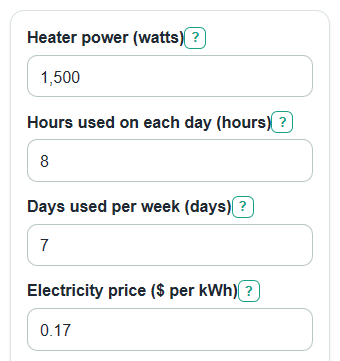
- Enter Heater power (watts) from the label on your heater, not the room size or heat setting name.
- Enter Hours used on each day (hours) and Days used per week (days) for a typical week.
- Enter Electricity price ($ per kWh) from your electric bill when possible; the default is only a starter estimate.
- Open Advanced options if you want to adjust Time actually heating (percent), Number of heaters (heaters), or Days in cost estimate (days).
- Check whether Electricity used for selected days looks reasonable compared with your bill usage; if it is much too high or low, recheck watts, hours, days, and on-time percent.
Definitions
Heater power (watts): The rated electric power from the heater label. More watts means more electricity used while the heater is heating.
Kilowatt-hour (kWh): A unit of electricity use. Electric bills commonly charge by kWh; 1 kWh is 1 kilowatt used for 1 hour [3].
Electricity price ($ per kWh): The cost for each kWh. For a bill estimate, use your delivered price if your bill shows one.
Time actually heating (percent): The share of the clock time when the heating element is on. A thermostat, timer, or eco mode can make this less than 100%.
Use day: A day when the heater is turned on for the hours you entered.
Average cost per calendar day: Weekly heater cost spread across all 7 days, even if the heater is used on only some days.
Common mistakes and quick fixes
Mistake: Using a heat setting name instead of Heater power (watts) .
Fix: Use the watt number on the heater label, such as 750 or 1500.
Mistake: Entering cents in Electricity price ($ per kWh) , such as 17 instead of 0.17.
Fix: Enter dollars per kWh, so 17 cents becomes 0.17.
Mistake: Treating Hours used on each day (hours) as full-power heating time when the thermostat cycles off.
Fix: Put clock hours in that field, then lower Time actually heating (percent) if the heater cycles.
Mistake: Setting Days used per week (days) to 7 for a heater used only on some days.
Fix: Enter the number of use days in a normal week, such as 3 for three days.
Mistake: Using Number of heaters (heaters) for heaters with different watt ratings or schedules.
Fix: Run the calculator separately for each heater type, then add the costs.
Mistake: Forgetting to change Days in cost estimate (days) to match a real bill.
Fix: Use the number of days in your billing period if you want the estimate to line up with that bill.
Limitations & Key Assumptions / Boundary Conditions
- The estimate assumes the heater draws its rated watts while it is actively heating.
- The calculator does not know your exact thermostat cycle. Time actually heating (percent) is your estimate of that cycle.
- If the heater has multiple heat settings, fan-only mode, or a variable-power design, use the watt rating for the setting you are estimating.
- The default Electricity price ($ per kWh) may not match your home. Delivery charges, supply charges, taxes, and fees can change the real price.
- Yearly cost if this pattern stayed the same extends the same weekly pattern for 365 days. It is not a weather forecast.
- This is a cost and energy estimate only. It does not check outlet load, cord safety, fire risk, or whether the heater is safe for your room.
Methodology
How the calculator works
The calculator first changes heater watts to kilowatts, because electric bills usually measure energy in kilowatt-hours [2]. It then multiplies power by run time, use days, thermostat on-time percent, number of heaters, and your electricity price.
power_kw = heater_watts / 1000
on_time_fraction = on_time_percent / 100
weekly_kwh = power_kw * hours_per_day * days_per_week * on_time_fraction * number_of_heaters
cost_per_clock_hour = power_kw * on_time_fraction * number_of_heaters * electricity_rate
cost_per_use_day = power_kw * hours_per_day * on_time_fraction * number_of_heaters * electricity_rate
weekly_cost = weekly_kwh * electricity_rate
average_cost_per_calendar_day = weekly_cost / 7
period_kwh = weekly_kwh / 7 * billing_days
period_cost = period_kwh * electricity_rate
yearly_cost_at_same_pattern = weekly_cost * 365 / 7
Worked example
For a 1500 W heater used 8 hours per day, 7 days per week, at $0.17 per kWh, with 100% time actually heating and 1 heater, power is 1500 / 1000 = 1.5 kW. Weekly energy is 1.5 * 8 * 7 * 1 * 1 = 84 kWh. Weekly cost is 84 * $0.17 = $14.28. For 30 days, energy is 84 / 7 * 30 = 360 kWh, and cost is 360 * $0.17 = $61.20.
Rounding
Money results are shown to the nearest cent. kWh results are shown to 2 decimals, with extra trailing zeros removed. Internally, the calculator uses the full entered numbers before rounding the displayed results.