
Enter a standard or troy ounce weight to find its mass in milligrams and verify the ounce type on the source label.
Advanced options
Table of contents
How to use our Ounces to Milligrams Converter
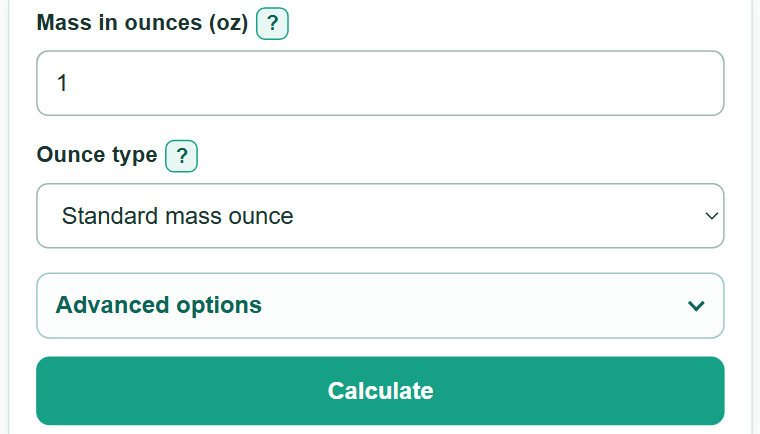
- Enter the weight from your package, scale, product specification, shipping record, or worksheet in "Mass in ounces (oz)".
- Choose "Standard mass ounce (oz)" for ordinary package and scale weights. Choose "Troy ounce (troy oz)" only when the source specifically says troy oz.
- Open "Advanced options" if you need more or fewer digits after the decimal point in the displayed answer.
- Select "Calculate" and read "Converted mass in milligrams" first.
- Check "Ounce meaning used" against the original label. For the same entered number, a troy-ounce conversion should be larger than a standard-ounce conversion.
Definitions
Milligram (mg): A unit of mass equal to one thousandth of a gram.
Standard mass ounce (oz): The ordinary ounce used for most US package and scale weights. It equals 28.349523125 grams. [1]
Troy ounce (troy oz): A mass unit used for precious metals and some other specialized goods. It equals 31.1034768 grams. [1]
Fluid ounce (fl oz): A unit of volume, not mass. Its mass changes with the material's density.
Decimal places: The number of digits shown after the decimal point. This setting changes displayed rounding only.
Common mistakes and quick fixes
Mistake: Entering fl oz as though it were a mass.
Fix: Fluid ounces measure volume. Use a mass in oz, or convert volume to mass first using the material's density.
Mistake: Using the standard-ounce choice for a weight marked troy oz.
Fix: Select "Troy ounce (troy oz)" when the source specifically says troy oz, such as a precious-metal listing.
Mistake: Typing an incorrectly grouped number such as 1,01.
Fix: Use commas only for thousands, such as 1,000. Use a decimal point for decimals, such as 1.01.
Mistake: Rounding the ounce amount before converting it.
Fix: Enter the most precise source value available, then round the milligram answer only when you need to report it.
Mistake: Assuming every oz label means the same mass.
Fix: Compare the source label with "Ounce meaning used" before relying on the converted mass.
Limitations & Key Assumptions / Boundary Conditions
- This converter handles standard mass ounces and troy ounces, not fluid ounces.
- Fluid ounces cannot be converted directly to milligrams because a volume needs the material's density to determine mass.
- The answer depends on the accuracy of the source weight and on selecting the same ounce type shown on the source.
- Low decimal-place settings can display a very small nonzero mass as zero; increase the displayed decimal places when small amounts matter.
- Negative mass is outside the physical input range for this converter.
Methodology
Conversion method
The calculator multiplies the entered mass by the factor for the selected ounce type. Standard mass ounces and troy ounces use different factors. The conversion factors follow NIST customary-unit conversion data. [1]
milligrams = standard ounces x 28,349.523125
milligrams = troy ounces x 31,103.4768
Worked example
For 0.5 standard oz, multiply 0.5 by 28,349.523125. The unrounded answer is 14,174.7615625 mg, which displays as 14,174.762 mg with three decimal places selected.
Calculation details
The calculator keeps the full converted value until it formats the displayed answer. Zero oz converts to exactly 0 mg. It rejects negative values, fluid-ounce entries, and incorrectly grouped numbers such as 1,01 because those inputs do not describe a valid mass for this conversion.