
Enter a millimeter length to find its decimal yards, or switch directions to convert yards to millimeters.
Advanced options
Table of contents
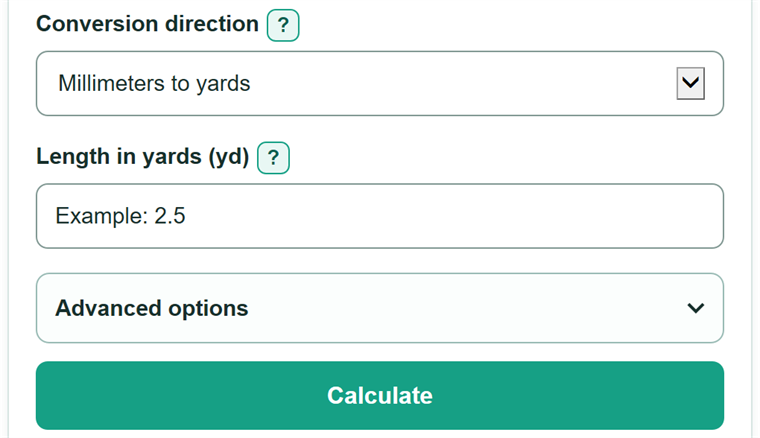
How to use our Millimeters to Yards Converter
- Choose the direction that matches the unit of your starting measurement.
- Enter a nonnegative length from a drawing, ruler, specification, product listing, or worksheet. You can type a matching mm or yd suffix.
- Select Calculate to see the converted linear length in the destination unit.
- Open Advanced options if you need 3, 6, 9, or 12 decimal places shown.
- Sanity-check the direction and unit: 914.4 mm equals 1 yd, while 2 yd equals 1,828.8 mm.
Definitions
Millimeter (mm): A metric unit of linear length. There are 1,000 millimeters in 1 meter.
Yard (yd): A US customary and imperial unit of linear length. One international yard is exactly 0.9144 meter, or 914.4 millimeters.
Decimal yard: A yard measurement written with a decimal point. For example, 0.5 yd is half a yard.
Linear length: Distance in one direction, such as the length of a line or board. It is different from area, which uses square units.
Foot (ft): A linear unit equal to one-third of a yard. One yard equals 3 feet.
Common mistakes and quick fixes
Mistake: Entering centimeters, meters, or inches in the millimeter field.
Fix: Convert the original measurement to millimeters first. Enter a bare number or add an mm suffix only.
Mistake: Treating the answer as square yards.
Fix: This is a linear-length converter. For area in square yards, measure both length and width first.
Mistake: Reading a decimal yard value as yards plus inches.
Fix: A result of 1.5 yd means one and one-half yards. It does not mean 1 yard 5 inches.
Mistake: Typing commas in an unusual pattern, such as 1,01.
Fix: Use commas only as thousands separators, such as 1,000 or 12,500.5. Use a period for the decimal point.
Mistake: Rounding a small result before using it in another calculation.
Fix: Choose more decimal places if your drawing or worksheet needs them, then round only at the final step required by the task.
Limitations & Key Assumptions / Boundary Conditions
- This tool converts nonnegative linear lengths. Negative entries are rejected because they do not describe a physical length for this conversion.
- The result is in decimal linear yards or millimeters, not square yards, cubic yards, or yards and inches.
- Choosing displayed decimal places changes rounding only; the conversion itself uses the unrounded value.
- Extremely large or extremely small values may be limited by browser floating-point number precision.
- Check the source unit before entering a value. A measurement in centimeters or inches must be converted to millimeters before using the millimeter field.
Methodology
Conversion method
The converter uses the exact international relationship that 1 yard equals 914.4 millimeters.
yards = millimeters / 914.4
millimeters = yards * 914.4
In the millimeters-to-yards direction, it also converts the unrounded yard result to feet.
feet = yards * 3
Worked example
For 500 mm, divide 500 by 914.4. This gives about 0.546806649 yd. Multiplying that unrounded yard value by 3 gives about 1.640419948 ft.
Calculation choices
Zero is valid and converts to zero. The calculator rejects blank entries, negative lengths, malformed comma grouping, nonfinite values, and unit suffixes that do not match the active field. It stores the converted value before display rounding, so changing decimal places does not use an already rounded result.