
Enter cubic inches or inside container measurements to find the volume in US liquid or UK/Imperial gallons.
Table of contents
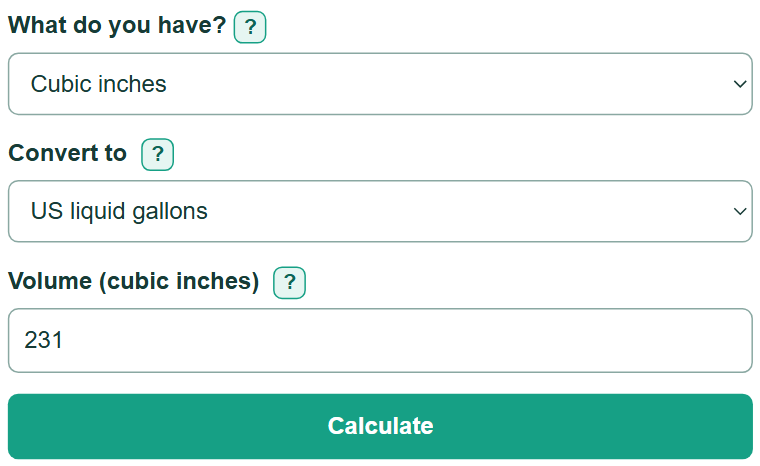
How to use our Cubic Inches to Gallons Converter
- Choose "Cubic inches" when you already know the volume. Choose "Rectangular container measurements" when you need to calculate volume from a container's inside measurements.
- Choose "US liquid gallons" for most US labels, manuals, and measurements. Choose "UK/Imperial gallons" only when the original source uses that gallon type.
- Enter a positive volume in "Volume (cubic inches)," or enter the inside length, inside width, and usable depth in inches.
- Click "Calculate" to see the converted gallon volume and the cubic inches used.
- Check the gallon type beside the answer. The same cubic-inch volume produces a smaller number of UK/Imperial gallons because an Imperial gallon is larger.
Definitions
Cubic inch: A volume equal to the space inside a cube that is 1 inch long, 1 inch wide, and 1 inch high.
US liquid gallon: A US volume unit equal to 231 cubic inches. [2]
UK/Imperial gallon: A gallon unit larger than a US liquid gallon. This converter uses 277.419432791 cubic inches per Imperial gallon.
Usable depth: The inside depth that can actually hold liquid. It can be less than the full inside height.
Common mistakes and quick fixes
Mistake: Entering a length in inches as though it were a volume.
Fix: Use "Volume (cubic inches)" only for a known volume. For length, width, and depth, choose "Rectangular container measurements."
Mistake: Measuring the outside of a container.
Fix: Measure usable inside length, width, and depth. Wall thickness reduces the space available for liquid.
Mistake: Mixing feet or centimeters with inches.
Fix: Convert each rectangular measurement to inches before entering it.
Mistake: Selecting the wrong gallon type.
Fix: Use "US liquid gallons" for most US sources. Select "UK/Imperial gallons" only when that convention is stated.
Mistake: Using full height when the container cannot safely or practically be filled to the top.
Fix: Enter the actual liquid-holding depth in "Usable depth (inches)."
Limitations & Key Assumptions / Boundary Conditions
- This is a volume conversion, not a safe-fill recommendation or a manufacturer's rated-capacity check.
- The rectangular-container calculation assumes straight, rectangular inside walls.
- Curved walls, sloped bottoms, dividers, fittings, and objects inside the container can change the actual capacity.
- Use inside measurements and usable liquid depth. Outside dimensions can overstate capacity.
- All rectangular measurements must be in inches.
- Inputs must be greater than zero because this converter is for positive physical volumes and capacities.
Methodology
Calculation method
For a known volume, the converter uses the entered cubic inches. For a rectangular container, it multiplies inside length by inside width by usable depth. This is the volume rule for a rectangular solid. [1]
cubic inches = inside length x inside width x usable depth
The converter divides that cubic-inch value by the selected gallon conversion. One US liquid gallon equals 231 cubic inches. [2]
US liquid gallons = cubic inches / 231
UK/Imperial gallons = cubic inches / 277.419432791
Mini-example
A rectangular space that is 10 inches long, 12 inches wide, and 5 inches deep holds 600 cubic inches. For US liquid gallons, 600 divided by 231 equals 2.597403 gallons after rounding to six decimal places.
Rounding
The calculator uses the unrounded value for its calculation, then displays gallons and cubic inches to six decimal places.