
Convert teaspoons to fluid ounces fast and choose either the exact US kitchen relationship or the rounded food-label version.
Table of contents
How to use our Teaspoons to Fluid Ounces Converter
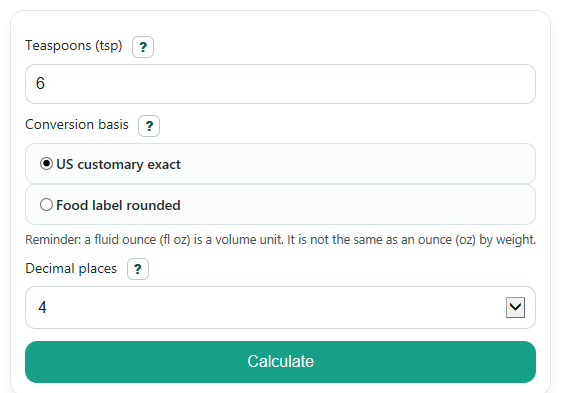
- Enter your value in Teaspoons (tsp). You can use whole numbers or decimals like 0.5 or 1.25.
- Choose a Conversion basis: use US customary exact for standard US kitchen measure relationships, or Food label rounded for common nutrition-label metric equivalents.
- Pick Decimal places if you want more or less rounding in the displayed answer.
- Click Calculate to see Fluid ounces, the Conversion used, and Milliliters.
- Sanity-check the result: if you entered 6 teaspoons, the Fluid ounces result should be 1 fl oz in either basis, while Milliliters will differ slightly by basis.
Definitions
Teaspoon (tsp): A small volume unit used in cooking and labeling.
Fluid ounce (fl oz): A volume unit, not a weight unit.
Conversion basis: The unit relationship the calculator uses to convert your value.
US customary exact: Uses the kitchen relationship 1 fl oz = 6 tsp.
Food label rounded: Uses common label-style metric values of 1 tsp = 5 mL and 1 fl oz = 30 mL [2].
Milliliters (mL): A metric volume unit shown as a cross-check.
Decimal places: How many digits appear after the decimal point in the displayed result.
Common mistakes and quick fixes
Mistake: Entering text or leaving Teaspoons (tsp) blank.
Fix: Type a number in Teaspoons (tsp) , such as 6 or 1.5.
Mistake: Reading Fluid ounces as ounces by weight.
Fix: Use Fluid ounces only for volume. Weight ounces are different.
Mistake: Picking the wrong Conversion basis for your task.
Fix: Use US customary exact for kitchen measure relationships and Food label rounded for label-style metric equivalents.
Mistake: Thinking the Milliliters value should always match across both bases.
Fix: Check Conversion used . Exact mode uses 29.5735295625 mL per fl oz, while food-label mode uses 30 mL per fl oz.
Mistake: Using too few Decimal places and assuming the rounded answer is exact.
Fix: Increase Decimal places when you need a closer displayed value.
Mistake: Entering a negative value in Teaspoons (tsp) and treating it like a physical amount.
Fix: A negative result usually means a correction or difference. Check the Note and confirm your sign.
Limitations & Key Assumptions / Boundary Conditions
- This converter handles volume only. It does not convert ounces by weight.
- The US customary exact and Food label rounded bases can give the same fluid-ounce number but slightly different milliliter values.
- Displayed answers are rounded to the selected Decimal places, so the shown value may be shorter than the full internal value.
- Negative inputs are allowed mathematically, but they usually describe a correction or change, not a real physical volume.
- The calculator converts teaspoons directly to fluid ounces and milliliters only. It does not estimate density, mass, or ingredient-specific weight.
Methodology
Calculation steps
The calculator first reads Teaspoons (tsp), then applies the selected Conversion basis. It shows the answer in Fluid ounces and also gives Milliliters as a cross-check.
Formulas used
fluid ounces = teaspoons / 6
fluid ounces = (teaspoons x 5) / 30
milliliters = fluid ounces x mL per fluid ounce
Basis details
In US customary exact, the converter uses 1 fluid ounce = 6 teaspoons. For the milliliter cross-check, it uses 29.5735295625 mL per US fluid ounce.
In Food label rounded, the converter uses 1 teaspoon = 5 mL and 1 fluid ounce = 30 mL [2]. That makes the fluid-ounce conversion simplify to teaspoons divided by 6, but the milliliter result follows the rounded labeling basis.
Mini example
If you enter 3 teaspoons in US customary exact mode:
fluid ounces = 3 / 6 = 0.5 fl oz
milliliters = 0.5 x 29.5735295625 = 14.78676478125 mL
If you enter the same 3 teaspoons in Food label rounded mode:
fluid ounces = (3 x 5) / 30 = 0.5 fl oz
milliliters = 0.5 x 30 = 15 mL
Assumptions and limits
This page assumes US teaspoon and US fluid ounce relationships, not other countries' spoon or ounce definitions. It also assumes you want a volume conversion only. Rounding changes how many digits you see, but not the underlying conversion basis.