
Convert grams to teaspoons or teaspoons to grams using the ingredient you picked, so the math matches weight and volume more closely.
Table of contents
How to use our Grams to Teaspoons Converter
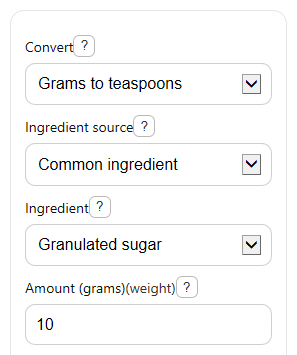
- Choose a direction in Convert: either grams to teaspoons or teaspoons to grams.
- Pick Ingredient source, then either choose a preset in Ingredient or enter Custom weight per teaspoon (g per tsp).
- Enter the active amount in Amount (grams) or Amount (teaspoons), then choose Show result as if you want decimals or kitchen-style fractions.
- Click Calculate and read Converted amount, then check Weight used for 1 teaspoon to see the exact assumption behind the answer.
- Sanity-check the result: if it looks too big or too small, confirm you used the right ingredient and remember that grams are weight while teaspoons are volume.
Definitions
Grams (g): A unit of weight or mass. In this tool, grams tell you how heavy the ingredient is.
Teaspoons (tsp): A unit of volume. In this tool, teaspoons tell you how much space the ingredient takes up.
Ingredient source: Whether the calculator uses a common preset ingredient or your own custom grams-per-teaspoon value.
Weight used for 1 teaspoon: The grams-per-teaspoon assumption used in the math. This is the most important number to check when comparing results.
Custom weight per teaspoon (g per tsp): Your own value for how many grams one level teaspoon of the ingredient weighs.
Kitchen fractions: Spoon-friendly rounded amounts such as 1/8, 1/4, 1/3, 1/2, 2/3, or 3/4 teaspoon.
Common mistakes and quick fixes
Mistake: Entering a value in Amount (grams) while Convert is set to teaspoons to grams.
Fix: Use Amount (teaspoons) in that mode, because the tool ignores the hidden direction's field.
Mistake: Leaving Ingredient on the wrong preset, such as sugar when you really mean flour.
Fix: Recheck Ingredient before you trust Converted amount , since each ingredient uses a different weight per teaspoon.
Mistake: Choosing Custom grams per teaspoon in Ingredient source but leaving Custom weight per teaspoon (g per tsp) blank or at 0.
Fix: Enter a positive number for Custom weight per teaspoon (g per tsp) .
Mistake: Assuming 1 gram always equals 1 teaspoon.
Fix: Check Weight used for 1 teaspoon ; that value shows why different ingredients convert differently.
Mistake: Picking Kitchen fractions in Show result as and treating a tiny result like exact zero.
Fix: If the spoon amount is very small, switch Show result as to decimal so you can see the exact estimate more clearly.
Limitations & Key Assumptions / Boundary Conditions
- This converter gives an estimate because teaspoon conversions depend on the ingredient, not just the number of grams.
- Preset values are based on standard kitchen references and can differ from your brand, grind, crystal size, moisture level, or how tightly the ingredient is packed.
- The teaspoon here is a US teaspoon. A different spoon size or a casual eating spoon can change the real-world amount.
- Custom results are only as accurate as the Custom weight per teaspoon (g per tsp) value you enter.
- Fraction display is meant for kitchen convenience. If rounding to a kitchen fraction changes the value too much, use decimal display for a closer estimate.
- This tool expects a positive amount in the active field only. Zero, negative values, or invalid text are not valid kitchen conversions.
Methodology
Core idea
This calculator converts between weight and volume using a grams-per-teaspoon value for the selected ingredient. That matters because grams measure weight, while teaspoons measure volume, so the ingredient changes the result.
Formulas used
teaspoons = grams / grams_per_teaspoon
grams = teaspoons * grams_per_teaspoon
grams_per_teaspoon_water = density_water_g_per_mL * mL_per_teaspoon
Preset assumptions
For common ingredients, the calculator uses a fixed grams-per-teaspoon value. Examples include granulated sugar = 4.2 g/tsp, all-purpose flour = 2.5 g/tsp, baking powder = 4 g/tsp, butter = 4.7083333333 g/tsp, baking soda = 6 g/tsp, and water = 4.92892159375 g/tsp. Ingredient chart values are supported by baking reference tables.[1]
Worked mini-example
If you convert 10 grams of granulated sugar to teaspoons, the calculator uses 4.2 g/tsp.
teaspoons = 10 / 4.2 = 2.380952381
So the main result is about 2.38 tsp, or a nearby kitchen fraction if that display option is chosen.
If you convert 2 teaspoons of baking powder to grams, the calculator uses 4 g/tsp.
grams = 2 * 4 = 8
So the result is 8 g.
How fraction display works
When fraction display is selected, the tool tries practical kitchen fractions such as 1/8, 1/4, 1/3, 1/2, 2/3, and 3/4 teaspoon. If that rounding would hide too much error, the decimal value should be treated as the more precise answer.
Assumptions and limits
The water preset is based on an approximate density of 1 g/mL and a US teaspoon of 4.92892159375 mL, so water comes out to about 4.92892159375 g per teaspoon. Real kitchen results can still vary with temperature, packing, leveling, and ingredient texture. The calculator also uses only the active input for the chosen direction and ignores the other amount field.