
Convert liters to cups using the cup standard that matches your recipe, label, or measuring system.
Advanced options
Table of contents
How to use our Liters to Cups Converter
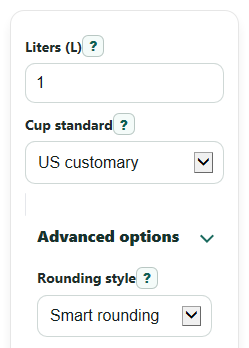
- Enter your amount in Liters (L). You can use whole numbers or decimals like 0.5 or 1.25.
- Choose the right Cup standard. Most US recipes use US customary, while some charts or international recipes use metric, imperial, or US legal cups.
- If you want, open Advanced options and pick a Rounding style for how the answer is shown.
- Click Calculate to see Cups, Kitchen breakdown, Cup size used, and Formula used.
- Sanity-check the result by comparing Cup size used and Note with your recipe source. If another site gives a different answer, it may be using a different cup standard.
Definitions
Liter (L): A metric unit of volume. This converter changes that amount into cups.
Cup standard: The cup size used for the conversion. Different standards use different milliliter amounts, so the answer can change.
US customary cup: A common US recipe cup, equal to about 236.588 mL.
Metric cup: A 250 mL cup often used in metric cooking references.
Imperial cup (UK): A larger cup based on the UK imperial system, about 284.131 mL.
US legal cup: A 240 mL cup often used in US nutrition labeling contexts.
Kitchen breakdown: A recipe-friendly version of the result shown as whole cups plus a smaller remainder, such as tablespoons or leftover mL depending on the cup standard.
Cup size used: The exact mL-per-cup value used in the math, so you can compare standards and explain differences.
Common mistakes and quick fixes
Mistake: Leaving Liters (L) blank or typing text instead of a number.
Fix: Enter a non-negative number in Liters (L) , such as 1, 0.75, or 2.5.
Mistake: Using the default Cup standard when your recipe actually uses metric or UK cups.
Fix: Match Cup standard to the source before trusting the Cups result.
Mistake: Thinking Cups should match every website exactly.
Fix: Check Cup size used and Formula used to see which cup definition was applied.
Mistake: Reading Kitchen breakdown as exact lab-level precision.
Fix: Use Kitchen breakdown for measuring convenience, and use Cups when you need the more exact decimal value.
Mistake: Changing Rounding style and assuming the real conversion changed.
Fix: Remember that Rounding style changes display only. The core math behind Cups stays the same.
Mistake: Ignoring the Note when using US legal or Imperial (UK) .
Fix: Read the Note and make sure you are not mixing recipe systems by accident.
Limitations & Key Assumptions / Boundary Conditions
- This converter only works for non-negative values in Liters (L). Negative amounts, blank entries, and non-numeric text should be treated as errors.
- The result depends on the selected Cup standard. Two correct sites can disagree if they use different cup sizes.
- Kitchen breakdown is for practical measuring, not perfect laboratory precision. Small rounding differences are normal.
- Metric cup recipes can be awkward to express in tablespoons because tablespoon standards vary. In that case, a leftover mL remainder may be clearer than tablespoons.
- Rounding style changes how values are displayed, not the underlying conversion math.
- This tool converts volume only. It does not convert ingredient weight, density, or recipe yield.
Methodology
Core method
The converter first changes liters to milliliters, then divides by the milliliters in the selected cup standard.
cups = liters * 1000 / mL_per_cup
Here, 1000 is the number of milliliters in 1 liter, and mL_per_cup depends on the selected Cup standard.
Cup sizes used
US customary: mL_per_cup = 236.5882365
Metric: mL_per_cup = 250
Imperial (UK): mL_per_cup = 284.130625
US legal: mL_per_cup = 240
Kitchen breakdown
After finding the decimal cup result, the tool splits it into whole cups plus a smaller remainder.
whole_cups = floor(cups)
remainder = cups - whole_cups
For US customary, US legal, and imperial cup displays, the remainder can be shown in tablespoons using 16 tablespoons per cup.
tablespoons = remainder * 16
For the metric 250 mL cup, a leftover mL remainder is often clearer than tablespoons because tablespoon conventions vary.
leftover_mL = remainder * 250
Mini example
If Liters (L) is 1 and Cup standard is US customary, the math is:
cups = 1 * 1000 / 236.5882365 = 4.2267528377
That means the main result is about 4.227 cups before display rounding. A kitchen-friendly version is 4 cups plus about 3.63 tablespoons.
Display rounding
Rounding style changes only how the answer is shown. The conversion is still calculated from the same full-precision value first, then rounded for display.
Practical notes
If your answer does not match another converter, compare the Cup size used. The most common reason for a mismatch is that one converter used a different cup standard, not different liters.
Assumptions used
This tool assumes exact liter-to-milliliter conversion and fixed cup-size definitions for each standard. Real recipes may still differ because authors sometimes mix systems, round aggressively, or use a cup meaning that is not stated clearly.