
Enter pints, choose US liquid, US dry, or Imperial, and get the matching volume in milliliters.
Advanced options
Table of contents
How to use our Pints to mL Converter
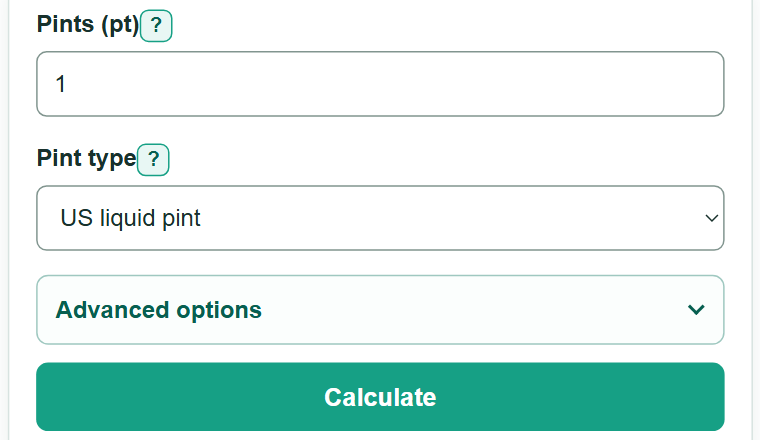
- Enter the quantity from your recipe, package, worksheet, or note in "Pints (pt)". Decimals, fractions such as 1/4, and mixed numbers such as 1 1/2 work.
- Choose the matching "Pint type". Use "US dry pint" only when the source says dry pint, and choose "Imperial pint" only when the source identifies that standard.
- Click "Calculate" to see the equivalent volume in mL.
- Read the "Pint standard used" card before copying the number. The same number of pints gives different mL amounts under different standards.
- Open "Advanced options" if an assignment or measuring tool requires a different number of displayed decimal places.
Definitions
Pint (pt): A volume unit. Its size depends on whether it is a US liquid, US dry, or Imperial pint.
US liquid pint: A US volume unit commonly used for liquids. One US liquid pint is 473.176473 mL.
US dry pint: A different US volume unit used only when a source identifies a dry pint. One US dry pint is 550.6104713575 mL.
Imperial pint: A volume unit in the Imperial system. One Imperial pint is 568.26125 mL.
Milliliter (mL): A metric volume unit equal to one thousandth of a liter.
Conversion factor: The number of milliliters in one pint of the selected type.
Common mistakes and quick fixes
Mistake: Treating every pint as the same volume.
Fix: Select the pint type named by the source before calculating.
Mistake: Selecting a US dry pint for a normal US liquid recipe.
Fix: Choose "US liquid pint" unless the source specifically says "dry pint."
Mistake: Using an Imperial pint for a US source, or a US pint for an Imperial source.
Fix: Check the source wording and country. Select "Imperial pint" only when that standard is stated.
Mistake: Typing 1,01 to mean one point zero one pints.
Fix: Use 1.01. Commas are only for thousands separators, such as 1,000.
Mistake: Rounding before converting.
Fix: Enter the original amount and use the displayed mL result. Change decimal places only after checking the pint type.
Limitations & Key Assumptions / Boundary Conditions
- The answer depends on the selected pint standard. If a source says only "pint," check which system it uses before relying on the conversion.
- This is a volume converter, not a weight converter. A pint of an ingredient does not have a fixed weight because density and packing can vary.
- Changing displayed decimal places changes rounding only. The calculation uses the full conversion factor.
- Recipe measures, package markings, and measuring cups may already be rounded, even when the converted answer shows more digits.
- Only zero and positive pint quantities are accepted. Negative volume amounts are outside this converter's range.
Methodology
Calculation
The converter selects a milliliters-per-pint factor for the chosen pint type, then multiplies that factor by the entered quantity. The three pint types use different factors because they are different volume units. [1]
milliliters = pints x milliliters per selected pint
US liquid: 473.176473 mL/pt; US dry: 550.6104713575 mL/pt; Imperial: 568.26125 mL/pt
Worked example
For 1.5 US liquid pints, multiply 1.5 by 473.176473 mL per pint.
1.5 x 473.176473 = 709.7647095 mL
At three decimal places, the displayed answer is 709.765 mL. Rounding happens after multiplication, not before it.