
Convert liters to milliliters instantly and see the exact answer plus the simple multiply-by-1,000 step.
Table of contents
How to use our Liters to mL Converter
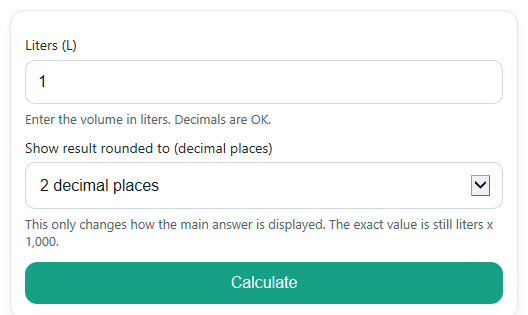
- Enter your amount in Liters (L). You can use whole numbers, decimals, zero, or a negative value if you need a signed conversion.
- Choose Show result rounded to if you want the main Milliliters (mL) display shorter or more precise.
- Click Calculate to see the rounded Milliliters (mL), the Exact value before display rounding, and How it was calculated.
- Sanity-check the result by making sure the decimal moved three places to the right from liters to milliliters, because 1 L equals 1,000 mL.
Definitions
Liter (L): A metric unit of volume.
Milliliter (mL): A smaller metric unit of volume. There are 1,000 milliliters in 1 liter.
Show result rounded to: A display setting that controls how many digits appear after the decimal point in the main answer.
Exact value before display rounding: The full conversion result before the chosen display rounding is applied.
How it was calculated: The worked step showing your entered liters multiplied by 1,000.
Common mistakes and quick fixes
Mistake: Leaving Liters (L) blank or typing text like "one".
Fix: Enter a number in Liters (L) , such as 1, 0.75, or -2.5.
Mistake: Moving the decimal the wrong way when checking Milliliters (mL) by hand.
Fix: For liters to milliliters, move the decimal 3 places right, or multiply the Liters (L) value by 1,000.
Mistake: Thinking the rounded Milliliters (mL) value is always the exact number.
Fix: Compare it with Exact value before display rounding when small decimal differences matter.
Mistake: Choosing too few digits in Show result rounded to and losing detail.
Fix: Pick more decimal places if you need a more precise displayed Milliliters (mL) value.
Mistake: Forgetting that a negative Liters (L) entry will give a negative Milliliters (mL) result.
Fix: Use a positive entry for real filled volume amounts, or keep the negative sign only if you intentionally need a signed change.
Limitations & Key Assumptions / Boundary Conditions
- This tool only converts from liters to milliliters. It does not convert from mL back to liters or to other volume units.
- The calculation assumes the exact metric rule 1 L = 1,000 mL.
- Rounding changes how the main Milliliters (mL) value is shown, but it does not change the underlying conversion.
- Very large or very tiny inputs may be harder to read, even though the converter formats the display to avoid scientific notation.
- Negative values are mathematically valid for signed changes, but many real-world volume amounts are normally non-negative.
Methodology
Conversion rule
This converter uses one exact metric relationship: 1 liter equals 1,000 milliliters.
mL = L * 1000
How the result is shown
The calculator first finds the exact milliliter value by multiplying the entered Liters (L) by 1,000. It then displays Milliliters (mL) using the decimal setting from Show result rounded to. The Exact value before display rounding stays visible so you can tell whether rounding changed the displayed answer.
Worked mini-example
If you enter 0.75 for Liters (L), the conversion is:
mL = 0.75 * 1000 = 750
So the main result is 750 mL, and the exact value is also 750 mL.
Signed values
If the input is negative, the output stays negative because unit conversion keeps the sign.
-2.5 L * 1000 = -2500 mL
Assumptions and limits
This method is a direct unit conversion only. It does not account for measuring error, container markings, or any real-world rounding done on labels or worksheets. Blank, non-numeric, or non-finite entries are treated as errors and must be corrected before calculation.