
Convert pounds to ounces fast, or add pounds and extra ounces together to get total weight ounces.
Advanced options
Table of contents
How to use our Pounds to Ounces Converter
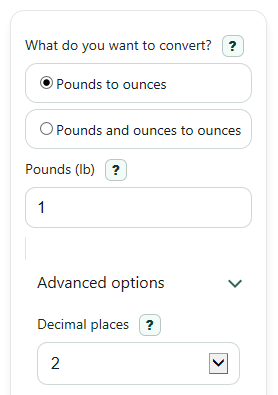
- Choose "Pounds to ounces" if you have one weight like 2.5 lb, or choose "Pounds and ounces to ounces" if your weight is split into pounds plus extra ounces.
- Enter "Pounds (lb)" and, if needed in mixed mode, enter "Extra ounces (oz)".
- Open "Advanced options" only if you want to change "Decimal places" for the ounces display.
- Click "Calculate" to see "Ounces (oz)", the "Formula used", and "Same weight as pounds and ounces".
- Sanity-check the result: 1 lb should equal 16 oz, and in mixed mode the "Same weight as pounds and ounces" line should match the weight you meant to enter.
Definitions
Pounds (lb): A unit of weight in the avoirdupois system used in the US. One pound equals 16 ounces [1].
Extra ounces (oz): Ounces added on top of the pounds value in mixed mode, such as 3 lb 4 oz.
Ounces (oz): The total weight in ounces after conversion. In this calculator, oz means weight ounces, not fluid ounces.
Decimal places: How many digits appear after the decimal point in the displayed ounces result.
Same weight as pounds and ounces: A helper result that rewrites total ounces as whole pounds plus remaining ounces.
Common mistakes and quick fixes
Mistake: Typing a liquid amount and expecting "Ounces (oz)" to mean fluid ounces.
Fix: Use this tool only for weight. The "Note" output reminds you that oz here means weight ounces.
Mistake: Entering 2.8 in "Pounds (lb)" while also using "Pounds and ounces to ounces" as if .8 means 8 ounces.
Fix: In mixed mode, put whole pounds in "Pounds (lb)" and put the extra amount in "Extra ounces (oz)".
Mistake: Leaving "Pounds (lb)" blank or typing text that is not a number.
Fix: Enter a numeric value in "Pounds (lb)", such as 1, 2.5, or 0.125.
Mistake: Typing a negative value in "Pounds (lb)" or "Extra ounces (oz)" for an everyday weight.
Fix: Use 0 or a positive number. Negative weights are blocked by the calculator.
Mistake: Entering 16 or more in "Extra ounces (oz)" and forgetting that 16 oz makes another pound.
Fix: The calculator can still compute it, but check "Same weight as pounds and ounces" to see the cleaner mixed form.
Mistake: Thinking a rounded display changed the actual conversion.
Fix: Change "Decimal places" only for display needs. The "Formula used" stays the same: pounds are multiplied by 16.
Limitations & Key Assumptions / Boundary Conditions
- This calculator converts avoirdupois weight only. It does not convert fluid ounces, volume, or shipping dimensional weight.
- Negative values are treated as invalid because everyday weight entries are expected to be zero or greater.
- In mixed mode, values of 16 or more in "Extra ounces (oz)" still calculate, but they may be less clear than moving full groups of 16 ounces into pounds.
- The displayed answer can be rounded by "Decimal places", so the shown value may be shorter than the exact internal value.
- Mixed mode is best for pounds plus extra ounces. If you enter decimal pounds there too, the calculator will still add correctly, but the input may be harder to interpret.
Methodology
How the calculator works
The converter uses the standard avoirdupois relationship of 1 pound = 16 ounces [1]. It chooses one of two formulas based on your selected mode.
oz = lb x 16
oz_total = lb x 16 + oz_extra
lb_whole = floor(oz_total / 16)
oz_rem = oz_total - 16 x floor(oz_total / 16)
What each formula means
If you choose pounds only, the calculator multiplies "Pounds (lb)" by 16 to get "Ounces (oz)". If you choose mixed input, it converts the pounds part to ounces, then adds "Extra ounces (oz)". After that, it can rewrite the total as whole pounds plus remaining ounces for the helper output.
Mini example
If "Pounds (lb)" is 2.5 in pounds-only mode, the result is 2.5 x 16 = 40, so "Ounces (oz)" is 40.
If "Pounds (lb)" is 3 and "Extra ounces (oz)" is 4 in mixed mode, the result is 3 x 16 + 4 = 52, so "Ounces (oz)" is 52. The helper converts 52 back to 3 lb 4 oz because 52 divided by 16 is 3 whole pounds with 4 ounces left.
Rounding and display
The "Decimal places" setting changes only how many digits are shown in the ounces result. It does not change the conversion factor or the underlying math.
Assumptions and limits
This method assumes standard avoirdupois weight units. It does not handle fluid ounces. It also expects nonnegative inputs for normal real-world use, and it warns when mixed-mode "Extra ounces (oz)" is 16 or more because that is usually better rewritten into pounds.