
Convert one power value into watts, kilowatts, megawatts, horsepower types, Btu per hour, and kilocalories per hour without mixing up similar units.
Advanced options
Table of contents
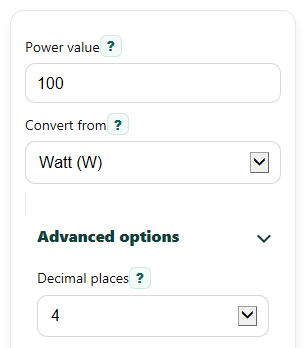
How to use our Power Converter
- Enter your number in Power value.
- Choose the starting unit in Convert from, paying close attention to the exact horsepower type if you picked a horsepower unit.
- If needed, choose how many digits to show in Decimal places.
- Click Calculate to see the main paired conversion first, then all other unit results below it.
- Sanity-check the answer by comparing Watts, Kilowatts, and the horsepower rows; for example, 1,000 W should equal 1 kW, and different horsepower types should be close but not identical.
Definitions
Power value: The starting number you want to convert.
Convert from: The unit your starting value is already in.
Watt (W): A standard SI unit of power, meaning the rate of energy transfer.
Kilowatt (kW): 1,000 watts.
Megawatt (MW): 1,000,000 watts.
Microwatt (uW): One-millionth of a watt.
Milliwatt (mW): One-thousandth of a watt.
Horsepower, mechanical: A common US horsepower definition, not exactly the same as other horsepower types [2].
Horsepower, electric: A separately defined horsepower unit used in some electrical contexts.
Horsepower, metric (PS): A metric horsepower unit, often written as PS.
Boiler horsepower (bhp): A much larger power unit used for boiler output.
Btu per hour (Btu/h): A thermal power unit often used in heating and cooling.
Kilocalorie per hour (kcal/h): Power expressed as kilocalories each hour.
Decimal places: How many digits are shown after the decimal point in results.
Common mistakes and quick fixes
Mistake: Leaving Power value blank or entering text like "ten".
Fix: Enter a numeric value such as 10, 100, or 2.5.
Mistake: Picking the wrong option in Convert from and using generic horsepower by accident.
Fix: Match the exact label, such as Horsepower, mechanical , Horsepower, electric , Horsepower, metric , or Boiler horsepower .
Mistake: Thinking Horsepower, mechanical and Horsepower, electric should give the same result.
Fix: Compare the separate output rows and keep the horsepower type with the value whenever you copy it.
Mistake: Reading a rounded display as an exact value when Decimal places is set low.
Fix: Increase Decimal places to 4 or 6 if small unit differences matter.
Mistake: Confusing Btu per hour with energy instead of power.
Fix: Use the Btu per hour row only as a rate of power, and compare it with Watts or Kilowatts .
Mistake: Assuming a negative value in Watts or Converted value is automatically wrong.
Fix: Negative power can be valid in signed systems; read the Note output to interpret the sign in your context.
Limitations & Key Assumptions / Boundary Conditions
- The calculator converts by fixed unit definitions, so it does not account for equipment efficiency, losses, or operating conditions.
- Horsepower values depend on the exact horsepower type selected. Using the wrong horsepower definition changes the result.
- Displayed values are rounded to the chosen Decimal places, even though the calculator keeps higher internal precision before rounding.
- Very large or very small values can be harder to read, even when the math is correct.
- Negative inputs are allowed because signed power can be meaningful in some systems, but many everyday device ratings are shown as positive values only.
- The main Converted value is a convenience pairing for quick reading. The full set of output rows is the more complete view.
Methodology
How the conversion works
The calculator first turns your starting value into watts, then converts that watt value into every other shown unit. This keeps the math consistent across all outputs.
P_W = input value x factor to watt(from unit)
P_target = P_W / factor to watt(target unit)
Conversion factors used
1 uW = 0.000001 W
1 mW = 0.001 W
1 kW = 1000 W
1 MW = 1000000 W
1 hp (mechanical) = 745.699871582 W
1 hp(E) = 746 W
1 PS = 735.49875 W
1 bhp = 9810.657 W
1 Btu/h = 0.29307107 W
1 kcal/h = 1.163 W
These kinds of power-unit relationships are standard converter reference values, and horsepower is not a single universal value because different definitions exist [1][2].
Main paired result
The first result row is a convenience output. It uses a simple paired target so the most likely comparison appears first. For example, watts usually pair to kilowatts, kilowatts usually pair to watts, and horsepower types usually pair to kilowatts.
primary converted = P_W / factor to watt(paired target unit)
Mini example
If you enter 1000 for Power value and choose Watt (W) in Convert from, the watt value stays 1000 W.
P_W = 1000 x 1 = 1000 W
kW = 1000 / 1000 = 1
MW = 1000 / 1000000 = 0.001
mechanical hp = 1000 / 745.699871582 = 1.341022...
That is why 1000 W shows as 1 kW and about 1.3410 mechanical horsepower.
Assumptions and limits
This tool assumes exact fixed conversion factors and does not model real machine performance. If a label, motor plate, boiler spec, or HVAC document uses a specific convention, match that exact unit name before comparing values.