
Enter kilograms and your material's density to find US liquid or UK Imperial gallons, or switch directions to convert gallons to kilograms.
Table of contents
How to use our kg to Gallons Converter
- Choose the direction that matches the amount you already know: kilograms to gallons or gallons to kilograms.
- Enter the mass or volume from your scale, label, recipe, shipment record, or specification.
- Choose the gallon type used by your source: US liquid gallon or UK Imperial gallon.
- For water, choose Water reference; for any other material, choose Custom density, enter its density, and select the unit printed on the source document.
- Select Calculate, then check that the displayed density and gallon type match your source before using the converted amount.
Definitions
Mass: The amount of matter in an item. This converter accepts mass in kilograms (kg).
Density: Mass per unit of volume. Density connects a mass in kilograms to a volume in liters. [2]
kg/L: Kilograms per liter. The converter changes custom density values into this unit before calculating.
Specific gravity: A unitless ratio that compares a material's density with the 1.000 kg/L water reference used by this converter.
US liquid gallon: A volume equal to 3.785411784 liters. [1]
UK Imperial gallon: A volume equal to 4.54609 liters. [1]
Common mistakes and quick fixes
Mistake: Treating kilograms as if they always convert to the same number of gallons.
Fix: Use the density for the actual material because kilograms measure mass and gallons measure volume.
Mistake: Entering 800 when Density unit is set to kg/L even though the source says 800 kg/m3.
Fix: Set Density unit to kg/m3 before entering 800.
Mistake: Using Water reference for oil, fuel, syrup, or a dry ingredient.
Fix: Choose Custom density and enter the density for that specific material.
Mistake: Mixing up US liquid gallons and UK Imperial gallons.
Fix: Choose the gallon type named by the label, recipe, country, or specification before calculating.
Mistake: Entering a negative mass or gallon amount.
Fix: Enter zero or a positive amount. Zero is valid and converts to zero.
Limitations & Key Assumptions / Boundary Conditions
- There is no single kilogram-to-gallon factor because the answer depends on the material's density.
- Water reference uses 1.000 kg/L as a simplified value; real water density changes with temperature and purity.
- A product's density can change with temperature, composition, concentration, and purity, so use its documented density when accuracy matters.
- For powders and other dry materials, bulk density can change with moisture, packing, compaction, and clumping.
- The result uses the selected US liquid or UK Imperial gallon. Choosing the other gallon type changes the answer.
Methodology
Calculation method
The converter first expresses density in kg/L. It then converts between mass and liters, then between liters and the selected gallon type.
ρ (density in kg/L) = entered density after unit conversion
V (volume in L) = m (mass in kg) / ρ (density in kg/L)
gallons = V (volume in L) / G (selected gallon size in L per gal)
m (mass in kg) = gallons x G (selected gallon size in L per gal) x ρ (density in kg/L)
A US liquid gallon is 3.785411784 L, and a UK Imperial gallon is 4.54609 L. [1]
Density units
kg/L and g/mL have the same numeric value. A density in kg/m3 is divided by 1,000. A density in lb per US gallon is converted using 0.45359237 kg per pound and 3.785411784 L per US liquid gallon. Specific gravity is multiplied by the 1.000 kg/L water reference.
Worked example
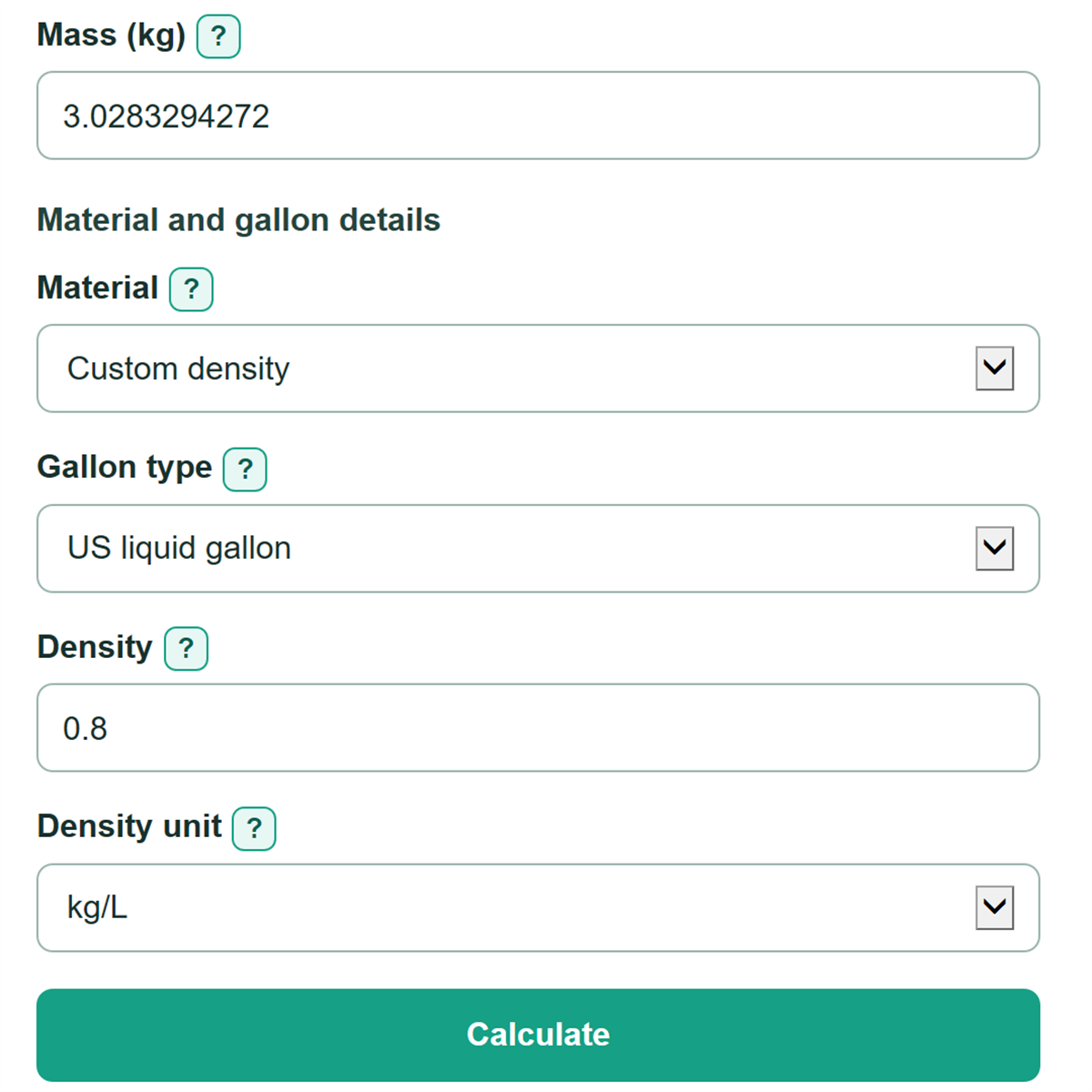
For 3.0283294272 kg of material with a density of 0.800 kg/L, the volume is 3.785411784 L. Dividing by 3.785411784 L per US liquid gallon gives 1 gallon.
Assumptions and limits
The calculation assumes the entered density fits the material and its conditions. A water reference is only an approximation, and dry-material bulk density can change with packing and moisture.