
Calculate a tank's nominal hydraulic retention time from liquid volume and flow, or find the volume or flow needed for a target time.
Table of contents
How to use our Hydraulic Retention Time Calculator
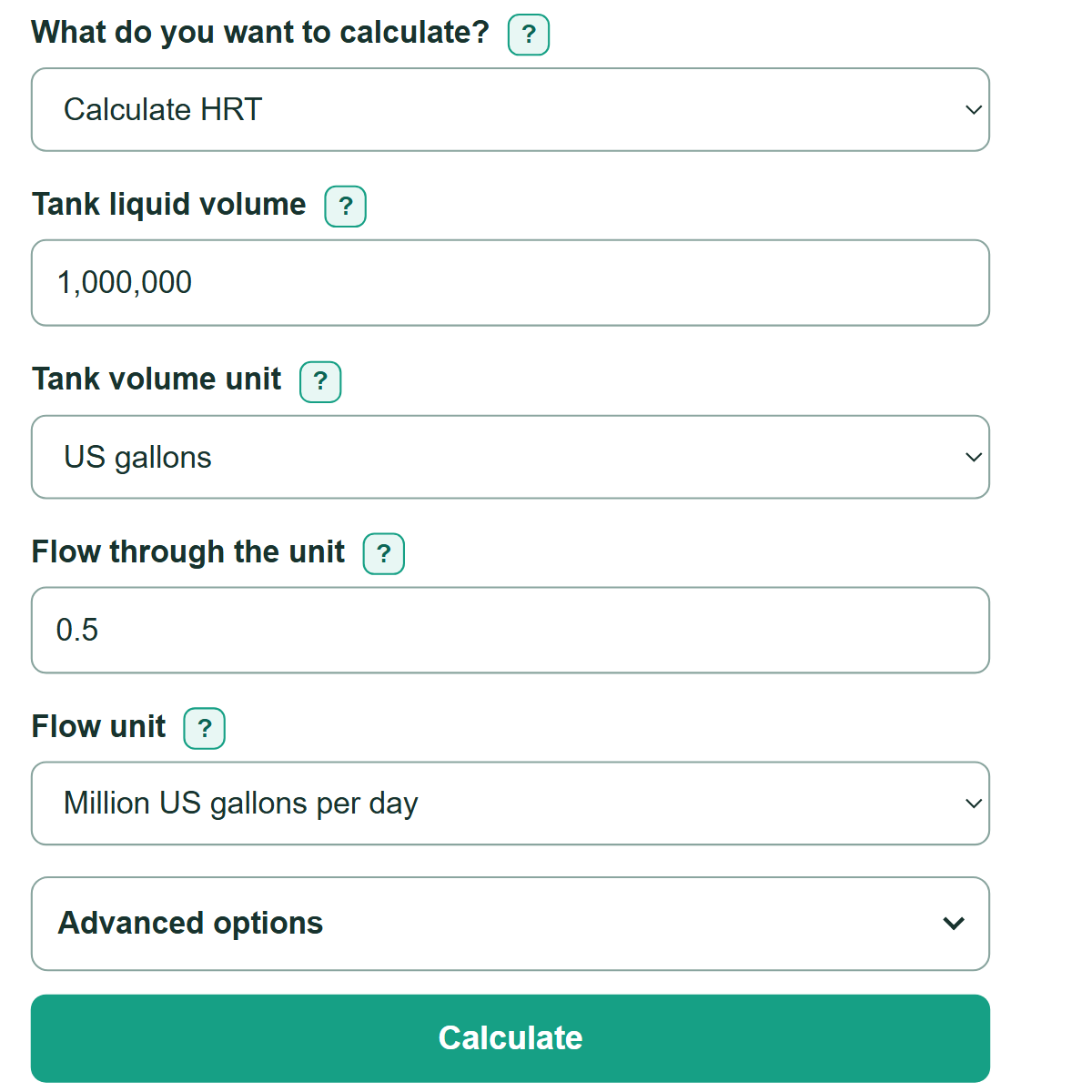
- Under "What do you want to calculate?", choose "Calculate HRT", "Find required volume", or "Find allowable flow".
- Choose "Tank volume unit" before entering a new "Tank liquid volume". Use the liquid volume from a drawing, level-volume table, or operating record.
- Choose "Flow unit" before entering "Flow through the unit". Use average, current, design, or other flow that matches the question.
- For "Find required volume" or "Find allowable flow", enter "Target retention time" and select the unit stated in the project criterion, operating plan, manual, or assignment.
- Click "Calculate". In "Calculate HRT", the first result is the nominal theoretical retention time based on liquid volume divided by flow.
- For an operating scenario in "Calculate HRT", open "Advanced options" and enter both "Hydraulically active volume (percent)" and "Peak flow multiplier". Compare those results with the nominal HRT.
- If you intentionally convert an already-correct entry, changing its unit preserves the same physical quantity. If you entered a source number under the wrong unit, select the correct unit and enter the original source number again.
Definitions
Hydraulic retention time (HRT): The theoretical average time liquid remains in a tank, basin, reactor, lagoon, or treatment unit based on liquid volume and volumetric flow.
Nominal HRT: The basic liquid-volume-divided-by-flow result using the values entered in the calculator.
Hydraulically active volume: The estimated part of the entered liquid volume that effectively participates in flow.
Peak flow multiplier: Peak flow divided by the base flow entered above. A value of 2 means peak flow is twice the base flow.
MGD: Million US gallons per day. One MGD equals 1,000,000 US gallons per day.
Common mistakes and quick fixes
Mistake: Using gross structure volume instead of liquid volume at the operating water level.
Fix: Enter the liquid volume available to the process. Use "Hydraulically active volume (percent)" only when you have a documented estimate of the participating share.
Mistake: Treating the same number as equivalent in gpm, gpd, MGD, cfs, L/s, and cubic meters per day.
Fix: Select the unit shown on the meter, report, pump record, or design basis before entering the number.
Mistake: Using average-flow HRT to answer a peak-flow question.
Fix: Enter the applicable flow directly, or enter both operating-scenario values to estimate the effect of active volume and higher peak flow.
Mistake: Treating nominal HRT as a tracer-test result or T10 value.
Fix: Use nominal HRT for a volume-to-flow planning calculation. Use hydraulic testing or the applicable engineering method when actual residence-time distribution is needed.
Limitations & Key Assumptions / Boundary Conditions
- This calculator gives a nominal volume-to-flow estimate. It does not measure mixing, short-circuiting, dead zones, residence-time distribution, or T10.
- Use liquid volume at the relevant operating level. Gross outside volume and construction volume may not be usable liquid volume.
- Average, current, design, and peak flow can produce different HRT values. Use the flow basis that matches the decision.
- The active-volume and peak-flow results are simplified scenarios based on the values entered. They are not hydraulic-test results.
- Required volume is working liquid volume only. It does not include freeboard, unusable space, construction geometry, redundancy, equipment displacement, or regulatory design requirements.
- Allowable flow is a nominal hydraulic calculation, not a process-capacity approval or permit limit.
Methodology
Calculation method
The calculator converts the entered liquid volume and flow to compatible units, then divides volume by flow. This gives a theoretical average retention time. [1]
τ (retention time in hours) = liquid volume / daily flow x 24
Volume and flow must use matching volume units. Dividing liquid volume by daily flow gives days, and multiplying by 24 changes days to hours.
Other solve choices
For "Find required volume", the calculator multiplies the entered flow by the target time. For "Find allowable flow", it divides the entered liquid volume by the target time.
Required liquid volume = flow x target time
Allowable flow = liquid volume / target time
Operating scenario
If both optional scenario values are entered in "Calculate HRT", the calculator applies the active-volume percentage to nominal HRT, then divides that result by the peak-flow multiplier.
Active-volume HRT = nominal HRT x active volume percent / 100
Peak-condition HRT = active-volume HRT / peak flow multiplier
Worked example
A tank with 1,000,000 US gallons and flow of 0.5 MGD has a nominal HRT of 2 days, or 48 hours. At 80 percent active volume, the scenario HRT is 38.4 hours. With a peak-flow multiplier of 2, it is 19.2 hours.
Unit conversions
The calculator uses 3.785411784 liters per US gallon and 28.316846592 liters per cubic foot, plus standard time conversions.