
Use this Michaelis-Menten equation calculator to solve for v, Vmax, Km, or substrate concentration and quickly interpret what the result means.
Advanced options
Units and labels
Extra enzyme metrics
How to use our Michaelis-Menten Equation Calculator
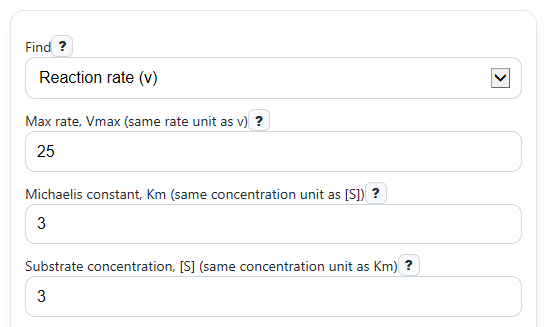
- Choose the missing value in Find, then enter the other visible core fields: Reaction rate, v, Max rate, Vmax, Michaelis constant, Km, and Substrate concentration, [S].
- Keep units consistent: Reaction rate, v and Max rate, Vmax must use the same rate unit, and Michaelis constant, Km and Substrate concentration, [S] must use the same concentration unit.
- If you want extra enzyme-kinetics outputs, open Advanced options and enter Total enzyme concentration, [E]t plus the Concentration scale.
- Click Calculate, then read Calculated value first, followed by Percent of max rate and Half-max check to see how the enzyme is behaving under this model.
- Sanity-check the result: if Substrate concentration, [S] equals Michaelis constant, Km, the Percent of max rate should be about 50%, and if your result turns negative or looks impossible, recheck units and which field you chose in Find.
Definitions
Reaction rate, v: The reaction speed at the substrate level you entered. In Michaelis-Menten work, this is usually the initial rate, measured before the reaction conditions change much [1].
Max rate, Vmax: The fastest rate the enzyme can reach when substrate is high enough that the enzyme is effectively saturated.
Michaelis constant, Km: The substrate concentration that gives half of Vmax in the basic Michaelis-Menten model. Smaller Km usually means half-max speed is reached at a lower substrate level [1].
Substrate concentration, [S]: How much substrate is present for the enzyme to act on, using the same concentration unit as Km.
Percent of max rate: The fraction v/Vmax written as a percent. A value of 50% means the reaction is running at half of its maximum rate.
Turnover number, kcat: Vmax divided by total enzyme concentration. It tells how many substrate molecules each enzyme site converts per unit time at saturation.
Catalytic efficiency, kcat/Km: A combined measure of enzyme performance at low substrate concentration. Larger values mean stronger performance when substrate is scarce.
Concentration scale: The concentration unit family used to label Km, [S], and optional enzyme concentration, such as M, mM, uM, or nM.
Common mistakes and quick fixes
Mistake: Entering different rate units in Reaction rate, v and Max rate, Vmax .
Fix: Use the same rate unit for both fields before trusting Calculated value or Percent of max rate .
Mistake: Mixing concentration units between Michaelis constant, Km and Substrate concentration, [S] , such as typing one in mM and the other in uM.
Fix: Convert them to the same concentration unit first, then calculate again.
Mistake: Choosing the wrong target in Find and then entering a number in the field you meant to solve for.
Fix: Set Find to the missing variable and treat that matching input row as the one the calculator will solve from the other three core values.
Mistake: Trying to solve Substrate concentration, [S] when Reaction rate, v is equal to or larger than Max rate, Vmax .
Fix: For this rearrangement, Reaction rate, v must be greater than 0 and less than Max rate, Vmax .
Mistake: Entering a negative value for Michaelis constant, Km , Substrate concentration, [S] , or Total enzyme concentration, [E]t .
Fix: Use nonnegative concentration values only; negative concentrations are not valid in this model.
Mistake: Expecting Turnover number, kcat or Catalytic efficiency, kcat/Km to appear without filling Total enzyme concentration, [E]t .
Fix: Enter Total enzyme concentration, [E]t and choose the correct Concentration scale so the calculator can compute the advanced outputs.
Limitations & Key Assumptions / Boundary Conditions
- This calculator uses the simple one-substrate Michaelis-Menten model, so it is not designed for allosteric enzymes, cooperativity, multi-substrate mechanisms, or inhibition effects.
- The equation is meant for initial-rate conditions; real experiments can differ if substrate is depleted, product builds up, or reverse reactions matter.
- Reaction rate, v and Max rate, Vmax must already be in matching rate units. The calculator cannot detect mismatched rate units automatically.
- Michaelis constant, Km, Substrate concentration, [S], and optional Total enzyme concentration, [E]t should use a consistent concentration scale if you want meaningful advanced outputs.
- Turnover number, kcat and Catalytic efficiency, kcat/Km are shown only when enzyme concentration is entered and the unit setup is compatible with the Vmax concentration basis.
- If your inputs force an impossible rearrangement, such as solving for Substrate concentration, [S] when Reaction rate, v is not below Max rate, Vmax, the model does not have a physically meaningful answer.
- Rounded display values can make near-half-Vmax cases look exact or slightly off, so use the full numeric result when precision matters.
Methodology
Core equation
This calculator uses the standard Michaelis-Menten relationship for a single-substrate enzyme under initial-rate conditions [1].
v = (Vmax x [S]) / (Km + [S])
How each missing value is solved
The calculator rearranges the same equation depending on what you choose in Find.
Vmax = v x (Km + [S]) / [S]
Km = [S] x (Vmax - v) / v
[S] = v x Km / (Vmax - v)
After the missing core value is found, the calculator also computes how close the system is to the maximum rate.
Percent of max rate = 100 x v / Vmax
If [S] equals Km, the model gives half of the maximum rate, so v = Vmax / 2 and the percent is 50% [1]. That rule is used for the plain-language Half-max check.
Optional advanced outputs
If you enter Total enzyme concentration, [E]t, the calculator can estimate turnover number and catalytic efficiency.
kcat = Vmax / [E]t
kcat/Km = kcat / Km
These outputs are shown only when enzyme concentration is provided and the concentration setup is consistent enough to express the result clearly.
Mini example
Suppose Max rate, Vmax = 25, Michaelis constant, Km = 5, and Substrate concentration, [S] = 5. Then the rate is:
v = (25 x 5) / (5 + 5) = 125 / 10 = 12.5
The rate is half of Vmax, so:
Percent of max rate = 100 x 12.5 / 25 = 50
If Total enzyme concentration, [E]t = 0.05 in the same concentration family, then:
kcat = 25 / 0.05 = 500
kcat/Km = 500 / 5 = 100
Assumptions used for interpretation
This page assumes a simple non-allosteric enzyme, one main substrate, no inhibitor term in the equation, and matched units across the inputs. Real lab data can differ when those assumptions are not met [1][2].