
Calculate buffer pH from pKa or Ka and weak acid and conjugate base amounts, with a quick check for ratio, buffer range, and shortcut limits.
Advanced options
How to use our Buffer pH Calculator
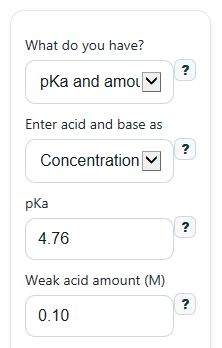
- Choose What do you have? and pick either pKa and amounts or Ka and amounts.
- Choose Enter acid and base as, then enter Weak acid amount and Conjugate base amount in matching units.
- Enter pKa or Ka, and optionally choose Decimal places for display.
- Click Calculate to get Buffer pH, Base-to-acid ratio, Usual buffer region check, More of which form?, Approximation note, and pOH.
- Sanity-check the result: if Base-to-acid ratio is 1, the Buffer pH should match pKa, and if the ratio is greater than 1, the pH should be above pKa.
Definitions
pKa: A number that shows how weak or strong the weak acid is. In this calculator, pKa is the reference value that the buffer pH shifts above or below.
Ka: The acid dissociation constant. If you enter Ka, the calculator converts it to pKa with pKa = -log10(Ka).
Weak acid amount: The amount of the acid form in the buffer pair. Enter it as concentration or moles, depending on your selected input style.
Conjugate base amount: The amount of the base form paired with the weak acid. This is the base term in the base-to-acid ratio.
Base-to-acid ratio: The conjugate base amount divided by the weak acid amount. A ratio above 1 means the mixture is shifted more basic than pKa; below 1 means more acidic.
Buffer region: The usual practical range where pH is within about 1 unit of pKa [1]. It is a helpful guideline, not a hard cutoff.
Henderson-Hasselbalch equation: A shortcut equation for estimating buffer pH from pKa and the base-to-acid ratio [1].
pOH: A classroom partner scale to pH, found here from pOH = 14 - pH for dilute aqueous solutions at 25 C.
Common mistakes and quick fixes
Mistake: Picking Ka and amounts under What do you have? but typing a pKa value into Ka .
Fix: Enter a true Ka value in Ka , such as 1.8e-5, or switch the mode and use pKa instead.
Mistake: Leaving Weak acid amount or Conjugate base amount as 0.
Fix: For a buffer shortcut, both Weak acid amount and Conjugate base amount must be greater than 0.
Mistake: Mixing units after choosing Enter acid and base as , such as entering acid in M and base in mol.
Fix: Use the same unit type for both Weak acid amount and Conjugate base amount .
Mistake: Using Moles (mol) when the acid and base are not in the same final mixture.
Fix: In Moles (mol) mode, both entries must describe the amounts present together in one final solution before you trust Buffer pH .
Mistake: Thinking a very large or very small Base-to-acid ratio still means a strong everyday buffer.
Fix: Read Usual buffer region check and Approximation note ; extreme ratios can make the shortcut less reliable.
Mistake: Assuming pOH is always useful in every chemistry setting.
Fix: Use pOH mainly for dilute aqueous solutions near 25 C, and focus on Buffer pH as the main result.
Limitations & Key Assumptions / Boundary Conditions
- This calculator uses the Henderson-Hasselbalch shortcut, so it gives an estimate rather than a full equilibrium solution.
- Both Weak acid amount and Conjugate base amount must be greater than 0. If either one is missing or zero, the shortcut does not describe a buffer pair.
- If you choose Moles (mol), the mole ratio only works as entered when both amounts refer to the same final solution mixture.
- The usual buffer-region check uses about pKa plus or minus 1 as a practical guideline, not a strict physical boundary.
- Very extreme base-to-acid ratios can make the shortcut less reliable, especially when one component is tiny compared with the other.
- The pOH result uses pH + pOH = 14, which is the common classroom relation for dilute aqueous solutions at 25 C.
- Real lab solutions can differ because of temperature, ionic strength, activity effects, dilution details, and non-ideal behavior.
- The calculator keeps mathematically possible pH values even if they fall outside 0 to 14, because some calculated cases can extend beyond that classroom range.
Methodology
Core method
This calculator estimates buffer pH with the Henderson-Hasselbalch equation [1]. It works best when a weak acid and its conjugate base are both present in meaningful amounts.
pH = pKa + log10(base_amount / acid_amount)
If you choose Concentration (M), the calculator uses the concentration ratio. If you choose Moles (mol), it uses the mole ratio, which gives the same result when both species are in the same final solution volume [1].
Ka to pKa conversion
In Ka mode, the calculator first converts Ka to pKa, then uses the same buffer formula.
pKa = -log10(Ka)
Ka must be greater than 0. A blank, zero, negative, or non-numeric Ka is an error.
Supporting outputs
The calculator also reports the ratio, which form is larger, whether the pH is in the usual buffer window, and pOH.
base_to_acid_ratio = base_amount / acid_amount
inside_region if abs(pH - pKa) <= 1
pOH = 14 - pH
If the ratio is greater than 1, there is more conjugate base and the pH should be above pKa. If the ratio is less than 1, there is more weak acid and the pH should be below pKa.
Worked mini-example
Suppose pKa = 4.76, Weak acid amount = 0.10, and Conjugate base amount = 0.20. The ratio is 0.20 / 0.10 = 2.
pH = 4.76 + log10(2)
pH = 4.76 + 0.3010 = 5.0610
pOH = 14 - 5.0610 = 8.9390
This result is within about 1 pH unit of pKa, so it falls in the usual buffer region check.
Assumptions behind the shortcut
This method assumes a weak acid buffer system and uses a practical approximation rather than a full equilibrium calculation [1]. Results can be less reliable when one component is extremely small, when the ratio is very large or very small, or when real-solution effects matter.