
Choose the chemistry values you have to calculate pKa or Ka for an acid, buffer, or monoprotic weak-acid solution.
Table of contents
How to use our pKa Calculator
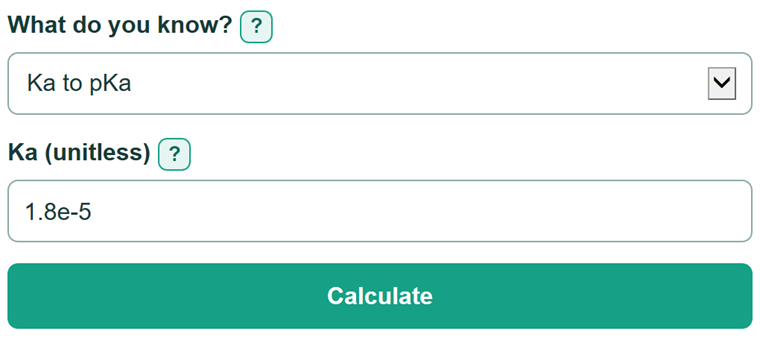
- Choose what you know from your problem, lab notes, or reference table.
- Enter the values shown for that choice. Ka and concentrations must be greater than 0, and Ka accepts scientific notation such as 1.8e-5.
- Click Calculate to see the requested value first, followed by the related Ka or pKa and the equation used.
- Check the answer against the chemistry: a larger Ka should give a smaller pKa, and a buffer with more [A-] than [HA] should have a pKa below its pH.
Definitions
Ka: The acid dissociation constant. Under the same conditions, a larger Ka means more acid dissociation.
pKa: The negative base-10 logarithm of Ka. A larger pKa corresponds to a smaller Ka.
pH: A base-10 logarithmic measure related to hydrogen-ion concentration in a solution.
[A-]: The concentration of the conjugate base, in molarity (M).
[HA]: The concentration of the weak acid, in molarity (M).
Monoprotic weak acid: An acid that donates one hydrogen ion in the dissociation step being calculated.
Common mistakes and quick fixes
Mistake: Entering 0 or a negative Ka.
Fix: Enter a finite Ka greater than 0. pKa cannot be calculated from zero because the base-10 logarithm of zero is undefined.
Mistake: Reversing the buffer ratio as [HA]/[A-].
Fix: Enter conjugate base [A-] and weak acid [HA] in their matching fields. The buffer equation uses [A-]/[HA].
Mistake: Using starting concentrations instead of the stated buffer concentrations after a reaction.
Fix: Use the weak-acid and conjugate-base concentrations for the buffer state described in the problem.
Mistake: Using the measured weak-acid method for a solution with an added conjugate base.
Fix: Choose the buffer method when both [A-] and [HA] are present as a buffer pair.
Mistake: Entering an initial weak-acid concentration that is no greater than the hydrogen-ion concentration from pH.
Fix: Enter an initial [HA] greater than 10 raised to the negative pH. Otherwise the calculated undissociated-acid concentration is zero or negative.
Limitations & Key Assumptions / Boundary Conditions
- Ka and pKa can change with temperature, ionic strength, and other solution conditions, so a measured value can differ from a table value.
- The buffer method uses the Henderson-Hasselbalch concentration ratio approximation and assumes both weak acid and conjugate base are present.
- The measured weak-acid method assumes a monoprotic weak acid, no added conjugate-base buffer pair, and hydrogen ions supplied mainly by that acid.
- For the measured weak-acid method, initial [HA] must be greater than the hydrogen-ion concentration calculated from pH.
- For a polyprotic acid, use the Ka or pKa for the specific dissociation step named in the problem.
- A buffer calculation is still defined when [A-]/[HA] is outside 0.1 to 10, but pH is then more than about 1 unit from pKa and the buffer is less balanced.
Methodology
Calculation method
The calculator uses base-10 logarithms and applies only the equation that matches the selected inputs.
pKa = -log10(Ka)
When pKa is known instead, it calculates Ka with:
Ka = 10^(-pKa)
For a buffer, it calculates the conjugate-base-to-acid ratio in that order, then rearranges the Henderson-Hasselbalch equation.
ratio = [A-] / [HA]
pKa = pH - log10(ratio)
For a measured solution containing only a monoprotic weak acid, it first converts pH to hydrogen-ion concentration and then calculates Ka.
[H+] = 10^(-pH)
Ka = [H+]^2 / (initial [HA] - [H+])
pKa = -log10(Ka)
Worked example
For a buffer with pH 5.20, [A-] = 0.20 M, and [HA] = 0.10 M, the ratio is 2. The pKa is 5.20 - log10(2) = 4.89897, or about 4.899. Converting that pKa gives Ka = 1.2619e-5.