
Use this wastewater calculator to find daily load, percent removed, detention time, surface overflow rate, or weir loading with clear unit-based results.
Advanced options
How to use our Wastewater Calculator
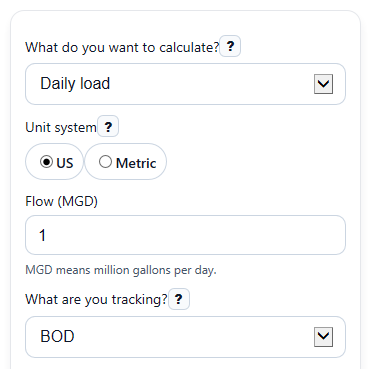
- Choose What do you want to calculate? and pick your Unit system first, because the meaning of Flow, Tank volume, Surface area, and Weir length changes with the selected units.
- Enter only the fields used for your mode: for load use Flow and Influent concentration (mg/L); for percent removed add Effluent concentration (mg/L); for detention time use Tank volume and Flow; for overflow rate use Surface area; for weir loading use Weir length.
- If needed, choose What are you tracking? so the result says BOD, TSS, COD, or your own Custom pollutant name. You can also add Process or tank name to make the result easier to recognize later.
- Click Calculate, then read the Main result first and use Same result in alternate common unit plus any supporting details to check your work in the unit style your class or plant uses.
- Sanity-check the answer before using it: make sure the unit labels match your notes, confirm the value moves in the direction you expect when flow or concentration gets bigger, and read the Note if the result is negative or unusually high.
Definitions
BOD: Biochemical oxygen demand. This is a common wastewater strength measure showing how much oxygen biodegradable material can use.
TSS: Total suspended solids. This means small solid particles floating in the water.
Influent concentration (mg/L): The pollutant level coming into the process, measured in milligrams per liter.
Effluent concentration (mg/L): The pollutant level leaving the process, measured in milligrams per liter.
Daily load: The amount of pollutant moving each day, usually shown as lb/day or kg/day.
Detention time: The average time water stays in a tank, usually shown in hours and days.
Surface overflow rate: Flow divided by clarifier surface area. It is a hydraulic loading rate on the tank surface.
Weir loading: Flow divided by total weir length. It shows how much flow passes each foot or meter of weir.
Common mistakes and quick fixes
Mistake: Entering Flow in gallons per day while Unit system is set to US load mode, where load uses MGD.
Fix: In US load or removal work, enter Flow in MGD. For example, 500,000 gallons per day should be entered as 0.5.
Mistake: Using Effluent concentration (mg/L) that is larger than Influent concentration (mg/L) and assuming the calculator is broken because percent removed is negative.
Fix: A negative Main result in removal mode is valid. It means the measured concentration increased across the selected process.
Mistake: Leaving Custom pollutant name blank after choosing Custom in What are you tracking? .
Fix: Either type a pollutant name such as NH3-N in Custom pollutant name or switch What are you tracking? back to BOD, TSS, or COD.
Mistake: Mixing detention time units by entering Tank volume in cubic meters while Unit system is set to US, or gallons while it is set to Metric.
Fix: In US mode, enter Tank volume in gallons. In Metric mode, enter it in cubic meters.
Mistake: Typing 0 for Influent concentration (mg/L) in percent removed mode.
Fix: Influent concentration (mg/L) must be greater than 0 for removal math. Enter the measured incoming value before calculating.
Mistake: Entering total sidewall area instead of plan-view Surface area for a clarifier check.
Fix: Use the top surface area only for Surface area , because Main result for overflow rate is flow divided by plan area, not wall area.
Limitations & Key Assumptions / Boundary Conditions
- The calculator uses standard steady-state wastewater math. Real plant performance can differ because of peak flow, short-circuiting, sludge blanket effects, recycle streams, and changing influent strength.
- For load and removal, concentrations are assumed to be in mg/L and flow must match the chosen unit system and mode. A unit mix-up can change the answer by a large amount.
- Percent removed is based only on influent and effluent concentrations. It does not prove biological performance by itself and does not explain why a concentration increased.
- Detention time is calculated as volume divided by daily flow, so it represents average theoretical retention time, not the exact path of every gallon or cubic meter through a tank.
- Surface overflow rate uses flow divided by top surface area, and weir loading uses flow divided by total weir length. These are screening checks, not complete design approval calculations.
- If a mode does not include enough information for a companion result, that extra output may be omitted rather than estimated.
Methodology
Core formulas
The calculator switches formulas based on your selected mode and unit system.
Load in US units (lb/day) = Flow in MGD x Concentration in mg/L x 8.34
Load in metric units (kg/day) = Flow in m3/day x Concentration in mg/L / 1000
Percent removed = ((Influent concentration - Effluent concentration) / Influent concentration) x 100
Detention time (days) = Tank volume / Flow per day
Detention time (hours) = Detention time in days x 24
Surface overflow rate = Flow per day / Surface area
Weir loading = Flow per day / Weir length
Mass removed per day = Influent load - Effluent load
How units are handled
In US load math, the constant 8.34 converts MGD and mg/L into lb/day using standard wastewater operator practice [1]. In metric load math, mg/L is treated as 0.001 kg/m3, so dividing by 1000 gives kg/day. The paired result converts between lb/day and kg/day, or between hours and days, so you can cross-check your answer.
Worked mini-example
Suppose you want BOD daily load in US units with Flow = 1.5 MGD and Influent concentration (mg/L) = 200.
Load = 1.5 x 200 x 8.34 = 2,502 lb/day
That same load is also shown in kilograms per day by multiplying pounds by 0.45359237.
2,502 lb/day x 0.45359237 = 1,134.89 kg/day
For a detention time example, if Tank volume = 50,000 gallons and Flow = 250,000 gallons/day, then:
Detention time (days) = 50,000 / 250,000 = 0.2 days
Detention time (hours) = 0.2 x 24 = 4.8 hours
Interpretation notes
A larger daily load means more pollutant mass is entering or leaving each day. A larger detention time means water stays in the tank longer. A larger surface overflow rate or weir loading means more hydraulic loading on the clarifier. In percent removed mode, a negative value means the effluent concentration is higher than the influent concentration, so the measured pollutant level increased across the selected process.
Assumptions used
The math assumes your flow and concentration values represent the same time basis and the same process location. It also assumes average conditions, not surge events or detailed reactor hydraulics. Standard operator formulas are used for educational and quick-check purposes [1][2].